Blog
How to Choose Injectable Aesthetic Products for Different Clinic Treatment Needs
Author
Ray
Published
Category
Design & Inspiration
Learn how clinics can choose injectable aesthetic products by treatment goals, patient needs, product characteristics, documentation, and supplier reliability.


Author
Ray
An esteemed medical aesthetics expert with 40 years of profound experience in the field. With decades of expertise in non-invasive procedures, anti-aging science, and advanced dermatological solutions, the author is dedicated to sharing insights that connect clinical innovation with real-world patient results. Passionate about advancing safe, effective, and high-impact aesthetic treatments for a global clientele.
What’s better than insider perks, pro tips, and surprises?
Sign up to get the most recent blog articles in your email every week.
Join now.
Our company’s main product lines include HA (Hyaluronic Acid) fillers, CaHA (Calcium Hydroxylapatite) fillers, PLLA (Poly-L-Lactic Acid) biostimulators, and other advanced aesthetic solutions, all developed and manufactured by trusted partner facilities with whom we have maintained long-term, stable collaborations.
I help them with sales and export operations, while our company also provides sourcing and procurement services in China to help international clients solve supply-related challenges. If you need assistance with procurement, please feel free to contact us.
Introduction
Choosing injectable aesthetic products for a clinic is not simply a matter of selecting the most popular filler or the newest formulation. Different products are designed around different treatment objectives, product characteristics, and clinical applications.
A clinic may need products for facial volume restoration, skin quality improvement, collagen stimulation, or specific areas such as the lips, cheeks, hands, or décolletage. Trying to build a product portfolio around a single injectable category can limit treatment options and create unnecessary inventory.
A more practical approach is to start with the treatment needs of the clinic and its patients, then select products that have a clear role within the treatment menu.
This approach can help clinics balance product variety, purchasing efficiency, and long-term portfolio development.
Start With Treatment Goals

Before choosing specific injectable products, clinics should first identify what they want their treatment portfolio to achieve.
Different treatment goals may require very different product characteristics.
For example, restoring facial volume is not the same as improving overall skin quality. Similarly, gradual collagen stimulation requires a different treatment approach from creating immediate structural support.
Facial Volume and Contour
Clinics offering facial contouring treatments may consider injectable products designed to provide volume, support, or definition.
Hyaluronic acid (HA) fillers are commonly used in aesthetic medicine for applications such as:
Lip enhancement
Cheek augmentation
Facial contouring
Chin enhancement
Soft-tissue volume restoration
Different HA formulations can have different characteristics, including gel structure, elasticity, cohesiveness, and lifting capacity. These differences can influence how a product is selected for a particular treatment area.
Calcium hydroxylapatite (CaHA) is another injectable material used in aesthetic applications and may be considered when both volumizing and collagen-stimulating properties are relevant to the treatment strategy.
The key consideration is not simply choosing between HA and CaHA. Clinics should determine what type of correction is required and then evaluate whether the product characteristics are appropriate for that purpose.
Skin Quality and Hydration
Not every patient seeking an injectable treatment wants more facial volume.
Some patients are primarily concerned with skin quality, hydration, texture, or overall appearance. For these treatment goals, clinics may consider skin booster and regenerative-oriented injectable categories rather than traditional volumizing fillers.
Hyaluronic acid-based skin boosters can be positioned around hydration and skin quality, while products containing ingredients such as PDRN or PN may be considered as part of regenerative aesthetic treatment strategies.
These products serve a different role from structural fillers.
Instead of asking:
“Which filler should we use?”
clinics can ask:
“Is the primary treatment goal volume, contour, hydration, or skin quality?”
This distinction can make product selection more focused and prevent unnecessary overlap within the portfolio.
Collagen Stimulation and Gradual Rejuvenation
Some aesthetic treatments focus on supporting collagen production rather than creating immediate volume.
PLLA-based products are commonly associated with collagen stimulation and gradual changes in skin and soft-tissue appearance. CaHA can also have biostimulatory characteristics depending on the formulation and treatment approach.
These products may be relevant for clinics that want to offer gradual rejuvenation options alongside more immediate volumizing treatments.
However, collagen-stimulating products should not automatically be treated as interchangeable. Their formulation, treatment protocol, expected onset, duration, and professional requirements can differ.
Clinics should evaluate the specific product rather than selecting an entire category based only on its general mechanism.
How to Build a Balanced Injectable Product Portfolio

Once treatment goals have been identified, the next step is deciding how many product categories a clinic actually needs.
A larger product portfolio is not necessarily a better one. Carrying too many products with overlapping applications can increase purchasing costs, complicate inventory management, and make staff training more difficult.
Start With Core Treatment Categories
A clinic can begin by identifying its most frequently requested treatment services.
For example, a clinic focused on facial rejuvenation may prioritize:
Facial fillers
Lip treatments
Skin boosters
Collagen-stimulating treatments
A clinic with a stronger focus on body or specialized rejuvenation services may require a different combination.
The product portfolio should therefore reflect the clinic's actual treatment menu rather than simply following industry trends.
Avoid Overstocking Similar Products
Having several products with nearly identical applications may appear to provide more choice, but it can create unnecessary inventory pressure.
Before adding another product, clinics should consider:
Does it serve a different treatment purpose?
Does it offer a meaningful difference from existing products?
Is there consistent patient demand?
Can the product be stored and managed appropriately?
Does the supplier provide sufficient documentation and support?
A focused portfolio is often easier to manage than a large collection of products with overlapping roles.
Match Products With Your Patient Base
Patient demographics and treatment preferences can also influence purchasing decisions.
A clinic serving patients primarily interested in subtle skin-quality improvements may have different product requirements from a clinic specializing in facial contouring and volume restoration.
The same principle applies to treatment areas. A product selected for one anatomical application should not automatically be assumed to be suitable for another simply because both are injectable products.
Clinics should evaluate the manufacturer's intended use, product information, and applicable professional requirements before incorporating a product into their treatment portfolio.
What Clinics Should Consider Before Choosing an Injectable Product
Once a clinic has identified its treatment goals, product selection should move beyond general categories. The same type of injectable product can differ significantly in formulation, specifications, documentation, and intended application.
Product Characteristics
Clinics should review the characteristics that directly affect how a product fits into their treatment menu.
Depending on the product category, this may include:
Composition
Concentration
Gel characteristics
Particle or molecular structure
Viscosity and elasticity
Product volume
Expected treatment profile
Storage requirements
Shelf life
For example, two HA fillers may both be marketed for facial applications but have different formulation characteristics and therefore different roles within a clinic's product portfolio.
The objective is not to find one product that can supposedly do everything. It is to understand why a particular product exists within the portfolio.
Treatment Area and Application
Treatment area should also be considered before purchasing an injectable product.
Facial areas can differ considerably in tissue structure, movement, volume requirements, and aesthetic objectives. A product intended for one application should not automatically be selected for another simply because the material appears similar.
Clinics should review the manufacturer's product information and intended application before incorporating a product into a treatment protocol.
This is especially relevant when a clinic wants to expand from facial treatments into areas such as the hands, décolletage, or body contouring.
Expected Treatment Approach
The desired treatment profile can help narrow down product choices.
For example, a clinic may want to provide:
Immediate volume restoration
Facial contour refinement
Skin hydration
Gradual collagen stimulation
A combination of different aesthetic approaches
These objectives may require different injectable categories.
A treatment portfolio can therefore be structured around what the patient is trying to achieve, rather than around a list of ingredients.
Supplier Documentation and Quality
Product quality should be evaluated together with the manufacturer's documentation and quality system.
Before purchasing, clinics and distributors can review information such as:
Product specifications
Instructions for Use
Certificate of Analysis where applicable
Batch and lot information
Storage requirements
Shelf life
Quality management certification
Market-specific regulatory documentation
Documentation should correspond to the specific product being purchased rather than simply demonstrate that the supplier has certificates in general.
For a more detailed approach to documentation review, see the guide on [injectable aesthetic product documentation].
How to Expand an Injectable Aesthetic Treatment Menu
Clinics do not necessarily need to purchase a large range of injectable products when first building their portfolio.
A gradual approach can make product selection easier to manage.
Build Around Established Treatment Demand
The starting point should be the treatments patients already request.
If facial volume restoration is a major part of the clinic's business, HA fillers may form part of the core portfolio. If patients increasingly request improvements in hydration and skin quality, skin booster or regenerative-oriented products may become relevant.
This creates a portfolio based on actual demand rather than speculation.
Add Complementary Products
Once core categories are established, clinics can consider products that complement existing treatments.
For example, a clinic offering facial fillers may later add products focused on skin quality or collagen stimulation.
The purpose is not to replace the existing treatment menu, but to give practitioners additional options for patients with different aesthetic objectives.
This can also create opportunities for treatment plans that address more than one concern without requiring the clinic to stock numerous products with essentially the same function.
Review the Portfolio Regularly
Product selection should not be a one-time decision.
Clinics can periodically review:
Which products are used most frequently
Which products remain in inventory too long
Which treatment categories generate the most demand
Whether products have overlapping applications
Whether new products provide a meaningful advantage
Whether supplier documentation remains current
This type of review can help prevent overstocking and keep the injectable portfolio aligned with the clinic's actual services.
A Practical Framework for Injectable Product Selection
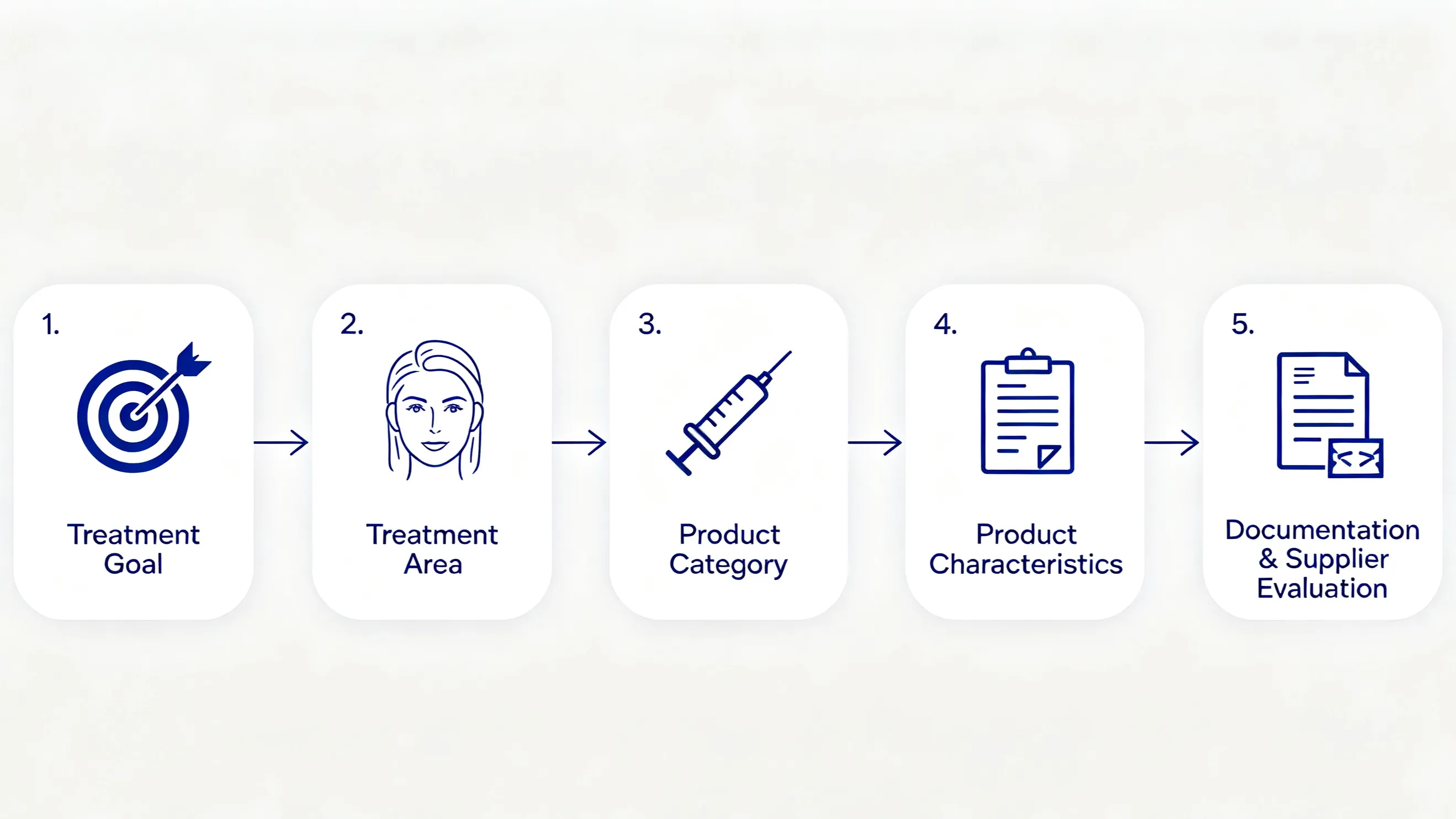
A simple decision process can make portfolio planning more consistent:
Treatment goal → Treatment area → Product category → Product characteristics → Documentation → Supplier evaluation
For example, a clinic may begin with a patient need such as facial volume restoration. It can then identify the relevant treatment area, compare appropriate product categories, review formulation characteristics, verify documentation, and finally evaluate the manufacturer or supplier.
This approach is more useful than selecting products based solely on brand popularity or purchase price.
Conclusion
Choosing injectable aesthetic products for a clinic should begin with treatment needs rather than individual product names.
HA fillers, skin boosters, PDRN or PN-based products, PLLA-based biostimulators, and CaHA products can each occupy different positions within an aesthetic treatment portfolio. The right combination depends on the clinic's services, patient demand, treatment areas, product characteristics, and purchasing requirements.
A focused portfolio can be more practical than a large one. Clinics can start with their core treatment categories, add complementary products as demand develops, and regularly review whether each product continues to serve a clear purpose.
For professional buyers, product selection should ultimately combine clinical application, product information, documentation, quality considerations, and supplier reliability rather than relying on price or market popularity alone.
Frequently Asked Questions
Q1: How many injectable aesthetic products should a new clinic start with?
There is no fixed number. A new clinic can start with a focused selection covering its most frequently requested treatment categories, then expand the portfolio as patient demand and practitioner experience develop.
Q2: Should a clinic choose products from one manufacturer or multiple manufacturers?
Either approach can work. Working with one manufacturer may simplify procurement and documentation, while multiple suppliers can provide greater product variety. The decision should depend on product suitability, quality, supply reliability, and business requirements.
Q3: How often should a clinic review its injectable product portfolio?
A periodic review is useful, particularly when inventory moves slowly, treatment demand changes, or new products are introduced. Clinics can review purchasing and usage data to identify products that are no longer contributing enough value.
Q4: Is a higher-priced injectable product always better?
No. Price alone does not establish product quality or suitability. Clinics should consider formulation, specifications, documentation, intended application, supplier reliability, and overall fit with their treatment services.
Q5: Should clinics stock products before there is confirmed patient demand?
Generally, clinics should avoid excessive inventory based only on predicted demand. Starting with established treatment needs can reduce unnecessary stock and allow the portfolio to develop according to actual usage.
Q6: Can aesthetic injectables from different manufacturers be used in the same treatment plan?
Different products may be incorporated into broader treatment strategies, but they should not be assumed to be interchangeable. Product selection and treatment combinations should be determined by appropriately qualified healthcare professionals based on the specific products and patient.
Q7: What information should clinics compare when evaluating two similar injectable products?
Clinics can compare composition, concentration, formulation characteristics, intended application, packaging, storage conditions, shelf life, documentation, and supplier support. The comparison should focus on meaningful differences rather than marketing claims alone.
Q8: How can a clinic determine whether a new injectable product is worth adding?
The clinic can evaluate whether the product addresses an existing patient need, provides a meaningful difference from current products, has appropriate documentation, and can be supplied reliably. A product should have a clear role within the treatment portfolio.
Q9: Does adding more injectable categories automatically allow a clinic to offer more treatments?
Not necessarily. Adding products does not replace practitioner training, appropriate treatment protocols, regulatory compliance, or clinical judgment. Each product must be evaluated according to its intended use and applicable requirements.
Q10: What is the most practical way to organize an injectable aesthetic product portfolio?
A useful approach is to organize products by treatment objective, such as volume restoration, contouring, skin quality, hydration, and collagen stimulation. The clinic can then select specific products within each category based on treatment area, product characteristics, documentation, and patient demand.
Other Blogs