Blog
Monophasic vs Biphasic Hyaluronic Acid Fillers: Key Differences
Author
Ray
Published
Category
Hyaluronic acid filler
Learn the differences between monophasic and biphasic hyaluronic acid fillers, including structure, rheology, cohesivity, elasticity, applications and manufacturing considerations.


Author
Ray
An esteemed medical aesthetics expert with 40 years of profound experience in the field. With decades of expertise in non-invasive procedures, anti-aging science, and advanced dermatological solutions, the author is dedicated to sharing insights that connect clinical innovation with real-world patient results. Passionate about advancing safe, effective, and high-impact aesthetic treatments for a global clientele.
What’s better than insider perks, pro tips, and surprises?
Sign up to get the most recent blog articles in your email every week.
Join now.
Our company’s main product lines include HA (Hyaluronic Acid) fillers, CaHA (Calcium Hydroxylapatite) fillers, PLLA (Poly-L-Lactic Acid) biostimulators, and other advanced aesthetic solutions, all developed and manufactured by trusted partner facilities with whom we have maintained long-term, stable collaborations.
I help them with sales and export operations, while our company also provides sourcing and procurement services in China to help international clients solve supply-related challenges. If you need assistance with procurement, please feel free to contact us.
Hyaluronic acid dermal fillers are not all manufactured in the same way. Even when two products contain similar concentrations of hyaluronic acid, differences in cross-linking technology, gel structure, particle characteristics and rheological properties can produce substantially different handling and performance characteristics.
One of the most common ways of describing hyaluronic acid fillers is to classify them as monophasic or biphasic fillers.
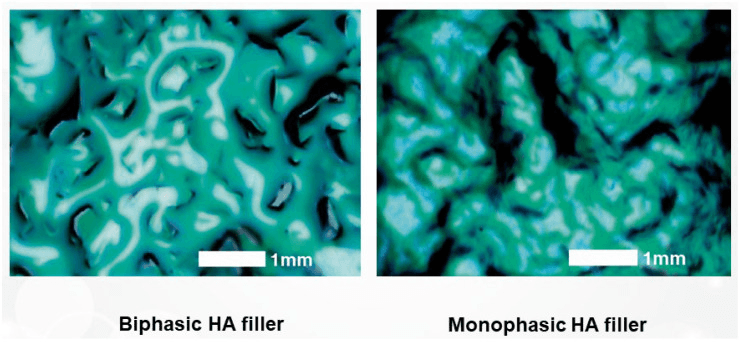
Monophasic fillers are generally characterized by a more homogeneous and cohesive gel structure, while biphasic fillers traditionally consist of distinct cross-linked hyaluronic acid gel particles dispersed within a carrier phase.
However, the difference is more complex than simply “smooth gel versus particles.” Modern filler technologies vary significantly, and properties such as elasticity, viscosity, cohesivity, particle size and degree of cross-linking should also be considered when evaluating an HA filler.
For aesthetic product brands, distributors, clinics and OEM buyers, understanding these differences can make it easier to evaluate formulations and select products suited to different market requirements.
What Is a Hyaluronic Acid Dermal Filler?
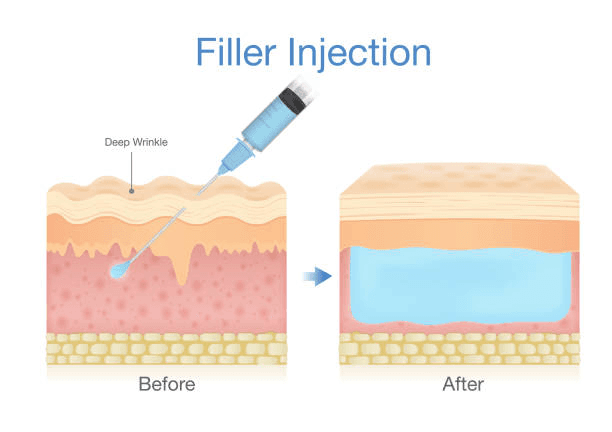
Hyaluronic acid, commonly abbreviated as HA, is a naturally occurring polysaccharide found throughout human connective tissues and the extracellular matrix.
Native hyaluronic acid has a relatively short residence time in tissue. For dermal filler applications, HA is therefore commonly modified through a cross-linking process that connects HA polymer chains and produces a three-dimensional gel structure.
Cross-linking helps increase resistance to enzymatic and chemical degradation while transforming the HA solution into a viscoelastic gel suitable for soft-tissue filling applications.
One commonly used cross-linking agent is 1,4-butanediol diglycidyl ether, or BDDE.
The final behavior of an HA filler depends not only on whether it is monophasic or biphasic but also on several formulation and manufacturing variables, including:
HA concentration
HA molecular weight
degree of cross-linking
cross-linking efficiency
particle characteristics
gel cohesivity
elastic modulus
viscosity
water absorption
and manufacturing technology.
For this reason, the terms monophasic and biphasic provide a useful starting point, but they do not completely describe the performance of an injectable HA gel.
What Is a Monophasic Hyaluronic Acid Filler?
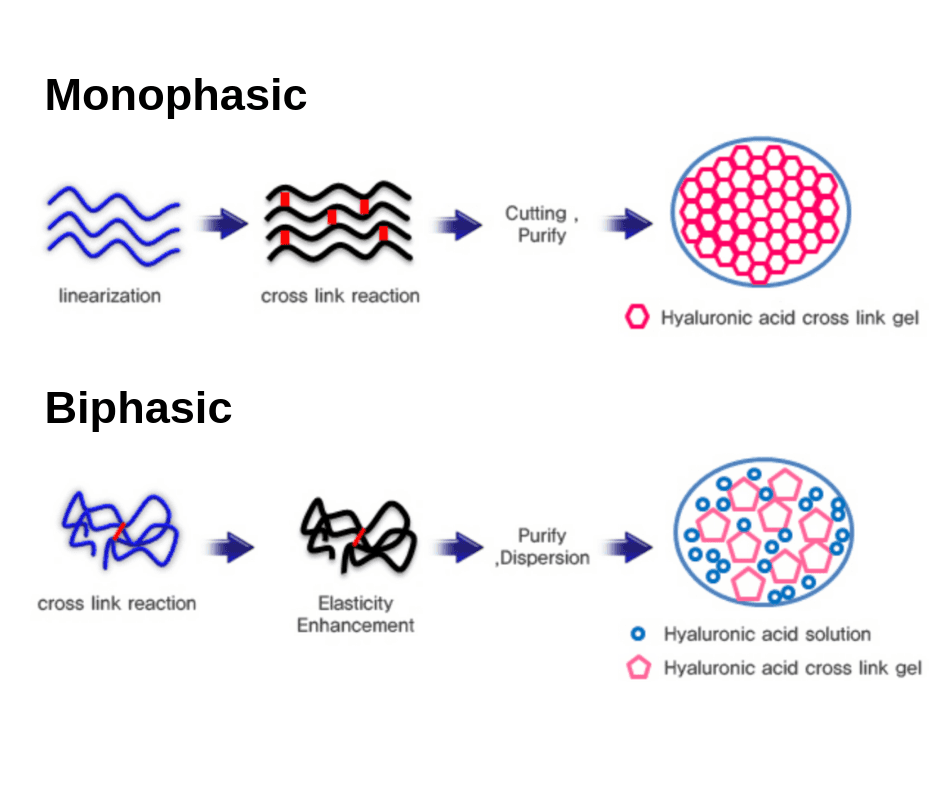
A monophasic hyaluronic acid filler is generally produced as a continuous, highly integrated cross-linked HA gel.
After cross-linking and processing, the material typically has a smooth and relatively homogeneous consistency. The gel components remain strongly integrated with one another, which can contribute to relatively high cohesivity.
Monophasic fillers are therefore often described as cohesive HA gels.
Their exact properties can differ significantly according to the manufacturing technology used. Some monophasic fillers are designed to be soft and flexible, while others are engineered to provide substantially greater structural support.
The term “monophasic” should therefore not automatically be interpreted as meaning that every monophasic product is soft or has a low elastic modulus.
Typical Characteristics of Monophasic Fillers
Depending on the formulation, monophasic HA fillers may demonstrate:
A smooth and homogeneous gel consistency
Relatively strong cohesivity
Good integration of the gel mass
Controlled spreading within tissue
Different levels of elasticity depending on cross-linking technology
Different levels of projection and lifting capacity
Flexible formulation possibilities for different aesthetic applications
The balance between elasticity, viscosity and cohesivity ultimately influences how the filler behaves after implantation.
What Is a Biphasic Hyaluronic Acid Filler?
A biphasic hyaluronic acid filler traditionally consists of cross-linked HA gel particles dispersed within a carrier phase, which may contain non-cross-linked or minimally cross-linked hyaluronic acid.
During manufacturing, a cross-linked gel mass can be processed into particles of controlled dimensions before being combined with the carrier phase to facilitate extrusion through a syringe and needle.
This creates the characteristic particulate structure historically associated with biphasic fillers.
Biphasic fillers can be engineered with different particle sizes and mechanical properties depending on the intended formulation.
Typical Characteristics of Biphasic Fillers
Depending on the specific product, biphasic fillers may demonstrate:
More distinct gel particles
Strong elastic behavior
Good resistance to deformation
Different levels of lifting capacity
Particle-size-dependent characteristics
Lower cohesivity than some highly cohesive monophasic gels
A defined particulate structure within the carrier phase
However, modern manufacturing technologies have blurred some of the traditional distinctions between the two categories. Individual product specifications and rheological data therefore provide more useful information than the monophasic or biphasic label alone.
Monophasic vs Biphasic Fillers: Key Differences
Characteristic | Monophasic HA Filler | Biphasic HA Filler |
|---|---|---|
General Structure | Continuous or highly integrated HA gel | Cross-linked HA gel particles within a carrier phase |
Texture | Generally smoother and more homogeneous | Generally more particulate or granular |
Cohesivity | Often relatively high | Often lower than highly cohesive monophasic gels |
Elasticity | Depends strongly on formulation | Often engineered for relatively strong elastic behavior |
Particle Characteristics | Less visually distinct in many formulations | More clearly defined particles |
Manufacturing Approach | Continuous gel processing and cross-linking technology | Gel formation followed by particle processing and dispersion |
Tissue Behavior | Can provide cohesive integration and controlled spread | Can provide defined structural behavior and resistance to deformation |
Product Selection | Determined by rheology and intended application | Determined by rheology, particle characteristics and intended application |
These characteristics represent general tendencies rather than universal rules.
A modern monophasic formulation can have greater elasticity than another manufacturer's biphasic product, while a biphasic filler can behave differently depending on particle size, HA concentration and cross-linking technology.
This is why comparing fillers only according to the words “monophasic” and “biphasic” can be misleading.
Why Rheology Matters More Than the Label Alone
Rheology describes how a material deforms and flows when external forces are applied.
This is especially important for dermal fillers because an implanted gel can experience compression, stretching, shear forces and movement from surrounding tissues.
Several rheological parameters are commonly used when comparing HA fillers.
G′ — Elastic or Storage Modulus
G′ indicates the elastic component of a viscoelastic material.
In simplified terms, it describes how strongly a filler tends to resist deformation and recover its structure after force is applied.
A filler with a relatively high G′ may provide greater structural resistance and projection, while a lower-G′ material can be more suitable when softness and adaptability are important.
However, G′ should never be evaluated alone.
G″ — Viscous or Loss Modulus
G″ represents the viscous component of the gel and describes how much energy is dissipated when deformation occurs.
Together, G′ and G″ help characterize the balance between the elastic and viscous properties of an HA filler.
Cohesivity
Cohesivity describes the tendency of the gel to remain together rather than separate when subjected to force.
Monophasic fillers are frequently associated with relatively strong cohesion because of their integrated gel structure.
High cohesivity may help a gel maintain continuity while adapting to surrounding tissue.
Viscosity
Viscosity describes resistance to flow.
A filler's viscosity affects extrusion behavior, spreading characteristics and how easily the material changes shape under applied forces.
Manufacturing parameters such as HA concentration, molecular weight and cross-linking technology can all influence viscosity.
Is Monophasic Filler Better Than Biphasic Filler?
Not necessarily.
Neither category is universally superior.
The better formulation depends on the desired mechanical properties, intended anatomical application, injection depth, treatment objective and product design.
A product requiring strong projection and structural support may need very different rheological characteristics from one developed for superficial correction or soft tissue integration.
Therefore, a professional comparison should examine parameters such as:
G′
G″
complex viscosity
cohesivity
HA concentration
degree of modification
cross-linking technology
particle characteristics
extrusion force
swelling behavior
and degradation characteristics.
Simply choosing a product because it is labeled “monophasic” or “biphasic” does not provide enough information to predict its complete performance.
Monophasic vs Biphasic Fillers for Different Applications
Different facial regions experience different mechanical forces and require different product characteristics.
Structural Support and Contouring
Applications requiring greater structural support may favor formulations with sufficient elasticity and resistance to deformation.
Important factors include:
Higher structural strength
Appropriate G′
Controlled projection
Resistance to compression
Suitable cohesivity
The ideal formulation may be either monophasic or biphasic depending on how the manufacturer has engineered the gel.
Volume Restoration
Volume restoration requires a balance between projection and tissue integration.
A filler should provide sufficient resistance to compression while maintaining an appropriate degree of flexibility.
Both monophasic and biphasic technologies can be engineered for this purpose.
Fine Lines and Superficial Applications
Products intended for relatively superficial placement generally require softer rheological characteristics and smooth integration.
Lower structural rigidity and appropriate gel flexibility can be desirable for these applications.
Again, the actual rheological profile of the product is more important than its monophasic or biphasic designation.
How Manufacturing Creates Different HA Filler Properties
The manufacturing process plays a major role in determining the final characteristics of a hyaluronic acid filler.
Production typically begins with purified hyaluronic acid, which is often obtained through microbial fermentation.
The HA is hydrated and subsequently subjected to a controlled cross-linking process.
Manufacturers can adjust variables such as:
HA molecular weight
HA concentration
cross-linker concentration
reaction temperature
reaction time
pH
mixing conditions
degree of modification
particle processing
purification
and homogenization.
These parameters can alter the gel's elasticity, cohesivity, viscosity, swelling behavior and resistance to degradation.
Following cross-linking, residual reagents and process-related impurities must be carefully removed through controlled purification.
The gel is then processed according to the required physical characteristics before filling into syringes and completing the validated manufacturing and sterilization processes appropriate to the product.
As a result, two fillers containing the same nominal concentration of sodium hyaluronate can still demonstrate very different rheological properties.
Why Cross-Linking Technology Is Important
Unmodified hyaluronic acid is readily degraded in the body.
Cross-linking creates bridges between HA chains, generating a three-dimensional network that can improve the material's stability and resistance to enzymatic degradation.
However, simply increasing cross-linking does not automatically produce a better dermal filler.
Manufacturers must balance:
Gel strength
Elasticity
Viscosity
Cohesivity
Extrusion characteristics
Flexibility
Biocompatibility
and degradation behavior.
The goal is to create a formulation with a rheological profile appropriate for its intended use rather than maximizing a single parameter.
This is why cross-linking technology is one of the most important factors differentiating modern HA filler platforms.
Does HA Concentration Determine Filler Quality?
No.
HA concentration is important, but a higher concentration does not automatically indicate a higher-quality filler.
Two products containing the same amount of HA per milliliter can behave very differently because of differences in:
HA molecular weight
degree of cross-linking
cross-linking efficiency
particle structure
free HA content
cohesivity
and manufacturing technology.
Professional buyers should therefore avoid comparing fillers solely by the number of milligrams of HA per milliliter.
A complete product evaluation requires both compositional and rheological information.
What Should Distributors and Private Label Brands Compare?
For distributors, medical aesthetic companies and private label brands, product selection should extend beyond marketing descriptions such as “monophasic,” “biphasic,” “hard,” or “soft.”
A more comprehensive supplier evaluation should include:
Product Composition
Confirm the concentration and specifications of sodium hyaluronate, lidocaine and other formulation components.
Cross-Linking Technology
Understand the cross-linking method, cross-linker used and manufacturing controls.
Rheological Data
Review available information for G′, G″, viscosity, cohesivity and other relevant mechanical characteristics.
Product Specifications
Compare syringe volume, needle configuration, gel properties and product variants.
Quality Documentation
Request appropriate manufacturing, testing, quality-control and regulatory documentation for the intended target market.
Manufacturing Capability
A manufacturer should demonstrate controlled production processes, validated quality systems, batch consistency and suitable analytical testing capabilities.
OEM and ODM Support
Brands planning their own product range may also require customization of formulation positioning, syringe size, packaging, branding and product documentation.
Aowita's Hyaluronic Acid Filler Portfolio
Aowita Biotech develops and manufactures multiple hyaluronic acid filler technologies for professional aesthetic markets.
The Rveiling® HA dermal filler portfolio includes product solutions based on:
Monophasic HA with lidocaine
Biphasic HA with lidocaine
Highly cross-linked HA with lidocaine
Micro-cross-linked HA with lidocaine
This allows product characteristics to be developed for different aesthetic and commercial requirements rather than relying on a single HA gel architecture.
Aowita also manufactures cross-linked sodium hyaluronate gel products and provides OEM and ODM services covering formulation, packaging, branding, production and related customization requirements.
For distributors and aesthetic brands, this makes it possible to evaluate HA products according to intended positioning, rheological characteristics and target-market requirements.
Monophasic vs Biphasic HA Fillers: Which Should Buyers Choose?
The decision should begin with the intended product positioning.
If the objective is to develop an HA filler range, buyers should first determine:
What anatomical applications the range is intended to address
Which injection depths are targeted
Whether the formulation should emphasize softness, projection or structural support
What syringe volumes are required
Whether lidocaine is required
What rheological characteristics are appropriate
What regulatory requirements apply in the target market
What OEM or private label customization is required.
A qualified HA filler manufacturer can then recommend or develop a formulation platform suited to these specifications.
The most important point is that monophasic versus biphasic should be treated as one product characteristic rather than the only selection criterion.
Conclusion
The difference between monophasic and biphasic hyaluronic acid fillers begins with how the HA gel is manufactured and structured, but the practical differences extend far beyond the basic classification.
Monophasic fillers generally feature a more integrated and cohesive gel structure, while traditional biphasic fillers contain more distinct cross-linked HA particles within a carrier phase.
Neither technology is inherently superior.
The performance of an HA filler depends on the interaction between its HA concentration, molecular weight, degree of cross-linking, particle characteristics, elasticity, viscosity, cohesivity and manufacturing technology.
For clinics, distributors and private label aesthetic brands, evaluating these parameters provides a much more reliable basis for product selection than relying on the monophasic or biphasic label alone.
As HA filler technology continues to evolve, manufacturers are increasingly able to engineer gels with specific rheological characteristics for different aesthetic applications. Understanding these properties is therefore becoming essential not only for clinical product selection but also for professional sourcing and product development.
References
Lee W, et al. Rheological Characteristics of Hyaluronic Acid Fillers as Viscoelastic Substances. Review of HA filler manufacturing, viscoelasticity, cohesivity and differences between monophasic and biphasic technologies.
Fundarò SP, et al. The Rheology and Physicochemical Characteristics of Hyaluronic Acid Fillers: Their Clinical Implications. Review of HA filler rheology, cross-linking, elasticity, viscosity and tissue behavior.
Choi MS. Basic Rheology of Dermal Filler. Review of rheological parameters used to characterize HA fillers and their implications for filler selection.
Lee W, et al. Manufacturing Process of Hyaluronic Acid Dermal Fillers. Review of HA production, microbial fermentation, cross-linking, purification and differences between monophasic and biphasic filler manufacturing.
Frequently Asked Questions
What is the main difference between monophasic and biphasic hyaluronic acid fillers?
Monophasic fillers are generally manufactured as highly integrated, relatively homogeneous cross-linked HA gels, while traditional biphasic fillers contain more distinct cross-linked HA gel particles dispersed within a carrier phase. These manufacturing differences influence properties such as cohesivity, elasticity, viscosity and particle behavior.
Are monophasic fillers smoother than biphasic fillers?
Monophasic fillers are generally perceived as smoother because their gel structure is more homogeneous and the particles are less distinct. Biphasic fillers traditionally have more clearly defined gel particles. However, modern filler manufacturing technologies have made this distinction less absolute.
Are biphasic fillers harder than monophasic fillers?
Not always. Some biphasic fillers have strong elastic characteristics, but the hardness or elasticity of a filler depends on several factors, including HA concentration, molecular weight, cross-linking technology and particle structure. The product's rheological data provide a better comparison.
Which has higher cohesivity, monophasic or biphasic filler?
Monophasic fillers are often associated with higher cohesivity because of their integrated gel structure. However, cohesivity varies significantly between formulations and manufacturers.
What is G′ in hyaluronic acid fillers?
G′, or the storage modulus, describes the elastic component of a viscoelastic gel. It is commonly used to evaluate how strongly an HA filler resists deformation. Higher G′ values can be associated with greater structural resistance, but filler selection should consider other rheological properties as well.
Does a higher HA concentration mean a better filler?
No. HA concentration is only one parameter. Cross-linking, molecular weight, cohesivity, viscosity, particle characteristics and manufacturing technology also affect filler performance.
Are monophasic fillers better for facial contouring?
A monophasic filler can be engineered for contouring, but the term monophasic alone does not determine whether a product is suitable. Structural support depends on the complete rheological profile of the formulation.
Can a manufacturer produce both monophasic and biphasic HA fillers?
Yes. Manufacturers with appropriate HA formulation and processing capabilities can develop different gel architectures for different product requirements. Aowita's HA portfolio includes both monophasic and biphasic HA filler solutions as well as highly cross-linked and micro-cross-linked formulations.
What should I ask an HA filler manufacturer before purchasing?
Professional buyers should evaluate product composition, HA concentration, cross-linking technology, rheological properties, manufacturing quality systems, available testing documentation, product specifications, packaging options and regulatory suitability for their target market.
Other Blogs