Blog
What Makes a High-Quality Hyaluronic Acid Filler? 10 Technical Factors Buyers Should Check
Author
Ray
Published
Category
HA
What Makes a High-Quality Hyaluronic Acid Filler? 10 Technical Factors Buyers Should Check


Author
Ray
An esteemed medical aesthetics expert with 40 years of profound experience in the field. With decades of expertise in non-invasive procedures, anti-aging science, and advanced dermatological solutions, the author is dedicated to sharing insights that connect clinical innovation with real-world patient results. Passionate about advancing safe, effective, and high-impact aesthetic treatments for a global clientele.
What’s better than insider perks, pro tips, and surprises?
Sign up to get the most recent blog articles in your email every week.
Join now.
Our company’s main product lines include HA (Hyaluronic Acid) fillers, CaHA (Calcium Hydroxylapatite) fillers, PLLA (Poly-L-Lactic Acid) biostimulators, and other advanced aesthetic solutions, all developed and manufactured by trusted partner facilities with whom we have maintained long-term, stable collaborations.
I help them with sales and export operations, while our company also provides sourcing and procurement services in China to help international clients solve supply-related challenges. If you need assistance with procurement, please feel free to contact us.
Introduction
The global demand for hyaluronic acid (HA) dermal fillers continues to grow as aesthetic clinics, distributors and private-label brands search for reliable injectable aesthetic products.
However, selecting a high-quality hyaluronic acid filler is more complicated than comparing product names or prices.
Many suppliers describe their products using terms such as:
Premium HA filler
Advanced cross-linking technology
Long-lasting dermal filler
High-purity hyaluronic acid
But professional buyers need more than marketing descriptions.
A high-quality HA filler is created through the combination of:
High-quality hyaluronic acid raw materials
Controlled molecular weight
Optimized cross-linking technology
Appropriate rheological properties
Strict manufacturing processes
Complete quality documentation
For distributors and OEM customers, understanding these technical factors helps identify reliable HA filler manufacturers and avoid purchasing decisions based only on cost.
What Defines a High-Quality Hyaluronic Acid Filler?
A high-quality HA filler is not determined by a single specification.
Some buyers focus only on:
HA concentration
Price per syringe
Cross-linking level
Brand popularity
However, the final performance of an injectable HA filler depends on how different components work together.
A professional evaluation should consider:
Raw material quality
Polymer characteristics
Gel structure
Mechanical properties
Manufacturing consistency
Regulatory documentation
The best HA filler is not necessarily the one with the highest numerical value.
It is the product with the most appropriate formulation design for its intended application.
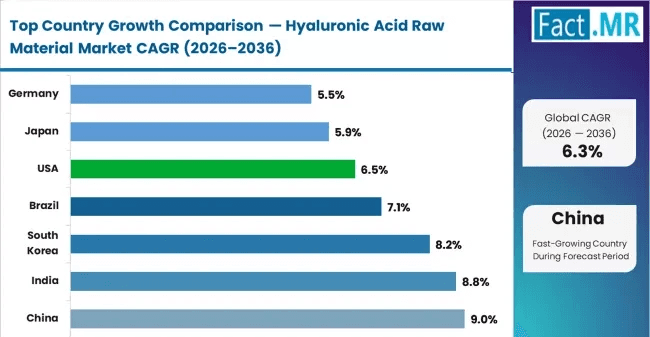
High-Quality Hyaluronic Acid Raw Materials
Why HA Raw Material Quality Matters
Hyaluronic acid is the fundamental material used in HA dermal fillers.
Before becoming an injectable gel, HA must undergo multiple manufacturing steps, including:
Fermentation
Purification
Molecular-weight control
Formulation processing
The quality of the starting HA directly influences the final product.
Important raw-material characteristics include:
Purity
Molecular-weight distribution
Biocompatibility
Consistency between batches
Pharmaceutical-Grade Hyaluronic Acid
Professional injectable products require HA materials produced under controlled conditions.
Important quality considerations include:
Low impurity levels
Controlled microbial contamination
Consistent chemical characteristics
Reliable supply chain
A high-quality HA filler manufacturer should be able to explain the origin and quality-control process of its HA raw materials.
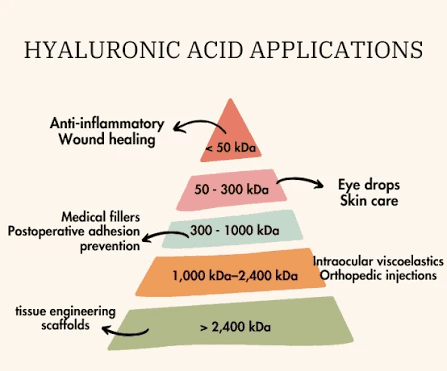
Controlled Hyaluronic Acid Molecular Weight
The Role of Molecular Weight in HA Fillers
Molecular weight describes the size of HA polymer chains.
It influences:
Solution viscosity
Polymer interaction
Gel formation
Cross-linking behavior
Longer HA chains generally create greater polymer entanglement compared with shorter chains.
However:
Higher molecular weight does not automatically mean better filler performance.
The final product depends on the interaction between:
Molecular weight
HA concentration
Cross-linking
Rheology
Why Manufacturers Control Molecular Weight
Different HA filler applications may require different material characteristics.
Manufacturers may optimize molecular weight to achieve specific goals:
Smooth gel structure
Appropriate viscosity
Controlled elasticity
Desired injection behavior
Therefore, molecular weight should be viewed as part of the formulation strategy rather than a standalone quality indicator.
Advanced Cross-Linking Technology
Why HA Needs Cross-Linking
Natural hyaluronic acid is rapidly degraded by biological processes.
To improve stability, manufacturers create connections between HA polymer chains through cross-linking.
This forms a three-dimensional hydrogel network.
Cross-linking can influence:
Resistance to degradation
Elasticity
Cohesivity
Gel stability
Residence time
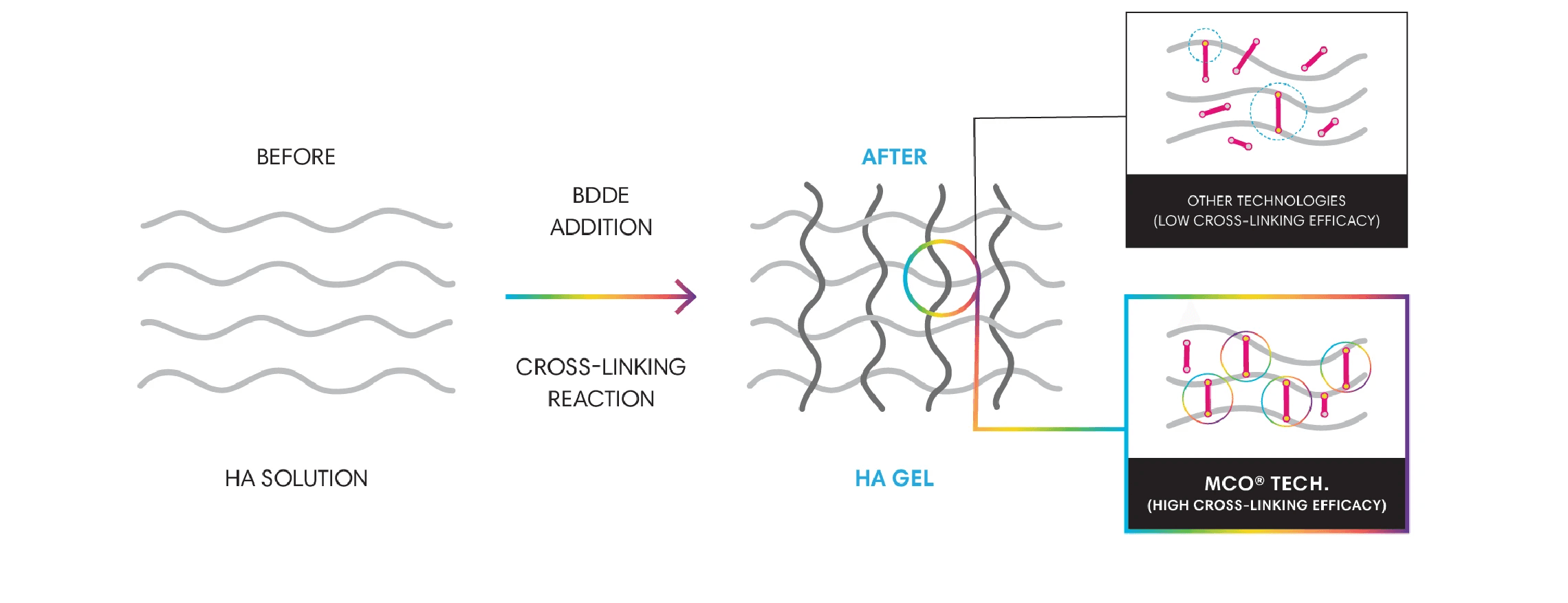
BDDE Cross-Linking Technology
BDDE (1,4-butanediol diglycidyl ether) is one of the most widely used cross-linking agents in commercial HA filler manufacturing.
During production, BDDE creates bridges between HA molecules.
The quality of the final gel depends on:
Cross-linking efficiency
Reaction conditions
Purification
Network structure
A professional manufacturer does not simply maximize cross-linking.
The goal is controlled optimization.
Why More Cross-Linking Is Not Always Better
Excessive cross-linking may influence:
Gel flexibility
Swelling behavior
Injection characteristics
Tissue interaction
A high-quality HA filler requires a balance between:
Stability
Elasticity
Cohesivity
Injectability
Optimized Rheological Properties
Why Rheology Matters in HA Fillers
Rheology describes how a material behaves when exposed to mechanical forces.
Because HA fillers are viscoelastic gels, their performance depends heavily on rheological characteristics.
Important parameters include:
G′
G″
Complex viscosity
Cohesivity
Storage Modulus (G′)
G′ represents the elastic component of the HA gel.
It describes how strongly the filler resists deformation.
A higher G′ may indicate stronger elastic behavior.
However:
A higher G′ does not automatically mean a superior filler.
Different products require different mechanical profiles.
Loss Modulus (G″)
G″ represents the viscous component of the gel.
It describes energy dissipation during deformation.
G′ and G″ should be evaluated together rather than separately.
Cohesivity
Cohesivity describes how well the gel maintains its internal structure.
It can influence:
Gel integrity
Tissue adaptation
Product handling
A balanced HA filler requires appropriate cohesivity rather than maximum cohesivity.
Viscosity and Injection Behavior
Viscosity influences:
Syringe extrusion force
Injection smoothness
Handling characteristics
A high-quality HA filler should provide a balance between:
Structural stability
Ease of injection
Appropriate HA Concentration
Why HA Concentration Alone Does Not Define Quality
HA concentration is usually expressed as:
mg/mL
For example:
20 mg/mL
24 mg/mL
25 mg/mL
However, concentration alone does not predict product performance.
Two fillers with identical HA concentration may behave differently because of differences in:
Molecular weight
Cross-linking
Gel architecture
Rheological properties
Evaluating Concentration With Other Parameters
Professional buyers should consider:
HA concentration
+
Molecular weight
+
Cross-linking technology
+
Rheology
rather than evaluating concentration separately.
Monophasic and Biphasic Gel Technology
Monophasic HA Fillers
Monophasic fillers generally contain a more homogeneous gel structure.
Potential characteristics include:
Smooth consistency
Integrated gel network
Uniform distribution
Biphasic HA Fillers
Biphasic fillers generally contain cross-linked HA particles within a carrier phase.
Their properties may depend on:
Particle size
Particle distribution
Cross-linking degree
Which Technology Is Better?
There is no universal answer.
The appropriate technology depends on:
Product positioning
Target application
Desired gel properties
A reliable manufacturer should understand both technologies.
Lidocaine Formulation Quality
Why Lidocaine Is Added to HA Fillers
Many modern HA fillers include lidocaine to improve injection comfort.
Lidocaine primarily affects:
Patient comfort
Injection experience
It does not define the structural performance of the HA gel.
What Buyers Should Check
For lidocaine-containing HA fillers, buyers should verify:
Lidocaine concentration
Formulation stability
Product documentation
Regulatory suitability
A high-quality manufacturer evaluates the complete HA-lidocaine formulation system.
Manufacturing Quality Control
Clean Production Environment
Injectable HA fillers require strict manufacturing controls.
Important factors include:
Controlled production areas
Hygiene management
Contamination prevention
Process Control
Manufacturers must control:
HA hydration
Cross-linking reaction
Purification
Homogenization
Filling process
Small process variations can influence final product consistency.
Batch-to-Batch Consistency
A reliable HA filler manufacturer should maintain consistency between production batches.
Important evaluation points include:
Product specifications
Testing procedures
Traceability
Quality release process
Product Documentation and Regulatory Support
Why Documentation Matters
Professional buyers should not evaluate suppliers only through:
Product photos
Price lists
Marketing materials
Technical documentation provides stronger evidence of manufacturing capability.
Important Documents for Buyers
Depending on the target market, buyers may request:
Product specification sheet
Certificate of Analysis
Stability information
Sterility documentation
Quality certificates
Regulatory documents
OEM and Private Label Capability
Why OEM Capability Matters
Many aesthetic brands want to create their own HA filler product lines.
A professional OEM manufacturer should support:
Custom packaging
Branding
Product portfolio planning
Technical documentation
Long-Term Manufacturing Partnership
The best supplier is not only able to produce one order.
A reliable partner should provide:
Stable production capacity
Consistent quality
Technical support
Long-term cooperation
How to Compare HA Filler Manufacturers
When comparing suppliers, consider:
Factor | Questions |
|---|---|
HA Technology | What formulation technology is used? |
Raw Materials | Is HA quality controlled? |
Cross-Linking | How is gel stability achieved? |
Rheology | Are technical data available? |
Quality System | How is production controlled? |
Documentation | Are product files complete? |
OEM | Can products be customized? |
Supply Capacity | Can demand increase over time? |
Common Mistakes When Buying HA Fillers
Choosing Only the Lowest Price
Low price does not always represent low cost.
Problems may include:
Limited documentation
Poor consistency
Reduced customization
Comparing Only HA Concentration
Concentration is only one specification.
Ignoring Technical Data
Professional buyers should request information about:
Rheology
Cross-linking
Manufacturing process
Selecting Suppliers Without Verification
A professional supplier evaluation process reduces risks.
Aowita Hyaluronic Acid Filler Manufacturing Solutions
Aowita develops cross-linked hyaluronic acid filler solutions for professional aesthetic markets.
The product portfolio includes:
Cross-linked sodium hyaluronate gels
Monophasic HA fillers
Biphasic HA fillers
Lidocaine-containing HA fillers
OEM/private label solutions
Aowita focuses on integrating:
Controlled HA raw materials
Optimized cross-linking technology
Rheological design
Manufacturing quality systems
For distributors, aesthetic brands and private-label customers, Aowita provides HA filler manufacturing solutions designed around product consistency, technical support and long-term cooperation.
Conclusion
A high-quality hyaluronic acid filler is created through the combination of science, engineering and manufacturing control.
The most important evaluation factors include:
HA raw material quality
Molecular-weight control
Cross-linking technology
Rheological performance
Manufacturing quality
Documentation
Supplier capability
For aesthetic brands and distributors, selecting an HA filler manufacturer is not simply a purchasing decision.
It is a long-term product strategy.
The right manufacturer should provide not only a product, but also:
technical expertise, consistent quality and reliable supply capability.
Frequently Asked Questions
What makes a high-quality hyaluronic acid filler?
A high-quality HA filler combines reliable raw materials, controlled cross-linking, optimized rheology, manufacturing consistency and complete documentation.
Is higher HA concentration better?
No. HA concentration is only one factor. The complete formulation determines product performance.
Does higher G′ mean a better filler?
No. Different applications require different rheological properties.
Does more cross-linking improve filler quality?
Not always. Optimized cross-linking is more important than maximum cross-linking.
How do I choose an HA filler manufacturer?
Evaluate technology, quality systems, documentation, OEM capability and production reliability.
Other Blogs
