博客
How Much Does Non-Surgical Body Sculpting Cost? Factors That Affect Treatment Pricing
作者
Ray
已发布
类别
设计与灵感
How much does non-surgical body sculpting cost? Explore the factors affecting treatment prices, including technology, treatment area, sessions, clinic costs, and equipment investment.


作者
Ray
一位享有盛誉的医学美学专家,在该领域拥有40年的深厚经验。凭借在非侵入性手术、抗衰老科学以及先进皮肤病学解决方案方面的数十年专业知识,作者致力于分享将临床创新与真实患者成果相结合的见解。热衷于为全球客户推进安全、有效且高影响力的美学治疗。
还有什么比内部优惠、专业建议和惊喜更好的呢?
注册可每周在您的电子邮件中接收最新的博客文章。
立即加入。
Our company’s main product lines include HA (Hyaluronic Acid) fillers, CaHA (Calcium Hydroxylapatite) fillers, PLLA (Poly-L-Lactic Acid) biostimulators, and other advanced aesthetic solutions, all developed and manufactured by trusted partner facilities with whom we have maintained long-term, stable collaborations.
I help them with sales and export operations, while our company also provides sourcing and procurement services in China to help international clients solve supply-related challenges. If you need assistance with procurement, please feel free to contact us.
Introduction
The cost of non-surgical body sculpting can vary considerably from one clinic to another, even when patients are asking about similar treatment areas. A single session may be priced differently depending on the technology being used, the size of the treatment area, the number of sessions recommended, and the clinic's location and positioning.
This makes body sculpting pricing more complicated than simply comparing a treatment fee from one clinic with another. A lower price does not necessarily mean a better deal if it covers a smaller treatment area, uses a different technology, or represents only one session when the recommended treatment plan requires several.
For patients, understanding these pricing factors makes it easier to compare treatment options realistically. For clinics and aesthetic businesses, understanding the cost structure is equally important when developing a body contouring service and deciding how to price it sustainably.
This guide explains the main factors that influence non-surgical body sculpting costs, how treatment plans affect the total price, and what clinics should consider when developing their own pricing strategy.
Understanding the Cost of Non-Surgical Body Sculpting
There is no universal price for non-surgical body sculpting because the term covers a range of technologies and treatment approaches. Different devices may use different energy sources, applicators, treatment protocols, and session durations.
Even within the same technology category, the cost of treating a small localized area can be very different from treating a larger region.
For this reason, patients should compare the complete treatment plan rather than looking only at the advertised price of one session.
Why There Is No Single Standard Treatment Price
Several variables can change the price of a body sculpting treatment.
The first is the technology itself. Different platforms require different levels of equipment investment and may have different operating costs. A clinic using a more sophisticated system may have a higher treatment fee because the equipment represents a larger capital investment.
The treatment area also matters. Treating a small area may require less treatment time or a smaller number of applicators than treating a larger region. Some technologies also price treatment according to the number of applicators, treatment cycles, or areas addressed during a session.
The patient's treatment plan is another variable. One person may need a single treatment area evaluated over time, while another may require multiple sessions or treatment areas to achieve the desired contour.
Location and clinic positioning can also influence pricing. Clinics operating in major metropolitan areas or premium medical-aesthetic environments may have higher facility, staffing, and operating costs than smaller clinics.
As a result, comparing two prices without understanding what each price includes can give a misleading impression of value.
What a Body Sculpting Treatment Fee Usually Includes
A treatment price may include more than the actual time spent using the body contouring device.
Depending on the clinic, the fee may cover the initial consultation, treatment planning, practitioner time, use of the equipment, consumables, and post-treatment follow-up.
Some clinics may also structure their pricing around a treatment area rather than a fixed session. For example, the quoted price may represent treatment of one specific area, while treating additional areas during the same appointment creates an additional charge.
Patients should therefore ask what is included before comparing prices.
For clinics, clearly defining what the treatment fee covers is equally important. Transparent pricing reduces misunderstandings and allows patients to compare treatment plans based on the actual service being provided rather than simply choosing the lowest advertised number.
The Main Factors That Affect Body Sculpting Prices
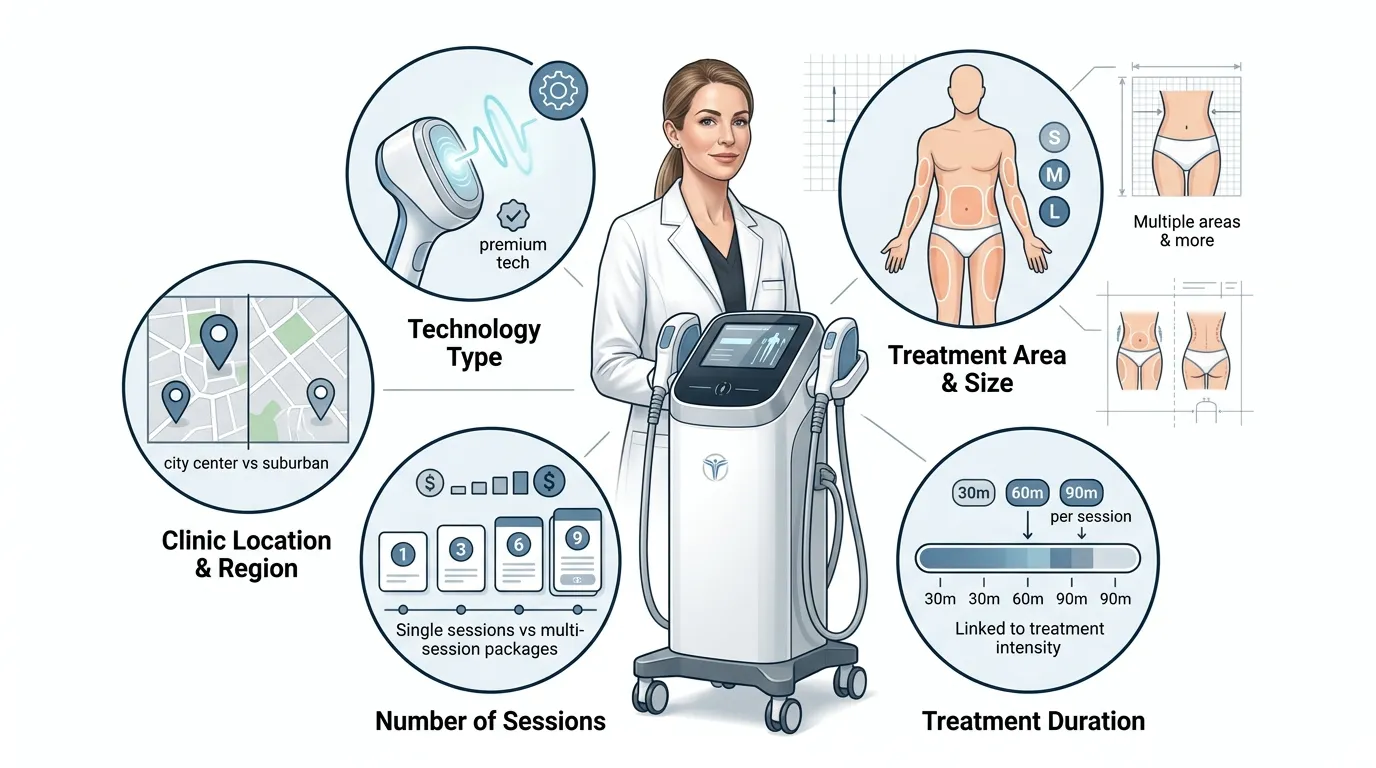
Once the basic pricing structure is understood, several factors consistently have the greatest influence on the final treatment cost.
Treatment Technology and Equipment
The technology used is one of the most important factors behind treatment pricing.
Non-surgical body contouring is not a single technology. Different systems may use controlled cooling, radiofrequency, ultrasound, or other energy-based approaches, with differences in treatment mechanism, applicator design, treatment time, and operating requirements.
The equipment itself represents a significant investment for a clinic. A professional system may involve not only the initial purchase price but also installation, staff training, maintenance, consumables, and technical support.
These costs eventually influence the economics of each treatment.
However, a higher equipment price should not automatically translate into a higher patient price. Clinics need to consider whether the technology provides meaningful advantages for their target treatment areas, patient demand, and overall service model.
Treatment Area and Treatment Size
The size and location of the treatment area can have a direct effect on pricing.
A small localized area may require less treatment time and fewer treatment resources than a larger area. Some body contouring systems also allow multiple areas to be treated during one appointment, which can change the total cost of a treatment plan.
For example, a patient interested in treating a limited flank area may have a different treatment requirement from someone seeking contouring across the abdomen and both flanks.
This is why “cost per session” can sometimes be less informative than cost per treatment area or complete treatment plan.
Clinics should make their pricing structure clear enough that patients understand exactly what they are paying for.
Number of Sessions Required
The number of sessions is another major factor affecting total expenditure.
A clinic may advertise the price of one session, but the patient's recommended plan could involve more than one treatment. The total cost therefore depends on both the individual session price and the number of sessions considered appropriate for the specific treatment protocol.
This does not mean that every patient should automatically purchase a multi-session package. Treatment requirements vary according to the technology, treatment area, patient characteristics, and clinical assessment.
For patients comparing providers, it is more useful to ask:
“What is the estimated cost of the complete treatment plan?”
rather than only:
“How much is one session?”
For clinics, this distinction is also important when designing packages. Pricing should reflect the actual resources required to deliver the treatment rather than simply applying a discount to the single-session price.
Clinic Location and Positioning
Geographic location can have a noticeable effect on aesthetic treatment pricing.
A clinic operating in a high-rent commercial district may have substantially different overhead costs from a clinic in a smaller market. Staffing expenses, facility costs, local competition, and customer demographics can all influence how a service is priced.
Clinic positioning matters as well.
A premium medical aesthetics clinic may invest heavily in consultation time, practitioner expertise, patient experience, treatment environment, and aftercare. Its pricing structure may therefore differ from a high-volume clinic designed around lower prices and faster treatment turnover.
For patients, this means that price should be evaluated alongside the overall service being provided.
For clinic owners, understanding local market positioning is essential. Simply matching the lowest competitor price can create pressure on margins without necessarily generating a sustainable advantage.
How Treatment Sessions Affect the Total Cost
The number and structure of treatment sessions can make a substantial difference to the total amount a patient spends.
A single-session price is useful for comparing basic treatment fees, but it does not always represent the actual investment required to complete a treatment plan.
Single Treatment vs Multi-Session Programs
Single-session pricing gives patients a straightforward way to understand the initial cost of treatment. It can also allow them to evaluate their response before deciding whether additional treatment is appropriate.
Multi-session programs work differently. Clinics may create packages that combine several treatment sessions at a predetermined price, sometimes with additional consultation or follow-up services.
The financial advantage of a package depends on the actual terms. A lower price per session does not automatically mean a better value if the patient does not need all of the included treatments.
Clinics should therefore avoid designing packages purely around discounts. A useful package should reflect a realistic treatment pathway and provide clear information about what is included.
Why Package Pricing Can Be Different From Per-Session Pricing
Package pricing can reduce the administrative and marketing cost associated with selling individual appointments, while also giving clinics greater visibility into future treatment demand.
For patients, packages can make the total treatment cost easier to understand when multiple sessions are genuinely expected.
However, clinics should avoid using packages to imply guaranteed results. The number of sessions and eventual outcome can vary between individuals, and treatment plans may need to be reassessed based on the patient's response.
A transparent approach is to explain the standard treatment protocol, provide the per-session price, and then show any package pricing separately.
This gives patients enough information to understand the difference between the cost of one appointment and the potential cost of a broader treatment program.
Comparing Body Sculpting Costs With Other Fat Reduction Options
Comparing prices is only useful when the treatments being compared have similar objectives. A non-surgical body sculpting session, a surgical fat-removal procedure, and another non-invasive contouring treatment may all be marketed toward people concerned about localized fat, but their costs reflect very different treatment models.
For patients, the important question is therefore not simply which option has the lowest advertised price. It is which treatment provides an appropriate balance between the desired outcome, treatment intensity, recovery, and overall expense.
Non-Surgical Body Sculpting vs Liposuction
Liposuction generally involves a much more substantial clinical process than a non-surgical body sculpting session. The overall cost can include surgical facility expenses, anesthesia or sedation where applicable, professional fees, post-operative care, and other costs associated with a surgical procedure.
Non-surgical body sculpting typically has a different cost structure. There is no surgical fat-removal procedure, but the patient may need multiple appointments depending on the technology and treatment plan.
This makes a simple price comparison misleading.
A lower per-session price for non-surgical body sculpting does not necessarily mean the complete treatment will cost less than every liposuction procedure. Conversely, a patient who only needs modest contour refinement may prefer a non-surgical approach because the treatment experience and recovery requirements are different.
Clinics should present these options according to their intended use rather than positioning one as universally cheaper or better.
Non-Surgical Body Sculpting vs Other Non-Invasive Treatments
Prices can also vary significantly between non-surgical technologies.
Two treatments may both be described as “non-invasive fat reduction,” while using different energy sources, applicators, treatment durations, and treatment protocols.
When comparing them, clinics and patients should look at:
The technology and mechanism used
Treatment area
Treatment time
Number of sessions
Consumable requirements
Equipment and operating costs
Practitioner involvement
This provides a more meaningful comparison than looking at the headline treatment price alone.
For clinics, it is particularly important to avoid assuming that every body contouring device has the same economics. A machine with a lower purchase price may have different consumable requirements, treatment capacity, or maintenance costs that change its profitability over time.
What Clinics Should Consider When Setting Body Sculpting Prices
Patient-facing pricing needs to work within the clinic's actual cost structure. A treatment may appear profitable when only the equipment purchase price is considered, but the calculation changes once staffing, facility expenses, consumables, maintenance, and appointment time are included.
Equipment Investment and Operating Costs
The initial equipment purchase is usually one of the most visible expenses when launching a body sculpting service, but it is only one part of the investment.
Clinics may also need to account for:
Installation
Practitioner training
Maintenance
Software or system updates, where applicable
Replacement parts
Marketing
Treatment-room costs
These expenses need to be considered when calculating the minimum sustainable treatment price.
For example, a clinic with relatively low equipment utilization may need a different pricing strategy from a high-volume clinic that can perform many treatments each month.
The objective should not be to recover the equipment investment as quickly as possible at any price. Instead, clinics should establish a pricing model that supports reasonable utilization, operating expenses, and long-term service quality.
Consumables, Staff Time, and Treatment Capacity
Consumables and labor can have a significant impact on the economics of a body sculpting treatment.
Some systems may require specific consumables or accessories, while others may rely primarily on reusable applicators. Treatment duration also affects how many appointments a clinic can schedule in a working day.
Staff time should therefore be calculated as part of the treatment cost rather than treated as an incidental expense.
A 30-minute procedure and a 90-minute procedure cannot be evaluated using the same revenue-per-session calculation, even if the advertised patient price is similar.
Treatment-room utilization is another consideration. A device that produces a lower margin per appointment may still be commercially attractive if it allows efficient scheduling and consistent demand. Conversely, an expensive treatment with limited demand can tie up equipment and clinical space.
Pricing Based on Patient Value Rather Than Equipment Cost Alone
Equipment cost is an internal business consideration, but it should not be the sole basis for patient pricing.
Patients ultimately evaluate the service they receive, including consultation quality, practitioner expertise, treatment experience, convenience, follow-up, and the suitability of the technology for their goals.
A clinic should therefore consider the overall value of its service when establishing prices.
This does not mean using premium branding as a reason for arbitrary pricing. The price should remain defensible in relation to the local market, operating costs, treatment quality, and patient experience.
How Clinics Can Evaluate Body Sculpting Equipment From a Business Perspective
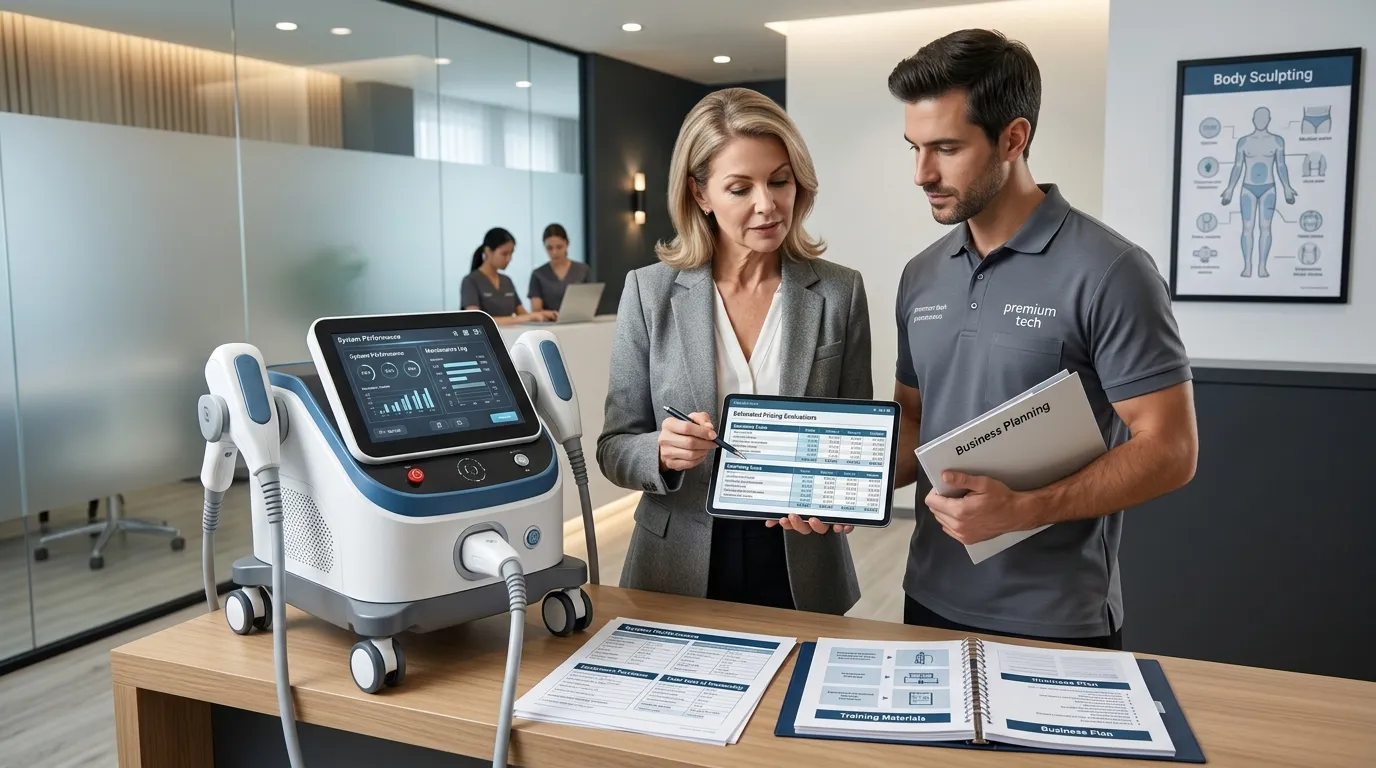
Choosing a body sculpting machine is a business decision as much as a technology decision.
Before purchasing equipment, clinic owners should estimate not only the initial investment but also how the machine will perform under realistic operating conditions.
Purchase Price vs Total Cost of Ownership
The purchase price provides only the starting point.
A more useful calculation considers the total cost of ownership, including the expenses associated with operating the equipment throughout its expected service life.
These may include:
Initial equipment investment
Shipping and installation
Training
Maintenance
Consumables
Repairs
Replacement components
Staff time
Clinics can then compare these costs against realistic treatment volume and expected revenue.
For example, a machine that costs less initially may require more consumables or maintenance. Another system may have a higher purchase price but lower operating costs. Without looking at the complete cost structure, the cheaper machine may not actually be the more economical option.
Manufacturer Support, Training, and After-Sales Service
Supplier support can also influence the long-term economics of a body sculpting system.
A manufacturer should be able to explain what is included with the purchase, including training, technical support, warranty coverage, maintenance procedures, and replacement-part availability.
Training is particularly important because the commercial value of a device depends on whether practitioners can operate it correctly and consistently.
For clinics sourcing equipment internationally, communication and after-sales support deserve additional attention. A machine may be competitively priced, but difficulties obtaining technical assistance or replacement parts can create unexpected downtime.
For this reason, supplier evaluation should be part of the equipment investment calculation rather than a separate consideration.
Common Mistakes When Comparing Body Sculpting Prices
Price comparisons become unreliable when buyers ignore what is actually included in each offer.
Choosing the Cheapest Treatment Without Comparing What Is Included
The lowest advertised price may represent only one treatment session, one small treatment area, or a limited service package.
Before comparing prices, patients should confirm:
What area is being treated
How long the appointment lasts
Whether consultation is included
Whether follow-up is included
Whether multiple sessions are expected
Clinics should apply the same principle when comparing equipment suppliers. A quoted machine price may exclude shipping, installation, training, accessories, or future maintenance.
Comparing Different Technologies as if They Were the Same
A second common mistake is treating all body sculpting systems as interchangeable.
Different technologies can have different mechanisms, treatment protocols, operating costs, and target applications. Their patient pricing should therefore not be compared without considering what the treatment actually provides.
For clinic owners, the better question is not:
“Which machine is cheapest?”
It is:
“Which system makes the most commercial and clinical sense for our target patients?”
That shift encourages a more complete evaluation of technology, demand, operating costs, and supplier support.
Conclusion
The cost of non-surgical body sculpting depends on much more than the number displayed on a clinic's price list. Treatment technology, treatment area, number of sessions, location, and the services included can all influence what a patient ultimately pays.
For clinics, the calculation goes further. Equipment investment, staff time, consumables, maintenance, treatment capacity, and supplier support all contribute to the real cost of delivering a body contouring service.
This is why both patients and clinic owners should compare the complete value and cost structure rather than choosing an option based solely on the lowest advertised price. A well-designed pricing model should reflect the actual resources required to deliver the treatment while remaining appropriate for the clinic's market and patient expectations.
Frequently Asked Questions
Q1: How much does non-surgical body sculpting usually cost?
There is no single standard price. The cost varies according to the technology, treatment area, number of sessions, clinic location, and services included in the treatment.
Q2: Is non-surgical body sculpting cheaper than liposuction?
It can have a lower cost per treatment because it does not involve the same surgical process, but the total expense depends on the number of non-surgical sessions required and the specific liposuction procedure being compared.
Q3: How many body sculpting sessions are usually needed?
The number of sessions varies according to the technology, treatment area, patient characteristics, and treatment goals. Clinics should determine the appropriate protocol individually rather than promising a fixed number for every patient.
Q4: Does treating a larger area cost more?
Often, yes. Larger treatment areas may require additional treatment time, applicators, treatment cycles, or sessions, all of which can affect the total cost.
Q5: Are body sculpting packages cheaper than individual sessions?
A package may offer a lower effective price per session, but patients should compare the complete package with the actual treatment plan they need rather than assuming a package is automatically better value.
Q6: Why do prices vary between clinics?
Prices can differ because of location, clinic positioning, practitioner expertise, equipment, treatment duration, operating costs, and the services included in the treatment.
Q7: Is expensive body sculpting equipment always better?
No. A higher purchase price does not automatically indicate better clinical or commercial suitability. Clinics should evaluate technology, intended applications, operating costs, training, documentation, and manufacturer support together.
Q8: What should clinics consider before buying a body sculpting machine?
Clinics should evaluate the technology, treatment applications, purchase price, total cost of ownership, consumables, training, maintenance, warranty, regulatory documentation, and after-sales support before making a purchase.
其他博客