博客
Hyaluronic Acid Powder: Properties, Benefits, Applications, and How to Choose
作者
Ray
已发布
类别
HA
Learn about hyaluronic acid powder, including its properties, molecular weight, benefits, applications, quality parameters, and how to choose the right grade and supplier.


作者
Ray
一位享有盛誉的医学美学专家,在该领域拥有40年的深厚经验。凭借在非侵入性手术、抗衰老科学以及先进皮肤病学解决方案方面的数十年专业知识,作者致力于分享将临床创新与真实患者成果相结合的见解。热衷于为全球客户推进安全、有效且高影响力的美学治疗。
还有什么比内部优惠、专业建议和惊喜更好的呢?
注册可每周在您的电子邮件中接收最新的博客文章。
立即加入。
Our company’s main product lines include HA (Hyaluronic Acid) fillers, CaHA (Calcium Hydroxylapatite) fillers, PLLA (Poly-L-Lactic Acid) biostimulators, and other advanced aesthetic solutions, all developed and manufactured by trusted partner facilities with whom we have maintained long-term, stable collaborations.
I help them with sales and export operations, while our company also provides sourcing and procurement services in China to help international clients solve supply-related challenges. If you need assistance with procurement, please feel free to contact us.
Introduction
Hyaluronic acid powder is a widely used raw material in cosmetic, personal care, medical aesthetic, and other professional formulations. Depending on its molecular weight, purity, concentration, and intended application, hyaluronic acid powder can provide different formulation characteristics and functional benefits.
For professional buyers, however, selecting hyaluronic acid powder is not simply a matter of finding the product with the highest purity or the lowest price. Molecular weight, viscosity, solubility, microbiological quality, production method, documentation, and intended application all need to be considered together.
Hyaluronic acid is also frequently referred to as HA, while its salt form, sodium hyaluronate, is commonly used in commercial formulations. These materials are related but should not automatically be treated as identical products.
This guide explains what hyaluronic acid powder is, its key properties, molecular-weight differences, applications, benefits, quality considerations, and the factors professional buyers should evaluate when selecting a supplier.

What Is Hyaluronic Acid Powder?
Hyaluronic acid is a naturally occurring polysaccharide found in the extracellular matrix of the human body. It is particularly associated with tissues such as skin, connective tissue, and the eyes.
Chemically, hyaluronic acid consists of repeating disaccharide units containing D-glucuronic acid and N-acetyl-D-glucosamine.
In commercial applications, hyaluronic acid-related materials are supplied in different physical forms. Powder is particularly useful as a raw material because it can be accurately weighed, transported, stored, and incorporated into controlled formulations.

Hyaluronic Acid Powder vs. Sodium Hyaluronate Powder
One of the most important distinctions for buyers is between hyaluronic acid and sodium hyaluronate.
Sodium hyaluronate is the sodium salt of hyaluronic acid. It is commonly used in cosmetic and pharmaceutical formulations because of its water-related properties and formulation behavior.
Parameter | Hyaluronic Acid | Sodium Hyaluronate |
|---|---|---|
Chemical relationship | Polysaccharide | Sodium salt of hyaluronic acid |
Typical physical form | Powder or other forms depending on product | Frequently supplied as powder |
Water interaction | Hydrophilic | Highly hydrophilic |
Formulation use | Depends on grade and molecular weight | Widely used in cosmetic and pharmaceutical formulations |
Molecular weight | Can vary significantly | Can vary significantly |
Selection factor | Application and specification | Application and specification |
For procurement purposes, buyers should always confirm the exact chemical identity, grade, molecular-weight range, specification, and intended use rather than relying only on the general term “hyaluronic acid powder.”
Key Properties of Hyaluronic Acid Powder
The performance of hyaluronic acid powder depends on several interconnected material characteristics.
Molecular Weight
Molecular weight is one of the most important parameters when selecting hyaluronic acid powder.
Commercial HA materials can be available across different molecular-weight ranges. Higher molecular weight generally produces different solution characteristics from lower molecular weight material, including differences in viscosity, water retention behavior, and interaction with the surrounding formulation.
For this reason, “hyaluronic acid powder” is not a single standardized material with identical performance across all suppliers.
A buyer should request the manufacturer's specified molecular-weight range rather than assuming that two products are interchangeable.
Water Solubility
Hyaluronic acid-related materials are strongly associated with water-based formulations.
However, solubility and hydration rate are not the same thing.
Powder may require appropriate dispersion, hydration time, concentration control, and mixing conditions to achieve a uniform solution. Molecular weight, concentration, temperature, pH, ionic strength, and processing conditions can all influence the behavior of the final formulation.
This is particularly important when developing high-concentration or high-viscosity products.
Viscosity
Viscosity is another important property.
As a general formulation principle, higher molecular weight HA can produce greater solution viscosity at comparable concentration than lower molecular weight material. The relationship is not simply determined by molecular weight alone, because concentration and formulation conditions also play significant roles.
Therefore, buyers should evaluate molecular weight and viscosity together rather than treating either parameter as an isolated measure of quality.
Hygroscopicity
Hyaluronic acid-related powders are hydrophilic and can interact strongly with moisture.
This means packaging and storage conditions are important for maintaining consistent raw-material quality.
For commercial products, buyers should review:
Packaging configuration
Moisture protection
Storage temperature
Shelf life
Recommended handling conditions
Batch consistency
A good specification should be supported by appropriate documentation rather than relying solely on a product description.
What Are the Benefits of Hyaluronic Acid Powder?
The benefits of hyaluronic acid powder depend strongly on its application and molecular characteristics.
Moisture Retention
One of the best-known properties of hyaluronic acid is its strong affinity for water.
In cosmetic formulations, HA-related ingredients are therefore commonly used in products designed to support skin hydration and improve the skin's surface feel.
The practical result depends on the molecular weight, concentration, formulation system, and other ingredients used in the finished product.
Film-Forming Properties
Certain HA grades can contribute to the formation of a hydrophilic film on the skin surface.
This property can support the sensory and moisturizing characteristics of skincare formulations.
However, a product developer should not assume that every molecular-weight grade will create the same film characteristics.
Skin-Conditioning Applications
Hyaluronic acid and sodium hyaluronate are widely incorporated into professional skincare formulations because their water-binding characteristics can complement other humectants, polymers, and active ingredients.
Typical formulations may include:
Serums
Essences
Creams
Lotions
Masks
Gels
Professional skincare formulations
Formulation Versatility
Another advantage is that HA-based ingredients can be incorporated into a wide range of water-based formulations.
For manufacturers, this versatility allows molecular weight and concentration to be adjusted according to the desired product characteristics.
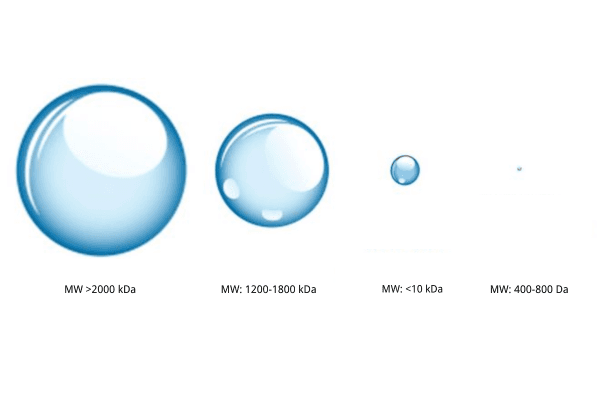
High vs. Low Molecular Weight Hyaluronic Acid Powder
One of the most important questions for professional buyers is whether to select high molecular weight or low molecular weight hyaluronic acid powder.
The answer depends on the intended application.
Characteristic | Higher Molecular Weight HA | Lower Molecular Weight HA |
|---|---|---|
Solution viscosity | Generally higher at comparable concentration | Generally lower |
Film-forming behavior | More pronounced in many formulations | Different formulation behavior |
Hydration profile | Primarily associated with surface hydration and film formation | Different interaction with formulation and skin |
Typical formulation role | Surface-oriented cosmetic formulations | Formulations requiring different rheological characteristics |
Processing | May require careful hydration and dispersion | Can behave differently during formulation |
Selection principle | Choose according to target viscosity and application | Choose according to target performance and formulation |
The terms “high molecular weight” and “low molecular weight” should always be supported by an actual specification.
There is no universal molecular-weight cutoff that automatically defines the ideal product for every application.
Why Molecular Weight Matters for Manufacturers
Suppose two suppliers both offer “99% pure hyaluronic acid powder.”
That does not necessarily mean their products will behave identically.
If one product has a significantly different molecular-weight distribution, the resulting formulation can show differences in:
Viscosity
Hydration behavior
Texture
Film formation
Processing time
Final product stability
This is why purity alone is not sufficient for raw-material selection.

What Is Hyaluronic Acid Powder Used For?
Hyaluronic acid powder has applications across several professional industries.
Cosmetic and Skincare Formulations
Cosmetic applications are among the most common uses.
HA-related raw materials can be incorporated into:
Facial serums
Moisturizing creams
Hydrating gels
Eye-care products
Facial masks
Professional skincare products
Anti-aging formulations
The appropriate grade depends on the product's formulation requirements.
Medical and Pharmaceutical Applications
Hyaluronic acid is also an important biomaterial in medical and pharmaceutical applications.
Its biocompatibility, biodegradability, viscoelastic characteristics, and interaction with biological tissues have made HA relevant to areas including ophthalmology, wound care, tissue engineering, and drug-delivery research.
However, cosmetic-grade HA should not automatically be treated as suitable for medical or injectable use.
Different applications can require substantially different specifications, manufacturing controls, sterility requirements, endotoxin controls, regulatory documentation, and clinical evidence.
Medical Aesthetic Applications
Hyaluronic acid is also widely associated with dermal filler technology.
However, there is an important distinction between:
hyaluronic acid powder as a raw material
and
a finished injectable dermal filler.
A finished injectable product involves much more than the presence of HA. Formulation design, crosslinking technology where applicable, particle characteristics, sterility, endotoxin control, rheology, packaging, manufacturing processes, regulatory status, and clinical evaluation all influence the finished product.
Therefore, raw-material specifications should never be interpreted as equivalent to finished-product clinical performance.
How Is Hyaluronic Acid Powder Used in Formulation?
For manufacturers, the powder-to-formulation process requires controlled handling.
A general development workflow may include:
Define the target product characteristics.
Determine the desired viscosity, texture, hydration profile, concentration, and application.Select the molecular-weight grade.
Choose the HA grade based on the formulation objective rather than simply selecting the highest molecular weight available.Determine the appropriate concentration.
Concentration has a major effect on viscosity and final product characteristics.Develop the dispersion and hydration process.
HA powder should be incorporated under controlled conditions to minimize clumping and achieve consistent hydration.Evaluate the finished formulation.
Check viscosity, appearance, pH, stability, microbiological quality, and other applicable parameters.Conduct appropriate quality and stability testing.
Finished-product testing should confirm that the formulation remains within its intended specifications throughout its shelf life.
The exact processing conditions depend on the selected material and final formulation. Manufacturers should follow the supplier's technical documentation rather than applying one generic mixing procedure to every HA powder.
What Quality Parameters Should Buyers Check?
A professional procurement decision should go beyond the phrase “pure hyaluronic acid powder.”
Molecular Weight and Distribution
Ask the supplier to provide the specified molecular-weight range or distribution method used for characterization.
If molecular weight is critical to the final product, this parameter should be included in the purchasing specification.
Purity
Purity is important, but the test method and specification should also be understood.
A reported percentage without a defined analytical method provides limited information for technical comparison.
Microbiological Quality
Depending on the intended application, buyers may need information relating to:
Total microbial count
Yeast and mold
Specified microorganisms
Bioburden
Sterility, where applicable
The required limits depend on the final use.
Endotoxin
For certain medical or injectable applications, endotoxin control can be critical.
However, the appropriate requirement depends on the intended product category and regulatory framework.
A cosmetic raw material and an injectable pharmaceutical or medical product should not be evaluated under identical quality criteria.
Moisture Content
Because HA-related powders are hydrophilic, moisture content can be relevant to storage stability, handling, and batch consistency.
Residual Solvents and Other Impurities
Depending on the manufacturing process and intended application, buyers may also request information about:
Residual solvents
Heavy metals
Protein content
Nucleic acid residues
Ash or inorganic residues
Other process-related impurities
The exact testing panel should reflect the intended application and applicable regulations.
How to Choose Hyaluronic Acid Powder
Selecting the right HA powder begins with defining the application.
1. Identify the Intended Use
Ask first:
What will the material be used to manufacture?
A cosmetic serum, professional skincare gel, pharmaceutical product, and injectable medical aesthetic product may require very different specifications.
2. Select the Molecular Weight
Do not automatically select the highest molecular weight.
Instead, determine the target:
Viscosity
Texture
Hydration characteristics
Film formation
Processing behavior
Final concentration
Then select the appropriate molecular-weight grade.
3. Verify the Specification
Request a complete technical specification rather than relying on a short online product description.
Important information may include:
Appearance
Identification
Assay or purity
Molecular weight
pH
Loss on drying or moisture
Protein content
Microbial limits
Endotoxin, where applicable
Residual substances
Storage requirements
4. Review Documentation
For B2B procurement, request relevant documents such as:
COA
TDS
SDS/MSDS
Product specification
Batch information
Stability information where available
Regulatory documentation applicable to the target market
5. Evaluate Batch Consistency
A supplier should be able to demonstrate consistent production across batches.
For manufacturers, consistency is often more valuable than a slightly lower raw-material price because variations in molecular weight, viscosity, moisture, or impurities can affect the finished formulation.
Hyaluronic Acid Powder Supplier Evaluation Checklist
When evaluating a supplier, consider the following:
Product identity: Is the material clearly defined?
Molecular weight: Is the range specified and supported by testing?
Purity: Is the analytical method documented?
Grade: Is the grade appropriate for the intended application?
Manufacturing: Is the manufacturing process controlled?
Quality system: Does the supplier operate under an appropriate quality-management system?
Documentation: Are COA, TDS, SDS, and other required documents available?
Batch traceability: Can individual batches be traced?
Packaging: Does the packaging protect the hydrophilic powder during storage and transportation?
Regulatory support: Can the supplier provide documents needed for the destination market?
Supply capacity: Can the supplier maintain consistent supply at the required volume?
For international buyers, supplier qualification should be treated as a technical and regulatory process rather than simply a price comparison.
Common Mistakes When Buying Hyaluronic Acid Powder
Choosing Based Only on Purity
A product with a high stated purity is not automatically the best choice.
Molecular weight, microbiological quality, moisture, processing characteristics, and intended application can be equally important.
Assuming All HA Powders Are Interchangeable
They are not.
Different suppliers may use different raw materials, fermentation processes, purification methods, molecular-weight specifications, and quality-control systems.
Selecting Molecular Weight Without Testing the Finished Formula
A theoretically suitable molecular weight may still behave differently in a real formulation.
Manufacturers should conduct formulation trials before committing to large-scale procurement.
Confusing Cosmetic Grade With Injectable Grade
This is particularly important in medical aesthetics.
A cosmetic-grade raw material should not be promoted as suitable for injection simply because it contains hyaluronic acid.
Finished injectable products require their own manufacturing, sterility, safety, regulatory, and clinical considerations.
Buying Without Batch Documentation
For professional manufacturing, the ability to trace a raw material to a specific batch is essential.
A supplier that cannot provide appropriate batch documentation may create avoidable quality-control and regulatory problems.
What Is the Best Hyaluronic Acid Powder?
There is no single “best hyaluronic acid powder” for every application.
The appropriate material depends on the product being developed.
For example:
Application | Key Selection Considerations |
|---|---|
Facial serum | Hydration profile, molecular weight, viscosity, cosmetic grade |
Moisturizing cream | Texture, formulation compatibility, hydration properties |
Hydrogel | Molecular weight, rheology, concentration, purity |
Professional skincare | Grade, purity, formulation performance, documentation |
Pharmaceutical application | Regulatory requirements, purity, microbial quality, application-specific specifications |
Medical aesthetic product | Material specifications, manufacturing controls, sterility-related requirements, regulatory status |
The correct question is therefore not “Which HA powder is the best?”
It is:
“Which hyaluronic acid powder has the right specifications for my intended application?”
Why Supplier Quality Matters
Raw-material quality directly affects manufacturing consistency.
A supplier should be able to provide more than a product name and a price quotation. Professional buyers should expect clear technical specifications, batch documentation, storage information, and appropriate regulatory support.
For international procurement, additional considerations may include:
Export documentation
Packaging configuration
Minimum order quantity
Production lead time
Batch traceability
Technical support
Private-label or OEM requirements where applicable
Destination-market documentation
A long-term supplier relationship should be based on consistent specifications and reliable documentation, not only the initial purchase price.
Conclusion
Hyaluronic acid powder is a versatile professional raw material, but there is no universal specification that works for every application. Molecular weight, purity, viscosity, solubility, moisture, microbiological quality, and intended use all influence material selection.
For cosmetic manufacturers, the right HA powder can contribute to hydration, film-forming characteristics, texture, and overall formulation performance. For medical and aesthetic applications, the evaluation becomes more demanding, with additional attention required for manufacturing controls, regulatory requirements, sterility-related specifications, and clinical suitability.
The most reliable procurement approach is to define the application first, select the appropriate molecular-weight grade, verify the complete technical specification, review quality documentation, and evaluate the supplier's ability to maintain consistent batches.
For professional buyers, the best hyaluronic acid powder is not necessarily the product with the highest purity or lowest price. It is the material whose specifications, quality system, documentation, and supply capability match the requirements of the final product.
Looking for a Professional Hyaluronic Acid Powder Supplier?
AOWITA works with professional buyers evaluating aesthetic and cosmetic raw materials and finished products for international markets.
If you are sourcing hyaluronic acid powder for cosmetic, professional skincare, medical aesthetic, or other specialized applications, the right starting point is a clear understanding of your required molecular weight, grade, specifications, documentation, and target market.
Contact AOWITA to discuss your product requirements and request the relevant technical and product information for evaluation.
Frequently Asked Questions About Hyaluronic Acid Powder
What is hyaluronic acid powder?
Hyaluronic acid powder is a dry-form HA-based raw material used in cosmetic, personal-care, pharmaceutical, medical, and other professional applications. Its characteristics depend on factors such as molecular weight, purity, formulation, and manufacturing process.
What is hyaluronic acid powder used for?
Hyaluronic acid powder is commonly used in skincare formulations, hydrating products, gels, professional cosmetic formulations, and selected medical or pharmaceutical applications. The required grade depends on the intended end use.
Does hyaluronic acid powder dissolve in water?
HA-based powders are hydrophilic and can be incorporated into water-based systems, but the dispersion and hydration process depends on molecular weight, concentration, formulation conditions, and processing technique.
What is the difference between high and low molecular weight hyaluronic acid powder?
The main differences relate to solution behavior, viscosity, hydration characteristics, and formulation performance. Higher molecular weight materials generally produce higher viscosity at comparable concentrations, while lower molecular weight grades can provide different formulation characteristics.
Is cosmetic-grade hyaluronic acid powder suitable for injection?
Not automatically. Cosmetic grade does not mean injectable grade. Injectable applications require appropriate product specifications, manufacturing controls, sterility and safety considerations, regulatory authorization, and clinical evaluation.
How should I choose hyaluronic acid powder?
Start with the intended application, then evaluate molecular weight, purity, viscosity characteristics, microbiological quality, moisture, documentation, packaging, regulatory requirements, and supplier consistency.
What documents should I request from a hyaluronic acid powder supplier?
Depending on the application, buyers may request a Certificate of Analysis (COA), Technical Data Sheet (TDS), Safety Data Sheet (SDS/MSDS), product specification, batch information, and applicable regulatory or quality documentation.
How should hyaluronic acid powder be stored?
Storage requirements depend on the specific manufacturer's instructions. Because HA-related powders are hydrophilic, appropriate moisture protection and controlled storage are important. Buyers should follow the supplier's specified storage conditions and shelf-life information.
Can different hyaluronic acid powders be substituted for each other?
Not necessarily. Differences in molecular weight, purity, manufacturing process, moisture, viscosity, and other specifications can affect formulation performance. Substitution should be evaluated through technical comparison and formulation testing.
其他博客


