Blog
High Molecular Weight vs Low Molecular Weight Hyaluronic Acid: What Is the Difference?
Author
Ray
Published
Category
HA
Compare high and low molecular weight hyaluronic acid, including viscosity, cross-linking, degradation, rheology and their role in HA dermal filler manufacturing.


Author
Ray
An esteemed medical aesthetics expert with 40 years of profound experience in the field. With decades of expertise in non-invasive procedures, anti-aging science, and advanced dermatological solutions, the author is dedicated to sharing insights that connect clinical innovation with real-world patient results. Passionate about advancing safe, effective, and high-impact aesthetic treatments for a global clientele.
What’s better than insider perks, pro tips, and surprises?
Sign up to get the most recent blog articles in your email every week.
Join now.
Our company’s main product lines include HA (Hyaluronic Acid) fillers, CaHA (Calcium Hydroxylapatite) fillers, PLLA (Poly-L-Lactic Acid) biostimulators, and other advanced aesthetic solutions, all developed and manufactured by trusted partner facilities with whom we have maintained long-term, stable collaborations.
I help them with sales and export operations, while our company also provides sourcing and procurement services in China to help international clients solve supply-related challenges. If you need assistance with procurement, please feel free to contact us.
Introduction
Two hyaluronic acid materials can have the same chemical repeating unit yet behave very differently.
One reason is molecular weight.
Hyaluronic acid is a long-chain polysaccharide, and its molecular weight reflects the approximate size and length of those polymer chains. Depending on how HA is produced, purified and processed, manufacturers can obtain materials with substantially different molecular-weight distributions.
These differences can influence:
Solution viscosity
Polymer-chain entanglement
Hydration behavior
Processing characteristics
Cross-linking behavior
Rheological properties
Degradation behavior
Final product design
For manufacturers of injectable hyaluronic acid hydrogels, molecular weight is therefore not simply a specification on a raw-material certificate. It is one of several variables that can influence how an HA filler is engineered.
However, there is an important point:
High molecular weight HA is not automatically better than low molecular weight HA.
Likewise:
Molecular weight does not determine filler quality by itself.
A finished HA dermal filler is the result of multiple interacting variables, including HA concentration, molecular weight, cross-linking technology, degree of modification, gel processing and rheological design. A 2024 review of injectable HA hydrogels specifically identifies molecular weight alongside concentration, cross-linker conditions, particle size and reaction parameters as factors influencing filler rheology.
Understanding these relationships helps distributors, aesthetic brands and OEM buyers evaluate HA products more intelligently.
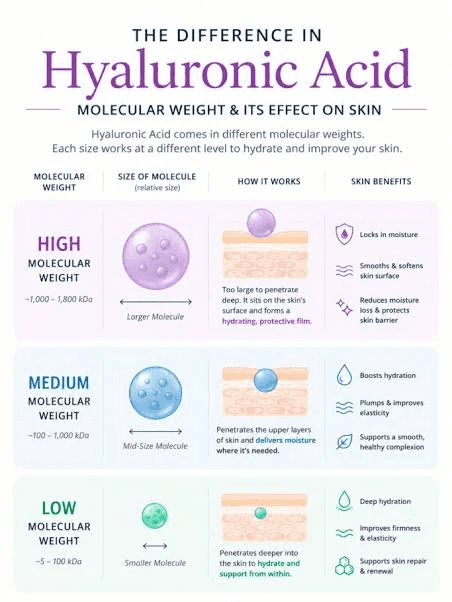
What Does Molecular Weight Mean in Hyaluronic Acid?
Hyaluronic acid consists of repeating disaccharide units joined together into long polymer chains.
The longer the chain, the greater its molecular mass.
HA molecular weight is generally expressed in:
Daltons (Da)
Kilodaltons (kDa)
Megadaltons (MDa)
For example:
1,000 kDa = 1 MDa
In biological tissues, hyaluronan is commonly synthesized as a high-molecular-mass polymer, although smaller fragments can be generated through enzymatic and oxidative degradation. Reviews of naturally occurring HA report broad molecular-size distributions depending on tissue and biological state.
For industrial HA production, molecular weight can be controlled through fermentation conditions, downstream processing and controlled degradation or fractionation strategies.
What Is High Molecular Weight Hyaluronic Acid?
High molecular weight hyaluronic acid, often abbreviated as HMW-HA, refers to HA composed of relatively long polymer chains.
There is no single universally accepted molecular-weight cutoff separating “high” from “low” molecular weight HA.
This is important.
Different scientific studies, raw-material suppliers and product categories may use different ranges.
For example, biological literature sometimes describes HA below approximately 200 kDa as low-molecular-weight material, while high-molecular-weight native HA may exist in the megadalton range. These classifications depend heavily on context.
Therefore, when comparing HA raw materials, buyers should ask for the actual molecular-weight range or distribution, rather than relying only on the label “high molecular weight.”
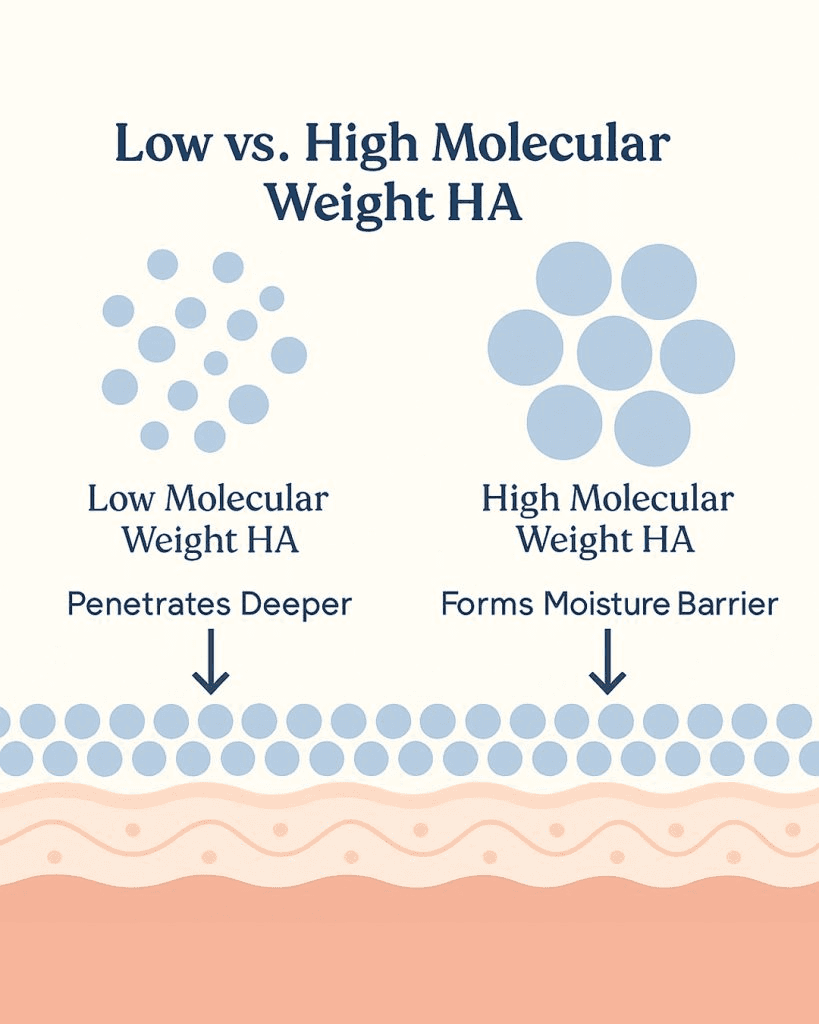
What Is Low Molecular Weight Hyaluronic Acid?
Low molecular weight hyaluronic acid, or LMW-HA, consists of shorter HA polymer chains.
These smaller chains can be produced through controlled depolymerization or other manufacturing processes.
Compared with very high molecular weight HA at the same concentration, lower molecular weight HA generally produces different solution and flow characteristics.
However, just as with HMW-HA, the term “low molecular weight” does not represent one universally standardized number.
A material described as LMW-HA by one supplier might fall into a different category under another technical classification.
Professional B2B sourcing should therefore focus on measurable specifications rather than marketing terminology.
High vs Low Molecular Weight HA: Key Differences
Property | High Molecular Weight HA | Low Molecular Weight HA |
|---|---|---|
Polymer Chain Length | Longer | Shorter |
Molecular Mass | Higher | Lower |
Chain Entanglement | Generally greater | Generally lower |
Solution Viscosity at Comparable Conditions | Usually higher | Usually lower |
Processing Behavior | Can be more viscous and difficult to handle | Generally easier to process at comparable concentration |
Biological Behavior | Size-dependent | Size-dependent |
Cross-Linking Behavior | Influenced by long-chain network interactions | Different network formation characteristics |
Use in Filler Development | Can support highly entangled HA networks | May be used alone or in multi-MW strategies |
Product Quality | Not inherently superior | Not inherently inferior |
These are general tendencies.
Actual behavior also depends strongly on HA concentration, temperature, ionic environment and manufacturing conditions.
Why Molecular Weight Changes HA Viscosity
One of the clearest effects of molecular weight can be observed in HA solution rheology.
Longer HA chains interact and entangle with one another more extensively.
As molecular weight and/or polymer concentration increase, these interactions can substantially increase resistance to flow.
A comprehensive review of HA physicochemical properties documents the relationship between molecular weight, concentration, zero-shear viscosity and complex viscosity.
In simplified terms:
Longer HA chains + sufficient concentration → greater chain interaction → higher viscosity
This has important manufacturing consequences.
A high-molecular-weight HA solution may require different:
Mixing conditions
Hydration times
Pumping parameters
Homogenization processes
Cross-linking conditions
than a lower-molecular-weight HA solution.
Molecular weight therefore affects not only the final material but also the manufacturing process itself.
Does Higher Molecular Weight Always Mean Higher Viscosity?
Not necessarily when comparing finished products.
If all other variables are kept equal, molecular weight strongly influences solution viscosity.
But commercial formulations rarely keep every other variable equal.
Viscosity can also change with:
HA concentration
Cross-linking
Temperature
Ionic strength
Shear rate
Polymer distribution
Gel processing
Therefore, a finished filler made from lower molecular weight HA could theoretically exhibit greater final gel resistance than another product made with higher molecular weight HA if the two products use different cross-linking and formulation technologies.
This is why raw-material molecular weight and finished-product rheology should not be treated as the same specification.
Molecular Weight vs HA Concentration: What Is the Difference?
These two specifications are frequently confused.
Molecular Weight
Molecular weight describes the approximate size or length of individual HA polymer chains.
HA Concentration
Concentration describes how much HA is present in a given volume of formulation.
For example:
20 mg/mL
describes concentration.
It does not describe molecular weight.
Two HA materials could both be formulated at 20 mg/mL but have very different polymer chain lengths.
Likewise, two finished fillers can contain the same nominal HA concentration while showing different:
G′
G″
Viscosity
Cohesivity
Extrusion force
Swelling behavior
because their molecular weight, cross-linking and processing technologies differ.
How Molecular Weight Influences Polymer Entanglement
Long HA molecules can physically interact and overlap.
At sufficient concentration, these long chains begin to entangle with neighboring polymer chains.
Think of the difference between:
short pieces of thread
and
a bowl of very long noodles.
The longer chains have more opportunities to become intertwined.
In HA manufacturing, this physical chain entanglement can contribute to the material's initial network structure even before chemical cross-linking is considered.
This concept is especially relevant to some modern HA filler technologies that combine physical molecular entanglement with chemical cross-linking.
Aowita's current cross-linked HA platform, for example, describes the use of high-molecular-weight HA chain entanglement followed by chemical modification to create a reinforced gel network.
How Does Molecular Weight Affect HA Cross-Linking?
Cross-linking connects HA polymer chains into a three-dimensional network.
The starting molecular weight of those chains can influence how that network forms.
Manufacturers must consider interactions among:
Molecular weight
HA concentration
Cross-linker concentration
Reaction time
pH
Temperature
Mixing conditions
A longer HA chain contains more repeating units and can participate in extensive polymer entanglement and network formation.
However, using high-molecular-weight HA does not automatically guarantee a stronger finished filler.
Cross-linking efficiency and network architecture remain critical.
The final hydrogel is the result of the entire manufacturing system, not one raw-material number.
High Molecular Weight HA and BDDE Cross-Linking
BDDE, or 1,4-butanediol diglycidyl ether, is one of the established cross-linking agents used in many HA dermal filler technologies.
During manufacturing, BDDE forms connections between HA polymer chains.
Starting molecular weight can influence the polymer environment in which this reaction occurs.
However, manufacturers must optimize:
HA molecular weight
Polymer concentration
BDDE ratio
Reaction conditions
Purification
Final gel processing
together.
This explains why two BDDE-cross-linked HA fillers can still exhibit very different rheological characteristics.
The cross-linker may be similar, but the polymer architecture can be different.
Molecular Weight vs Cross-Linking: They Are Not the Same Thing
This distinction is essential.
Molecular weight describes the size of an HA polymer chain.
Cross-linking describes connections created between polymer chains.
A product may contain:
High-MW non-cross-linked HA
Low-MW non-cross-linked HA
High-MW cross-linked HA
Different molecular-weight fractions within a cross-linked system
Therefore:
High molecular weight does not mean highly cross-linked.
And:
Low molecular weight does not mean non-cross-linked.
They are separate technical variables.
For professional filler evaluation, both should be considered independently.
How Does Molecular Weight Affect HA Filler Rheology?
The rheological behavior of an injectable HA hydrogel is influenced by molecular weight, but molecular weight is only one part of the system.
Important filler parameters include:
G′ — Storage Modulus
G′ represents the elastic component of the gel.
It provides information about resistance to deformation under specified testing conditions.
G″ — Loss Modulus
G″ represents the viscous contribution during deformation.
Complex Viscosity
Complex viscosity provides information about resistance to deformation and flow under oscillatory testing.
Cohesivity
Cohesivity describes the internal tendency of a gel to remain integrated.
A 2024 review of injectable HA hydrogels notes that molecular weight, HA concentration, cross-linking-agent concentration, particle size and reaction parameters can all be manipulated to obtain specific rheological properties.
Therefore:
Molecular weight influences rheology, but does not independently determine it.
Can Two Fillers Made From High-Molecular-Weight HA Behave Differently?
Absolutely.
Suppose two manufacturers both state that they use high-molecular-weight HA.
Product A could still have:
Greater cohesivity
Higher HA concentration
Greater cross-link density
while Product B could be engineered to have:
Lower G′
Greater flexibility
Different swelling behavior
Easier extrusion
Both may begin with high-MW HA.
The difference comes from how the polymer is transformed into the finished hydrogel.
This is why B2B buyers should not select an injectable filler simply because the supplier advertises:
“High Molecular Weight HA.”
The complete formulation matters.
Does Molecular Weight Affect HA Degradation?
Yes, molecular size is associated with HA degradation and biological turnover, but the relationship becomes more complex in a cross-linked dermal filler.
Natural HA undergoes continuous degradation in biological tissues.
As high-molecular-weight HA is broken down, progressively smaller fragments can form.
Scientific reviews show that HA molecular size is closely associated with its physicochemical and biological properties.
However, for a finished dermal filler, persistence depends on much more than initial molecular weight.
Important factors include:
Cross-linking
Network density
HA concentration
Gel architecture
Enzymatic exposure
Oxidative environment
Injection location
Therefore, claiming that a filler lasts longer only because it uses higher molecular weight HA would be an oversimplification.
Does Low Molecular Weight HA Behave Differently Biologically?
Scientific literature indicates that HA molecular size can affect receptor interactions and biological signaling.
High-molecular-weight HA and smaller HA fragments have demonstrated different biological activities in experimental systems involving receptors such as CD44 and RHAMM.
Some experimental literature associates high-molecular-weight HA with tissue-homeostasis or anti-inflammatory signaling, while smaller HA fragments have been associated with different inflammatory and regenerative responses.
However, these findings require careful interpretation.
They do not mean:
“Low molecular weight HA is unsafe”
or
“High molecular weight HA is always biologically superior.”
Many of these observations depend on:
Molecular-size range
Concentration
Tissue environment
Receptor expression
Experimental model
Finished injectable medical products must therefore be evaluated as complete formulations rather than making safety conclusions from molecular weight alone.
Is Low Molecular Weight HA Better Because It Is Smaller?
Not automatically.
In cosmetic marketing, lower-molecular-weight HA is often presented as “better penetrating.”
That statement needs context.
Topical skin penetration, injectable hydrogel manufacturing and dermal filler performance are very different topics.
For an injectable HA filler, the objective is not to make HA molecules “penetrate deeper through the skin.”
The material is delivered through an injection system to a defined tissue layer.
For this reason, molecular weight in filler manufacturing should instead be evaluated in relation to:
Polymer processing
Network formation
Rheology
Cross-linking
Degradation
Finished gel performance
This is a more scientifically relevant framework for professional filler buyers.
Why Do Some Manufacturers Use Multiple HA Molecular Weights?
Modern HA technologies do not always rely on a single molecular-weight fraction.
Some formulation strategies may combine different molecular weights to influence:
Polymer packing
Cross-linking efficiency
Flow behavior
Network structure
Gel flexibility
The concept is that different chain lengths may interact differently within the polymer network.
However, “multi-molecular-weight HA” should not automatically be interpreted as a quality guarantee.
The resulting performance must still be demonstrated through appropriate:
Rheological characterization
Physicochemical testing
Manufacturing validation
Finished-product testing
A sophisticated formulation is valuable only if the finished product is well controlled.
High Molecular Weight vs Low Molecular Weight HA in Dermal Filler Manufacturing
From a manufacturing perspective, the choice of molecular weight influences multiple stages.
Raw Material Hydration
High-molecular-weight HA can produce highly viscous solutions and may require careful hydration and mixing.
Mixing
Greater chain entanglement can make homogeneous mixing more technically demanding.
Cross-Linking
Polymer chain length influences the environment in which the cross-linking reaction takes place.
Purification
Manufacturing processes must remove relevant process-related residues while maintaining the intended gel characteristics.
Homogenization
Post-cross-linking processing can further change the mechanical characteristics of the gel.
Filling
The final product must be compatible with the intended syringe, needle or cannula system.
The manufacturer therefore has to balance molecular-level polymer design with real-world manufacturing requirements.
Which Molecular Weight Is Better for HA Dermal Fillers?
There is no universal answer.
A more appropriate question is:
Which molecular-weight strategy supports the intended filler design?
For example, a manufacturer developing a highly structured cross-linked gel may choose one molecular-weight strategy.
A formulation designed for greater flexibility may use another.
What matters is the final relationship between:
Molecular weight + concentration + cross-linking + gel processing + rheology
rather than a single “high” or “low” value.
High Molecular Weight HA Does Not Automatically Mean a Better Filler
This point deserves emphasis because “high molecular weight” can easily become a marketing phrase.
A professional buyer should not automatically interpret:
2 MDa HA
as being superior to:
1 MDa HA
without understanding the complete formulation.
The finished product may have different:
G′
Cohesivity
Complex viscosity
Extrusion force
Swelling behavior
Degradation behavior
The specification must be interpreted within the context of the entire hydrogel.
What Should B2B Buyers Ask About HA Molecular Weight?
When evaluating a hyaluronic acid supplier or dermal filler manufacturer, buyers can ask several useful questions.
What Molecular-Weight Range Is Used?
Instead of asking whether the HA is “high molecular weight,” request the actual specification where appropriate.
Is the Value an Average or a Distribution?
Polymers typically contain a range of chain lengths rather than one perfectly uniform molecular weight.
At What Stage Is Molecular Weight Measured?
Ask whether the specification refers to:
Raw sodium hyaluronate
Pre-cross-linking material
Another manufacturing stage
This distinction matters because the finished cross-linked hydrogel is a three-dimensional network rather than a simple solution of independent polymer chains.
How Does Molecular Weight Relate to the Product's Rheology?
Ask for available data concerning:
G′
G″
Viscosity
Cohesivity
where relevant.
What Cross-Linking Technology Is Used?
Molecular weight alone does not predict the final hydrogel.
How Is Batch Consistency Controlled?
Professional manufacturing requires consistency from one batch to another.
Molecular Weight vs Rheology: Which Matters More for Buyers?
For raw HA purchasing, molecular weight can be a major specification.
For finished dermal filler purchasing, however, rheological and finished-product data may provide more direct information about how the formulated gel behaves.
Think of it this way:
Molecular weight is an input.
Rheology is part of the resulting material behavior.
Both matter, but they answer different questions.
A B2B buyer evaluating a finished HA filler should therefore avoid choosing a product exclusively according to the molecular weight of its starting HA.
Molecular Weight vs Particle Size
These are also different concepts.
Molecular Weight
Refers to the size of individual HA polymer molecules.
Particle Size
In particulate or processed gel systems, particle size refers to the physical dimensions of gel particles after manufacturing.
A filler can therefore use high-molecular-weight HA and still be processed into different gel particle sizes.
For biphasic filler technology in particular, particle characteristics can contribute significantly to final product behavior.
This reinforces the central theme:
HA filler performance is multidimensional.
Molecular Weight vs Degree of Cross-Linking
Another common mistake is assuming that high-MW HA naturally means higher cross-link density.
It does not.
Cross-link density depends on factors such as:
Cross-linker availability
Reaction conditions
Polymer concentration
Reaction efficiency
Network architecture
Molecular weight influences the polymer environment, but it is not a direct measurement of cross-link density.
How Aowita Uses High-Molecular-Weight HA in Cross-Linked Gel Design
Aowita's current Rveiling® cross-linked HA platform describes a manufacturing approach that begins with high-molecular-weight HA chain entanglement, followed by chemical modification to reinforce the network.
According to its current product information, this approach is used to build a homogeneous cross-linked sodium hyaluronate gel designed to balance elasticity, cohesivity and structural support.
Its cross-linked HA products include formulations for professional aesthetic applications and currently list sodium hyaluronate, lidocaine hydrochloride, sodium chloride, water for injection and phosphate buffer systems among their formulation components.
For distributors and OEM/private-label customers, this illustrates an important principle:
Raw-material molecular weight should be integrated into a complete hydrogel-engineering strategy rather than treated as an isolated marketing specification.
How to Evaluate an HA Manufacturer Beyond Molecular Weight
A professional HA filler sourcing assessment should consider at least five areas.
1. Raw Material
Evaluate:
HA source
Molecular-weight specification
Purity
Raw-material quality
2. Formulation
Evaluate:
HA concentration
Lidocaine where applicable
Buffer system
Other formulation components
3. Cross-Linking Technology
Understand how the manufacturer builds the HA network.
4. Rheology
Review appropriate:
G′
G″
Viscosity
Cohesivity
data where available.
5. Manufacturing and Quality
Evaluate:
Process controls
Sterility
Batch consistency
Documentation
Regulatory suitability for the destination market
This approach provides far more useful information than asking only whether the manufacturer uses HMW or LMW HA.
Conclusion
The difference between high and low molecular weight hyaluronic acid begins with polymer-chain length, but its impact extends throughout HA formulation and manufacturing.
Higher-molecular-weight HA generally provides longer chains, greater molecular entanglement and different rheological behavior compared with shorter-chain HA under equivalent solution conditions.
Frequently Asked Questions
What is high molecular weight hyaluronic acid?
High molecular weight HA refers to relatively long hyaluronic acid polymer chains with higher molecular mass. There is no single universally accepted cutoff, so actual kDa or MDa specifications should be reviewed when making technical comparisons.
What is low molecular weight hyaluronic acid?
Low molecular weight HA consists of shorter HA polymer chains. Exact definitions vary across studies, industries and product applications.
Is high molecular weight HA better than low molecular weight HA?
No. Each can have different physicochemical and biological characteristics. The appropriate molecular weight depends on the product design and manufacturing objective.
Does higher molecular weight make HA more viscous?
Molecular weight strongly influences HA solution rheology. At comparable concentration and conditions, longer HA chains generally produce greater chain entanglement and higher viscosity. However, finished-product viscosity also depends on concentration, cross-linking and processing.
Does high molecular weight mean highly cross-linked HA?
No. Molecular weight and cross-linking are separate properties. Molecular weight describes polymer-chain size, while cross-linking describes connections between chains.
Does high molecular weight mean higher G′?
Not automatically. Molecular weight can influence rheology, but G′ also depends on HA concentration, cross-linking and gel-processing technology.
Can low molecular weight HA be cross-linked?
Yes. Molecular weight and cross-linking status are separate formulation variables.
Can a filler contain different HA molecular weights?
Yes. Different formulation technologies may use one or multiple molecular-weight fractions depending on the intended polymer-network design.
Does molecular weight determine how long an HA filler lasts?
Not by itself. Filler persistence is influenced by cross-linking, HA concentration, gel architecture, degradation environment and other formulation variables.
What molecular weight should B2B buyers request?
There is no universal “best” molecular weight. Buyers should define the intended product and evaluate molecular weight together with rheology, cross-linking technology and finished-product specifications.
Other Blogs
