博客
How Salmon PDRN Works: A Regenerative Skincare Breakthrough
作者
Ray
已发布
类别
PDRN Serum
Learn how Salmon PDRN (polydeoxyribonucleotide) supports skin repair, collagen signaling, and calming inflammation—plus PDRN vs exosomes.

作者
Ray
一位享有盛誉的医学美学专家,在该领域拥有40年的深厚经验。凭借在非侵入性手术、抗衰老科学以及先进皮肤病学解决方案方面的数十年专业知识,作者致力于分享将临床创新与真实患者成果相结合的见解。热衷于为全球客户推进安全、有效且高影响力的美学治疗。
还有什么比内部优惠、专业建议和惊喜更好的呢?
注册可每周在您的电子邮件中接收最新的博客文章。
立即加入。
Our company’s main product lines include HA (Hyaluronic Acid) fillers, CaHA (Calcium Hydroxylapatite) fillers, PLLA (Poly-L-Lactic Acid) biostimulators, and other advanced aesthetic solutions, all developed and manufactured by trusted partner facilities with whom we have maintained long-term, stable collaborations.
I help them with sales and export operations, while our company also provides sourcing and procurement services in China to help international clients solve supply-related challenges. If you need assistance with procurement, please feel free to contact us.
Regenerative skincare has a pattern: a new ingredient gets popular, marketing gets louder, and the science gets blurred. Salmon PDRN is one of the few trends where there is a coherent biological story—if you strip away the hype. In plain terms, PDRN (polydeoxyribonucleotide) is a DNA-derived mixture of nucleotide sequences that research links to tissue regeneration signaling, including pathways associated with calming inflammation and supporting repair processes in skin. In skincare and aesthetics, that translates into a focus on texture, resilience, and recovery—especially when skin is stressed, sensitized, or aging.
Key Takeaways
Salmon PDRN (polydeoxyribonucleotide) is a DNA-derived ingredient used in regenerative aesthetics to support skin repair signaling.
Mechanistically, PDRN is commonly discussed in relation to adenosine A2A receptor pathways, dermal fibroblasts, and cytokine regulation—all relevant to healing and inflammation control.
Realistic outcomes are typically described as improvements in skin elasticity and texture, post-procedure recovery, and overall “skin quality,” rather than dramatic lifting.
Delivery matters: topical PDRN serum for anti-aging supports routine care; in-clinic approaches (microneedling/mesotherapy) aim to place actives where they can interact more directly with skin biology.
PDRN vs Exosomes is not a simple “which is better” question; they’re different categories with different evidence maturity and regulatory variability.
If you’re seeking non-invasive skin rejuvenation, PDRN is best framed as a skin-repair and quality support tool, not a filler replacement.
What Salmon PDRN is (and what it is not)
Salmon PDRN is typically described as purified DNA fragments (polynucleotides / polydeoxyribonucleotide) derived from salmon sources and processed for biomedical or cosmetic use. In a skincare context, it’s usually positioned as a bio-stimulator-adjacent ingredient—supporting the skin environment associated with repair rather than acting like a pigment corrector or exfoliating acid.
Two quick boundaries that keep expectations realistic:
PDRN isn’t a filler. It doesn’t physically “fill” like hyaluronic acid dermal fillers.
PDRN isn’t the same as growth factors or exosomes. It’s a different kind of signal-support material.
Polydeoxyribonucleotide skincare: the technical definition
Polydeoxyribonucleotide (PDRN) refers to a mixture of DNA fragments—effectively chains of nucleotides. You’ll see it discussed as providing “building blocks” or acting through receptor-mediated pathways connected to repair signaling. Skincare brands often simplify this to “skin regeneration,” but the more accurate framing is: supportive signaling + anti-inflammatory context + repair-friendly environment.
“Salmon sperm DNA skincare” — clarifying the source vs the ingredient
“Salmon sperm DNA skincare” is a common search phrase because it’s literal—and controversial-sounding. What matters for buyers is not the headline, but the processing and standards:
The source (salmon-derived DNA) is not the same as the finished ingredient (purified, standardized PDRN/polynucleotide fraction).
Responsible manufacturers and clinics should be able to explain sourcing, purification, and compatibility testing in plain language. If they can’t, treat it as a red flag.
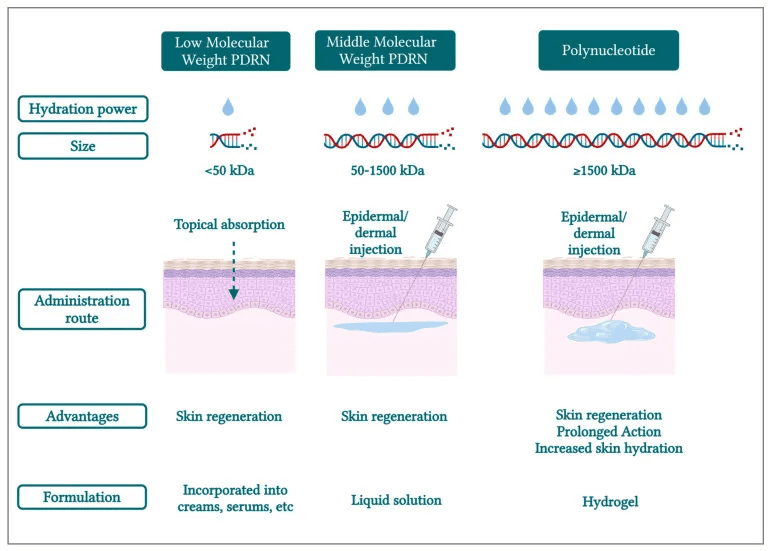
Featured snippet: How Salmon PDRN works in the skin (simple mechanism)
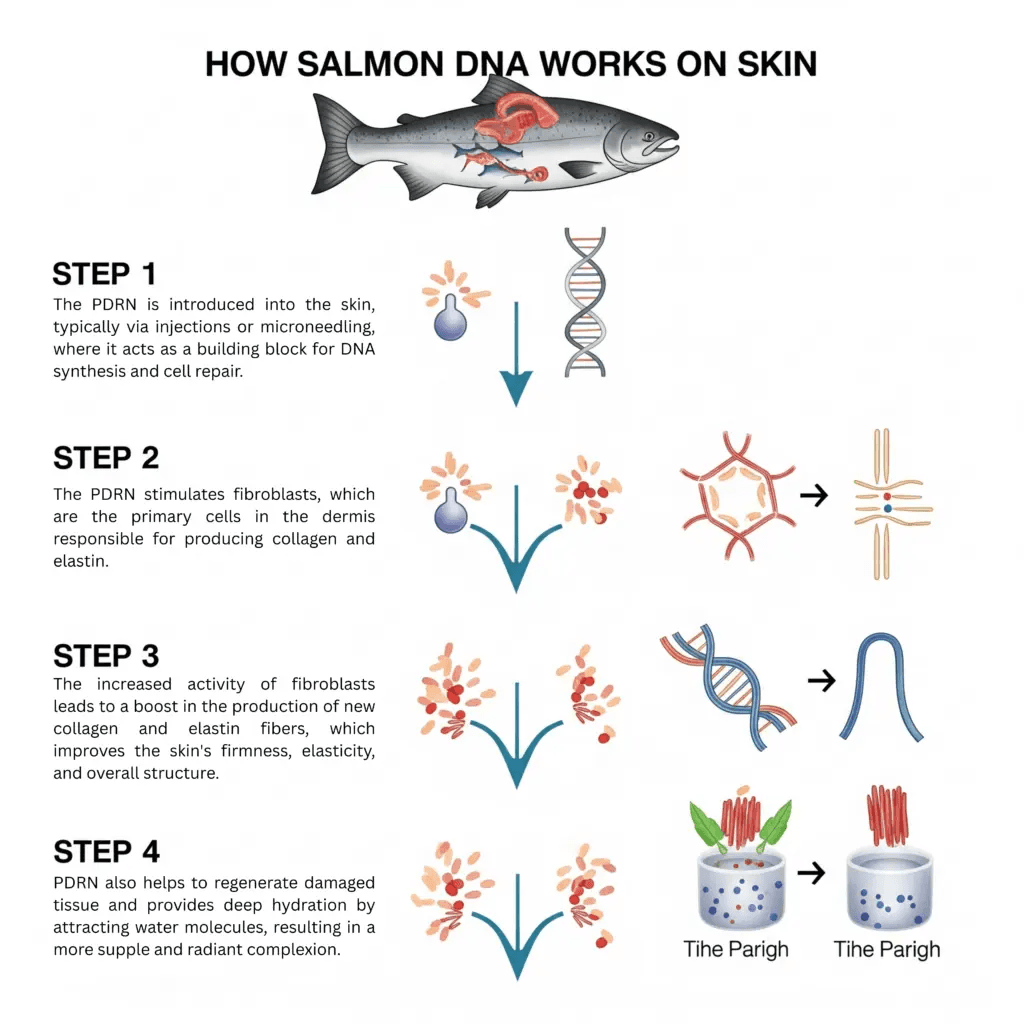
How Salmon PDRN works (high-level):
Provides DNA-derived nucleotide sequences that interact with skin’s repair biology.
Is commonly linked to activation/modulation of adenosine A2A receptor pathways associated with tissue repair signaling.
Helps create a more favorable environment for dermal fibroblasts, the cells involved in producing collagen and elastin.
Supports a calmer inflammatory profile via anti-inflammatory effect and cytokine regulation (important for redness, irritation, and recovery).
In aesthetics, these effects are leveraged to improve skin elasticity and texture and support non-invasive skin rejuvenation outcomes.
Note: Exact effects depend on formulation, delivery method, patient skin condition, and treatment plan.
The biology: receptors, fibroblasts, and cytokines
To understand why PDRN shows up in professional protocols, you need a basic map of skin repair.
Adenosine A2A receptor signaling (why it’s linked to tissue repair)
One of the most cited mechanistic frames for PDRN involves the adenosine A2A receptor—a receptor associated in research with wound repair processes and modulation of inflammation. In simplified terms: A2A signaling is often discussed as helping shift tissue from an “inflamed and reactive” state toward a “repair and rebuild” state.
It’s not magic. It’s the kind of biological nudge that matters most when skin is stressed: after procedures, during barrier disruption, or with chronic irritation patterns.
Nucleotide sequences and the “salvage” concept (skin resource support)
Skin is constantly renewing. In that renewal process, cells use raw materials—one conceptual model is that supplying nucleotide components can support cellular processes during repair. You’ll sometimes see this described as a “salvage pathway” concept (cells reusing building blocks rather than synthesizing everything from scratch). The skincare takeaway: PDRN is positioned as a resource and signaling support ingredient during repair cycles, not a quick cosmetic “cover-up.”
Dermal fibroblasts, collagen, and elastin production
Dermal fibroblasts are key cells in the dermis. They produce components that influence firmness and resilience, including collagen and elastin. When PDRN is discussed in relation to “collagen synthesis with PDRN,” the responsible interpretation is:
PDRN is associated with signaling environments that may encourage fibroblast activity and extracellular matrix support.
Visible changes (if they occur) tend to show up as improvements in skin texture, bounce, and overall “skin quality,” not dramatic lifting.
Anti-inflammatory effect and cytokine regulation
Inflammation isn’t always visible as redness. It can show up as sensitivity, rough texture, prolonged post-procedure recovery, or reactive breakouts.
PDRN is frequently positioned as calming because research discussions often include anti-inflammatory effect and cytokine regulation—meaning it may influence signaling molecules that amplify or reduce inflammation. For skincare users, the practical value is often: skin feels less reactive, recovers faster, and tolerates routines better. (Individual results vary, and this is not a medical claim.)
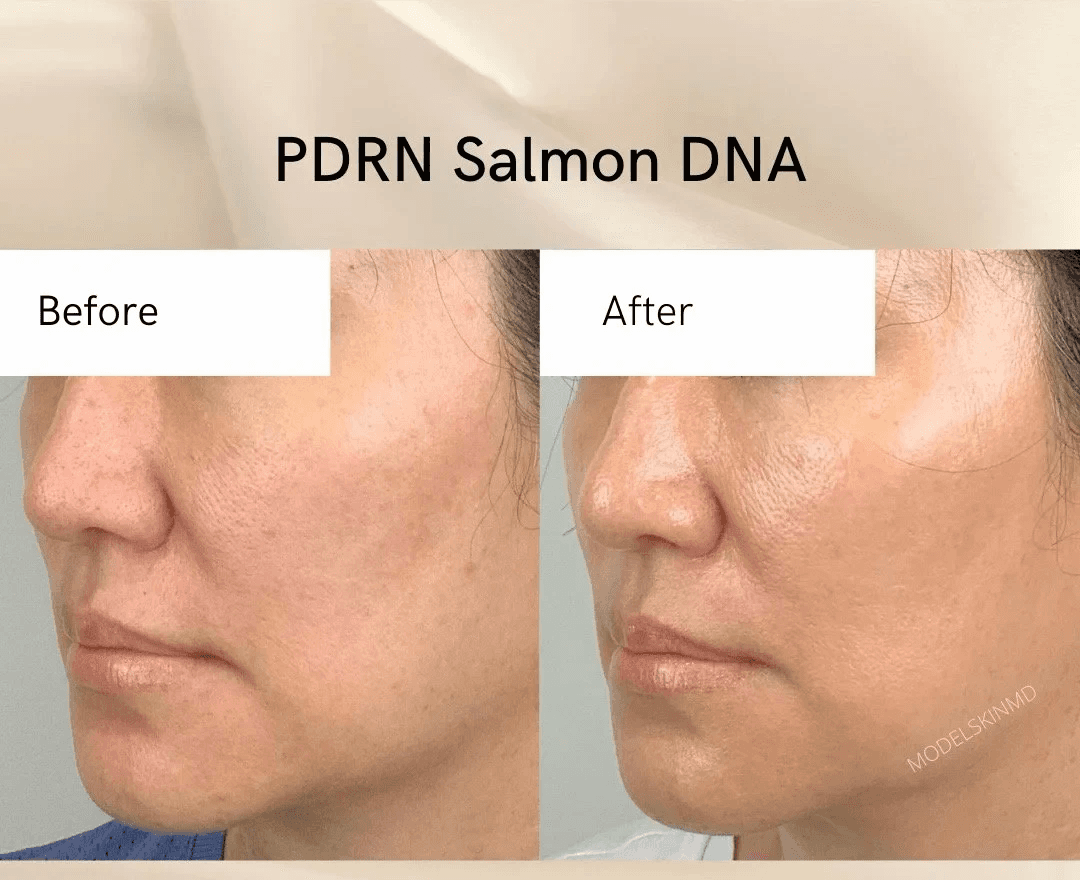
What results to expect: texture, elasticity, and barrier support
The most useful way to think about PDRN is: it’s a skin quality ingredient, not a dramatic reshaper.
Collagen synthesis with PDRN (what’s plausible to claim)
A careful, consumer-safe way to frame it:
PDRN is used in regenerative aesthetics because it’s associated with pathways relevant to tissue repair and matrix support.
Over time, that may contribute to improved appearance of skin elasticity and texture.
Expect gradual change, not a single-session transformation.
If a brand promises a specific percentage increase in collagen or “reverses aging,” treat that as marketing unless backed by credible, product-specific data. [source needed]
Skin barrier repair PDRN: redness, sensitivity, and recovery
“Skin barrier repair PDRN” is a strong keyword because it reflects a real consumer need: irritated, over-exfoliated, post-procedure, or seasonally stressed skin. In practical routines, PDRN is commonly paired with barrier-support basics (gentle cleansing, moisturizers, and daily SPF) to support comfort and resilience.
Wound healing properties of PDRN: clinical context vs skincare context
You’ll often see “wound healing properties of PDRN” in discussions because PDRN has been studied in medical contexts. Skincare users should interpret that responsibly:
Clinical wound healing is not the same as cosmetic improvement.
A skincare product cannot claim to treat wounds or medical conditions.
The relevance is mainly that PDRN is associated with repair-linked pathways, which is why it appears in post-procedure and “regenerative” aesthetic conversations.
Delivery methods: topical PDRN serum vs in-clinic treatments
How you deliver an active often matters as much as the active itself.
PDRN serum for anti-aging (who it helps most)
A PDRN serum for anti-aging is usually positioned for:
early texture changes
dehydrated-looking, stressed skin
those who want a supportive, calming “skin quality” layer in their routine
What to look for:
clear ingredient labeling (PDRN / polydeoxyribonucleotide / polynucleotides)
supportive formulation (hydrators, barrier lipids, soothing agents)
conservative claims and good usage instructions
Topical use is typically about consistent support rather than instant results.
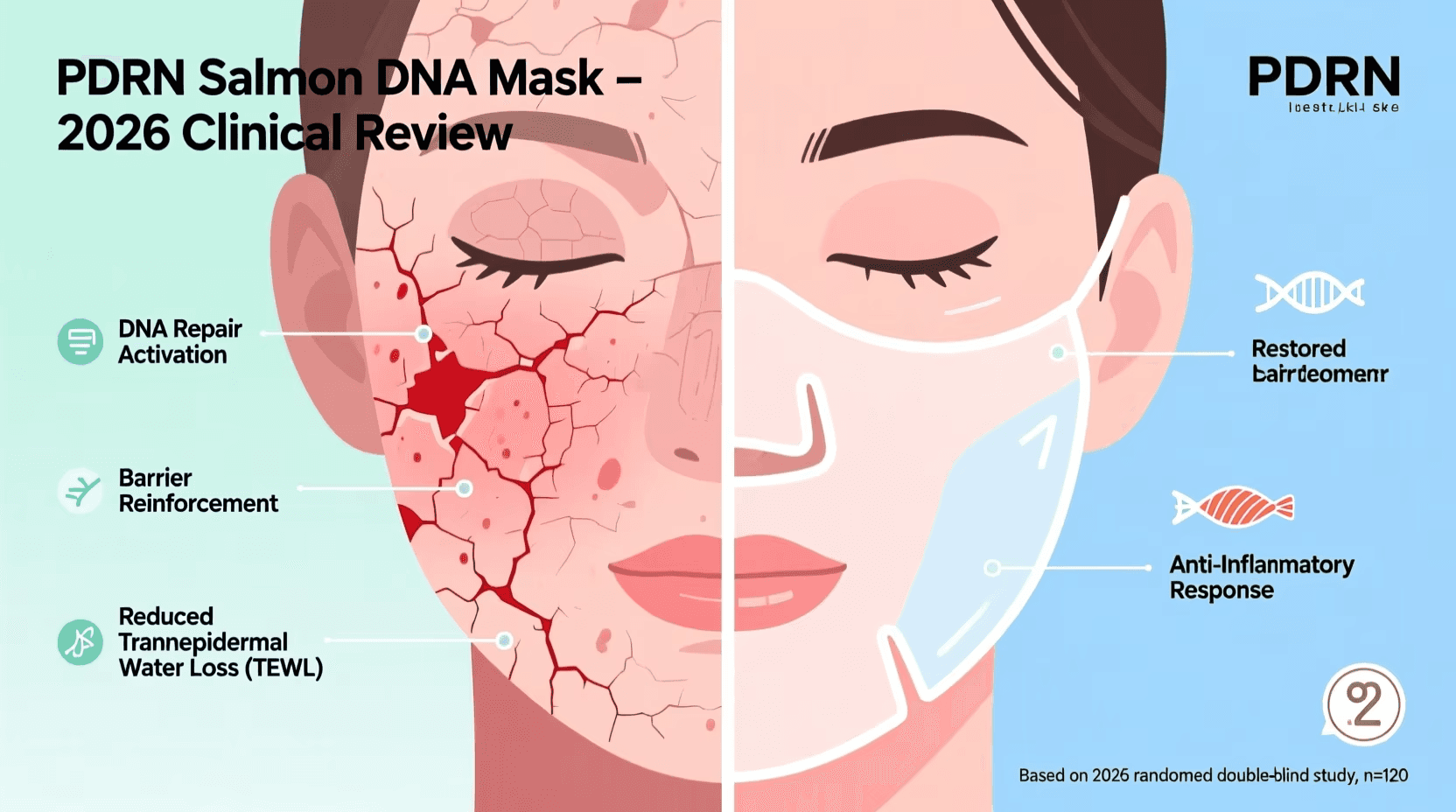
Salmon DNA facial: microneedling + mesotherapy use cases
A “Salmon DNA facial” typically refers to a professional protocol where PDRN-containing solutions are used alongside techniques like microneedling or mesotherapy. The rationale is straightforward: these methods aim to enhance delivery to deeper layers than surface application alone.
Practical considerations:
These are procedure-based services; outcomes depend heavily on provider skill, protocol, and your skin’s baseline condition.
Post-treatment care (barrier protection and sun avoidance) affects results.
Rejuran Healer science: what people mean when they say “PDRN skin booster”
“Rejuran Healer science” is a major search driver because Rejuran is one of the best-known PDRN/polynucleotide skin booster brands in the aesthetic market. When people reference Rejuran, they’re usually talking about a professional-grade, injection-based approach aimed at improving “skin quality” (texture, hydration appearance, resilience) rather than volumizing like classic fillers.
Important: availability, indications, and regulations vary by country. Always consult a qualified clinician for any injectable procedure.
PDRN vs Exosomes: what’s different and how to choose
PDRN vs Exosomes is a high-intent comparison because both are discussed under “regenerative” aesthetics—but they are not interchangeable.
Mechanism and evidence maturity (high-level comparison)
PDRN (polydeoxyribonucleotide): DNA fragment mixture commonly linked to repair-associated signaling (often discussed with A2A receptor pathways) and anti-inflammatory context.
Exosomes: extracellular vesicles involved in cell-to-cell communication; in aesthetics, discussions often focus on signaling cargo (proteins, RNAs) and “cell messaging.”
A key practical difference: exosome products vary widely in sourcing, processing, and regulatory clarity by region. Evidence and standardization can be uneven, so buyer diligence matters.
Practical decision guide by goal and risk tolerance
Choose PDRN when you want:
a “skin quality” support ingredient with a clearer ingredient identity (what it is)
a focus on calming + recovery narratives
Consider exosomes only when:
you have strong confidence in the provider/product provenance
you understand local regulatory context and documentation
you’re comfortable with variability across offerings
If a provider cannot clearly explain sourcing and documentation, neither option is a good bet.
Smart pairing: hyaluronic acid synergy and “cocktail” logic
You’ll often see hyaluronic acid synergy mentioned with PDRN because they play different roles:
Hyaluronic acid (HA): hydration support and cushioning; improves the look of plumpness and comfort.
PDRN: positioned as a regenerative-support ingredient focusing on repair signaling and inflammation calming.
Together, protocols may aim for both: immediate comfort/hydration (HA) and longer-term skin quality support (PDRN). The key is that pairing should be intentional, not a random “everything serum.”
Safety, side effects, and who should avoid it
For topical products, risk is typically similar to other active-containing serums: irritation, sensitivity, or reaction to supporting ingredients. Patch testing is wise, especially for reactive skin.
For professional treatments (microneedling/mesotherapy/injectables):
Expect possible redness, swelling, bruising, or temporary sensitivity.
Infection control and sterile technique matter.
People who are pregnant, breastfeeding, immunocompromised, or managing active skin infections should consult a clinician and follow medical guidance.
This article is educational and not medical advice.
How to evaluate a PDRN product or clinic (buyer checklist)
Use this checklist to filter quality quickly:
Ingredient clarity: Is it labeled as PDRN / polydeoxyribonucleotide / polynucleotides?
Claims discipline: Are benefits described as skin quality support (texture, resilience, recovery) rather than medical treatment?
Formulation logic: Does it include barrier-support partners (hydrators, soothing agents), not just a buzzword?
Provenance & documentation (professional use): Can the clinic explain what product they use, sourcing, and appropriate patient screening?
Protocol transparency: What’s the treatment plan, downtime expectations, and post-care guidance?
Expectation setting: Do they emphasize gradual improvement and maintenance rather than “one session fixes all”?
Conclusion: the most realistic way to use PDRN for non-invasive skin rejuvenation
Salmon PDRN earns its reputation when it’s positioned correctly: a regenerative-support ingredient associated with repair signaling, calming inflammation, and improving skin quality over time. Whether you choose a PDRN serum for anti-aging or a professional “Salmon DNA facial,” the best outcomes come from matching the method to your goal—texture, resilience, and recovery—while keeping expectations grounded.
If your priority is non-invasive skin rejuvenation, PDRN is most compelling as part of a long-term strategy: barrier-first skincare, consistent sun protection, and (when appropriate) professionally delivered protocols by qualified providers.
FAQ
1) What is Salmon PDRN in skincare?
Salmon PDRN is short for polydeoxyribonucleotide derived from salmon DNA sources. It’s used in regenerative skincare and aesthetics to support repair-associated signaling and skin quality goals like texture and resilience.
2) Is “salmon sperm DNA skincare” the same as PDRN?
The phrase refers to the biological source often used to obtain DNA. The skincare ingredient is a purified, processed PDRN/polynucleotide material. What matters is purification standards and product documentation.
3) What does PDRN do for collagen?
PDRN is discussed in relation to dermal fibroblasts and repair-associated pathways, which can be relevant to collagen and elastin support over time. Avoid products that promise dramatic, immediate collagen rebuilding without evidence.
4) PDRN vs Exosomes: which is better?
They’re different categories. PDRN is a defined DNA-fragment ingredient used for repair-support narratives; exosomes are vesicles with more variability in sourcing and regulatory context. The best choice depends on documentation quality, provider trust, and your risk tolerance.
5) Can I use a PDRN serum at home instead of professional treatments?
Topical PDRN can be a good option for routine skin quality support and comfort, but in-clinic delivery methods may target deeper layers. Many people use topical care for maintenance and consider procedures for stronger intervention.
6) What is Rejuran and why is it associated with PDRN?
Rejuran is a well-known professional polynucleotide/PDRN-related skin booster brand. People search “Rejuran Healer science” to understand its regenerative positioning and skin-quality benefits. Availability and indications vary by country.
其他博客