Blog
Hyaluronic Acid Filler Rheology Explained: G′, G″, Cohesivity and Viscosity
Author
Ray
Published
Category
Hyaluronic acid filler
Understand HA filler rheology, including G′, G″, G*, tan δ, cohesivity and viscosity, and how these properties influence hyaluronic acid filler design.


Author
Ray
An esteemed medical aesthetics expert with 40 years of profound experience in the field. With decades of expertise in non-invasive procedures, anti-aging science, and advanced dermatological solutions, the author is dedicated to sharing insights that connect clinical innovation with real-world patient results. Passionate about advancing safe, effective, and high-impact aesthetic treatments for a global clientele.
What’s better than insider perks, pro tips, and surprises?
Sign up to get the most recent blog articles in your email every week.
Join now.
Our company’s main product lines include HA (Hyaluronic Acid) fillers, CaHA (Calcium Hydroxylapatite) fillers, PLLA (Poly-L-Lactic Acid) biostimulators, and other advanced aesthetic solutions, all developed and manufactured by trusted partner facilities with whom we have maintained long-term, stable collaborations.
I help them with sales and export operations, while our company also provides sourcing and procurement services in China to help international clients solve supply-related challenges. If you need assistance with procurement, please feel free to contact us.
Introduction
Two hyaluronic acid dermal fillers can contain similar HA concentrations and even use similar cross-linking agents, yet behave very differently.
One may form a relatively firm and resistant gel, while another may be softer and more deformable. One formulation may spread more readily, while another may maintain a more cohesive gel mass.
Why?
An important part of the answer lies in rheology.
Rheology describes how materials deform and flow when mechanical forces are applied. For hyaluronic acid fillers, it provides a technical framework for evaluating characteristics such as elasticity, viscous behavior, gel strength, cohesivity and resistance to flow.
Common rheological and physicochemical parameters include:
Storage modulus (G′)
Loss modulus (G″)
Complex modulus (G*)
Tan delta (tan δ)
Complex viscosity (η*)
Cohesivity
These parameters help manufacturers characterize HA gels and understand how changes in HA concentration, molecular weight, cross-linking technology and manufacturing processes affect the final formulation.
For aesthetic brands, distributors and OEM buyers, understanding these terms provides a more meaningful way to compare HA filler products than relying only on HA concentration or marketing descriptions such as “soft,” “medium” and “hard.”
What Is Rheology in Hyaluronic Acid Fillers?
Rheology is the study of how materials deform and flow when subjected to force.
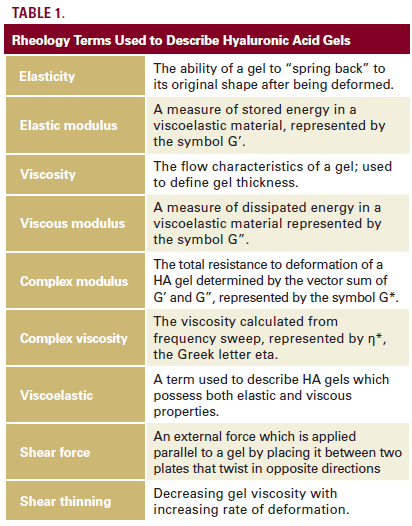
Cross-linked hyaluronic acid fillers are viscoelastic materials, meaning they exhibit both elastic and viscous behavior.
An elastic material tends to recover its original shape after deformation.
A viscous material tends to flow and dissipate energy when force is applied.
HA dermal fillers demonstrate a combination of both characteristics.
When a filler is subjected to mechanical stress, its gel structure may:
Resist deformation
Temporarily change shape
Flow under shear
Recover part of its original structure
Spread within surrounding material
Rheological testing helps quantify these behaviors.
Modern research therefore increasingly evaluates HA fillers as complex engineered hydrogels rather than comparing them only by HA concentration.
Why Does Rheology Matter for HA Fillers?
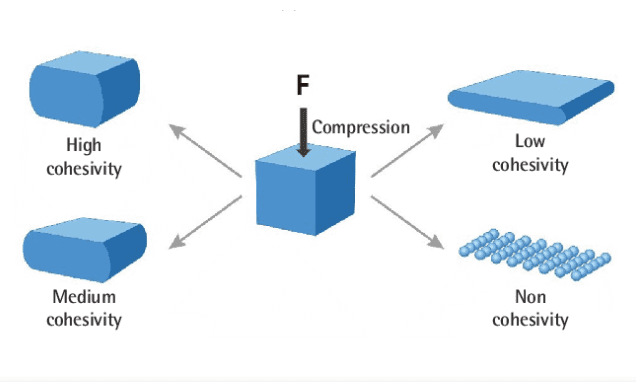
HA fillers are not static materials.
After manufacturing and during use, they may experience multiple types of mechanical force, including:
Shear
Compression
Stretching
Extrusion through a needle or cannula
Movement within surrounding soft tissue
A filler must therefore achieve an appropriate balance between structural resistance and deformability.
A gel that is extremely rigid may have very different handling characteristics from a highly flexible gel.
Likewise, a formulation that flows easily may behave differently from one designed to maintain greater structural integrity.
Rheological parameters provide manufacturers with measurable data that can be used when designing these different product profiles.
Key HA Filler Rheology Parameters
Parameter | Meaning | What It Helps Describe |
|---|---|---|
G′ | Storage or elastic modulus | Elastic resistance to deformation |
G″ | Loss or viscous modulus | Energy dissipated during deformation |
G* | Complex modulus | Overall resistance to deformation |
tan δ | G″ / G′ | Relative balance of viscous and elastic behavior |
η* | Complex viscosity | Resistance to flow under oscillatory testing |
Cohesivity | Internal gel adhesion | Ability of the gel mass to remain integrated |
These parameters are related, but they should not be treated as interchangeable measurements.
Understanding each one separately is important.
What Is G′ in Hyaluronic Acid Fillers?
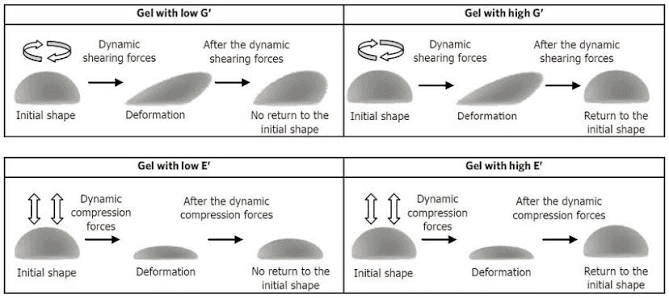
G′, pronounced G prime, is known as the storage modulus or elastic modulus.
It represents the elastic component of a viscoelastic gel.
When force is applied to a material, part of the applied energy can be temporarily stored within its structure. If the material is sufficiently elastic, this stored energy contributes to recovery after the force is removed.
G′ is measured in pascals (Pa).
In simplified terms:
Higher G′ = greater resistance to deformation
Lower G′ = greater softness and deformability
However, this interpretation should not be oversimplified.
G′ is only one characteristic of a filler.
Two products with similar G′ values may still behave differently because of differences in:
Cohesivity
HA concentration
Cross-linking technology
Gel structure
Particle characteristics
Swelling properties
Manufacturing process
Therefore, G′ should be evaluated together with other rheological and physicochemical parameters.
Does Higher G′ Mean Better Filler?
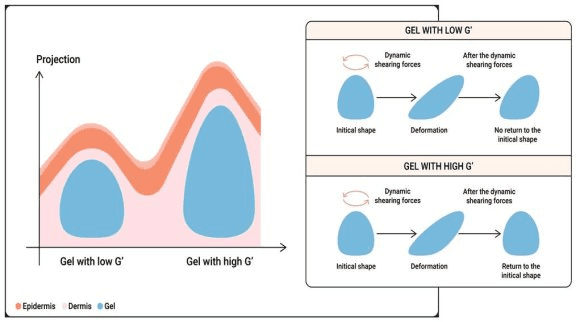
No.
A higher G′ value does not automatically indicate better quality.
Different HA fillers are intentionally engineered to produce different mechanical characteristics.
For example, one product design may prioritize greater structural resistance, while another may emphasize flexibility and adaptability.
The correct rheological profile depends on the intended product design.
A professional manufacturer therefore does not simply attempt to maximize G′.
Instead, the objective is to create a formulation in which elasticity works together with:
Cohesivity
Viscosity
HA concentration
Cross-linking
Gel structure
Extrusion characteristics
This is an important distinction for OEM buyers comparing products.
A higher number on a specification sheet does not automatically mean superior formulation technology.
What Is G″ in HA Fillers?
G″, pronounced G double prime, is the loss modulus or viscous modulus.
It represents the portion of energy dissipated when a material undergoes deformation.
Where G′ describes the elastic component, G″ describes the viscous contribution to the material's viscoelastic behavior.
G″ is also measured in pascals.
In simplified terms:
G′ describes how strongly the gel behaves elastically.
G″ describes how much energy is lost through viscous deformation.
For most cross-linked HA filler gels, G′ is typically greater than G″ under commonly reported oscillatory testing conditions, reflecting predominantly elastic or gel-like behavior.
Is G″ the Same as Viscosity?
No.
This distinction is important.
G″ is sometimes casually described as “viscosity,” but technically it is the loss modulus, not viscosity itself.
Viscosity describes resistance to flow.
G″ describes the viscous component of a material's response during oscillatory deformation.
Related rheological testing may also report *complex viscosity (η)**, which provides additional information about resistance to deformation and flow.
Therefore:
G″ ≠ viscosity
Although the two concepts are related to viscous behavior, they describe different rheological measurements.
For technical product comparisons, manufacturers and buyers should avoid using these terms interchangeably.
What Is G* in Dermal Fillers?
G* is known as the complex modulus.
It combines the elastic contribution represented by G′ and the viscous contribution represented by G″.
It can therefore be viewed as an indicator of the overall resistance of the gel to deformation under the specified test conditions.
Conceptually:
G′ = elastic component
G″ = viscous component
G* = combined viscoelastic response
A higher G* generally indicates that greater force is required to deform the material under the testing conditions.
However, just like G′, G* should not be interpreted independently from the rest of the formulation.
What Is Tan Delta in HA Filler Rheology?
Tan delta, written as tan δ, represents the ratio between G″ and G′.
The relationship is:
tan δ = G″ / G′
It helps describe whether a material behaves more like an elastic solid or a viscous liquid under the tested conditions.
When:
tan δ < 1
elastic behavior dominates.
When:
tan δ > 1
viscous behavior dominates.
Cross-linked HA dermal fillers commonly demonstrate tan δ values below 1 during conventional oscillatory rheological testing, meaning their elastic contribution is greater than their viscous contribution.
A lower tan δ generally indicates stronger elastic dominance.
A higher tan δ indicates a relatively greater viscous contribution.
However, tan δ does not show the actual magnitude of G′ or G″.
For example, two fillers could have similar tan δ values while having substantially different absolute G′ values.
Tan δ should therefore be considered together with G′ and G″.
What Is Viscosity in Hyaluronic Acid Fillers?
Viscosity describes a material's resistance to flow.
A material with high viscosity resists flow more strongly, while a lower-viscosity material flows more easily.
HA filler viscosity can be affected by:
HA concentration
Molecular weight
Cross-linking
Gel structure
Temperature
Applied shear rate
Manufacturing technology
Because cross-linked HA fillers are non-Newtonian viscoelastic materials, their apparent flow behavior may change under different testing conditions.
For this reason, a single viscosity value does not completely characterize an HA filler.
What Is Complex Viscosity?
Complex viscosity, commonly written as η*, is obtained during oscillatory rheological testing.
It reflects the resistance of the viscoelastic gel to deformation under the specified oscillatory conditions.
Complex viscosity can help manufacturers compare different formulations, but the test conditions must be considered.
Factors such as:
Frequency
Temperature
Strain
Rheometer geometry
can affect reported measurements.
This becomes particularly important when comparing technical data from different manufacturers.
What Is Cohesivity in HA Fillers?
Cohesivity describes the internal attraction or adhesion within the HA gel.
In practical terms, it reflects how strongly the gel tends to remain together rather than separating into smaller portions when subjected to force.
A highly cohesive formulation tends to maintain greater gel continuity.
A less cohesive formulation may separate or spread more readily.
Cohesivity is influenced by the formulation and manufacturing process and contributes to the overall behavior of the filler.
However, cohesivity is not simply another name for G′.
A filler can have relatively high elasticity without necessarily having the highest cohesivity.
This is why both properties should be evaluated independently.
How Is HA Filler Cohesivity Measured?
Unlike G′ and G″, cohesivity does not have one universally adopted measurement method.
Different approaches have been developed.
One well-known method involves introducing colored filler gel into moving water and visually evaluating how rapidly the material separates.
Other approaches use mechanical compression or deformation testing.
Because different methodologies can produce different numerical scales, cohesivity values from unrelated testing systems should not always be compared directly.
For B2B buyers, the testing method is therefore just as important as the reported value.
G′ vs Cohesivity: What Is the Difference?
These two properties are frequently confused.
G′ Measures Elastic Resistance
G′ indicates how strongly a gel resists shear deformation and stores energy elastically.
Cohesivity Measures Internal Gel Integrity
Cohesivity describes the forces helping the gel remain together as a continuous mass.
A formulation may therefore demonstrate:
High G′ + high cohesivity
High G′ + lower cohesivity
Lower G′ + high cohesivity
or other combinations.
This is one reason HA filler performance cannot be predicted from a single rheological number.
How Do G′, G″, Viscosity and Cohesivity Work Together?
The behavior of an HA filler results from the interaction of multiple properties.
Consider two hypothetical formulations.
Filler A
Relatively high G′
Strong elastic dominance
High cohesivity
Higher resistance to deformation
Filler B
Lower G′
Greater deformability
Different cohesivity profile
Lower resistance to mechanical deformation
Neither formulation is automatically better.
They represent different material designs.
The goal of formulation development is to create the rheological profile that matches the intended product characteristics.
How Does Cross-Linking Affect HA Filler Rheology?
Cross-linking is one of the major factors influencing rheological behavior.
As discussed in the previous article in this HA series, cross-linkers such as BDDE create connections between HA polymer chains.
The final gel characteristics depend on much more than simply whether BDDE is present.
Manufacturers must control:
Degree of modification
Cross-linking efficiency
Reaction conditions
HA molecular weight
HA concentration
Purification
Post-cross-linking processing
Changes in these parameters can alter G′, G″, viscosity and other gel characteristics.
This explains why two BDDE-cross-linked products can still have substantially different rheological profiles.
Does HA Concentration Determine G′?
Not by itself.
Increasing HA concentration can influence the mechanical properties of a filler, but concentration is only one variable.
A product containing 24 mg/mL HA is not automatically more elastic or structurally resistant than a product containing 20 mg/mL HA.
Other variables include:
Molecular weight
Cross-linking degree
Cross-linker-to-HA ratio
Gel processing
Particle size
Free HA content
Network structure
Therefore, comparisons based solely on “mg/mL” can be misleading.
For B2B sourcing, HA concentration should be reviewed alongside rheological data and manufacturing information.
How Does HA Molecular Weight Affect Rheology?
HA molecular weight influences polymer chain length and interactions within the gel network.
Manufacturers may use different molecular-weight strategies when developing HA formulations.
Depending on the manufacturing technology, these differences can affect:
Gel formation
Cross-linking efficiency
Mechanical properties
Viscosity
Degradation characteristics
Some formulations may also use combinations of HA with different molecular weights.
Again, molecular weight should not be evaluated independently from the complete manufacturing process.
How Do Monophasic and Biphasic Fillers Differ Rheologically?
Monophasic and biphasic fillers may exhibit different rheological profiles because of differences in gel processing and structure.
Monophasic Fillers
Monophasic HA fillers generally feature a more integrated or homogeneous gel network.
Depending on the formulation, they may demonstrate strong cohesivity and smooth gel behavior.
Biphasic Fillers
Traditional biphasic HA fillers contain cross-linked gel particles dispersed within a carrier phase.
Their rheological properties can be affected by:
Particle size
Particle distribution
Cross-linking
Carrier phase
However, it is incorrect to assume that every monophasic filler has lower G′ or that every biphasic filler has higher G′.
Modern manufacturing technologies produce a wide range of rheological profiles within both categories.
The actual test data matter more than the category label alone.
What Is Extrusion Force?
Extrusion force is not the same as G′ or viscosity, although it can be influenced by the material's physical characteristics.
It describes the force required to push a filler through a syringe and needle or cannula system.
Extrusion force can be affected by:
Gel rheology
Syringe geometry
Needle gauge
Needle length
Gel homogeneity
Lubrication
Temperature
Manufacturing consistency
This parameter is particularly relevant during product development because a filler needs to maintain its desired mechanical properties while remaining practical to deliver through its intended injection system.
Why Rheological Data from Different Studies May Not Match
One important issue in HA filler comparison is that rheological measurements are highly dependent on testing conditions.
Published studies have shown that even measurements of the same filler can vary substantially when different rheometer settings and testing protocols are used.
Variables include:
Temperature
Frequency
Strain
Sample preparation
Plate geometry
Gap size
Relaxation period
For example, G′ measured at one frequency should not automatically be compared with G′ reported at another frequency.
Therefore, when comparing suppliers, buyers should ask whether products were tested under the same methodology.
A number without test conditions provides limited information.
Why Manufacturers Use Frequency Sweep Testing
Frequency sweep testing evaluates how the gel behaves when oscillatory deformation is applied at different frequencies.
This can provide information about the stability of the viscoelastic network.
Typical measurements include:
G′
G″
G*
tan δ
If G′ remains above G″ across the tested frequency range, the gel demonstrates predominantly elastic behavior under those experimental conditions.
Frequency sweep testing is commonly used when characterizing cross-linked HA hydrogels.
Why Manufacturers Use Amplitude Sweep Testing
Amplitude sweep testing evaluates a material across increasing levels of deformation.
At sufficiently low deformation, the internal structure remains relatively undisturbed.
This region is called the linear viscoelastic region, or LVER.
Testing within the LVER allows manufacturers to characterize the gel without substantially disrupting its structure.
As strain increases beyond this region, the material can begin to lose structural integrity.
Amplitude sweep testing can therefore provide additional information about gel strength and resistance to deformation.
What Determines the Final Rheological Profile of an HA Filler?
The final rheological behavior is created by the complete formulation and manufacturing process.
Important variables include:
HA Concentration
Changes polymer density within the formulation.
HA Molecular Weight
Affects polymer-chain characteristics and network formation.
Cross-Linking Technology
Controls how HA chains are connected.
Degree of Modification
Influences the structure of the cross-linked network.
Particle Size
Particularly relevant for particulate or biphasic formulations.
Homogenization
Affects consistency and gel structure.
Purification
Must remove process-related residues while maintaining appropriate material characteristics.
Sterilization
Manufacturing and sterilization conditions can also influence polymer integrity and final gel properties.
Therefore, rheology is effectively the result of many interconnected manufacturing decisions.
What Should OEM Buyers Ask About HA Filler Rheology?
Companies sourcing private-label or OEM HA fillers should avoid selecting products only by HA concentration or price.
Useful questions include:
What Is the Product's G′?
Request both the value and the measurement conditions.
What Are the G″ and tan δ Values?
These provide additional information about the balance between elastic and viscous behavior.
How Is Cohesivity Evaluated?
Ask which testing methodology is used.
What Is the Complex Viscosity?
This may provide additional information about resistance to deformation and flow.
What Is the Extrusion Force?
This is relevant when evaluating the complete syringe-and-gel system.
Are Test Methods Consistent Across Product Variants?
Comparable testing methods make it easier to understand differences within a product portfolio.
How Is Batch Consistency Controlled?
Rheological testing can be useful as part of manufacturing quality and consistency evaluation.
Why a Complete Rheological Profile Is Better Than One Number
It is tempting to compare fillers using one simple specification.
For example:
“Product A has higher G′ than Product B.”
But this ignores the rest of the material system.
A more meaningful evaluation considers:
G′
G″
tan δ
viscosity
cohesivity
HA concentration
cross-linking technology
particle structure
extrusion characteristics
Together, these parameters create a more complete picture of how the gel has been engineered.
Aowita's Approach to HA Filler Product Development
Aowita develops hyaluronic acid filler solutions across different HA gel structures.
Its current Rveiling® HA portfolio includes monophasic HA with lidocaine and biphasic HA with lidocaine, alongside other cross-linked HA product configurations.
Aowita also lists cross-linked sodium hyaluronate products designed with different structural and product specifications, allowing its HA portfolio to address different formulation requirements.
For distributors, aesthetic companies and private-label brands, rheological characterization can therefore be considered alongside:
HA formulation
Cross-linking technology
Product specifications
Packaging
Manufacturing capability
OEM/ODM requirements
The objective is not simply to manufacture a filler with the highest possible G′ or HA concentration, but to develop a balanced gel profile for the intended product positioning.
Conclusion
Rheology provides one of the most useful technical frameworks for understanding the differences between hyaluronic acid dermal fillers.
G′ describes elastic behavior.
G″ describes the viscous contribution during deformation.
G* reflects the combined viscoelastic response.
Tan δ describes the balance between elastic and viscous behavior.
Viscosity characterizes resistance to flow.
Cohesivity describes how strongly the gel remains internally integrated.
None of these parameters should be evaluated alone.
The final behavior of an HA filler results from the interaction between formulation design, HA concentration, molecular weight, cross-linking technology, gel processing and other manufacturing variables.
For distributors, aesthetic brands and OEM buyers, understanding this complete rheological profile provides a more technically meaningful way to compare HA fillers and evaluate potential manufacturing partners.
Frequently Asked Questions
What does G′ mean in dermal fillers?
G′ is the storage or elastic modulus. It measures the elastic component of a viscoelastic gel and indicates how strongly the material resists deformation under specified testing conditions.
Is higher G′ always better?
No. Higher G′ indicates greater elastic resistance to deformation, but the appropriate value depends on the complete product design. Cohesivity, viscosity, HA concentration and other properties must also be considered.
What is G″ in HA fillers?
G″ is the loss modulus. It represents the viscous component of the gel's response and the energy dissipated during deformation.
Is G″ the same as viscosity?
No. G″ is the loss modulus, whereas viscosity describes resistance to flow. Complex viscosity is another rheological parameter that may be measured separately.
What is G*?
G* is the complex modulus and reflects the combined elastic and viscous resistance of a material to deformation.
What does tan δ mean?
Tan δ is calculated as G″ divided by G′. It describes the relative balance between viscous and elastic behavior.
What is cohesivity in a dermal filler?
Cohesivity describes the internal forces that help the HA gel remain integrated rather than separating when subjected to deformation.
Is cohesivity the same as elasticity?
No. Elasticity and cohesivity are different characteristics and should be evaluated separately.
Does more cross-linking always increase G′?
Cross-linking can strongly affect mechanical properties, but the relationship is influenced by the overall formulation, degree of modification, HA molecular characteristics and processing technology. More cross-linking should not automatically be interpreted as better performance.
Can two HA fillers with the same HA concentration have different G′ values?
Yes. Products with similar HA concentrations may have very different rheological properties because of differences in molecular weight, cross-linking, gel structure and manufacturing technology.
Can G′ values from different manufacturers be directly compared?
Only with caution. Rheological values are affected by testing conditions such as frequency, strain, temperature and equipment configuration. Comparisons are most meaningful when products are measured using consistent methods.
Other Blogs