Blog
What Are the Cons of Hyaluronic Acid Injections? Risks, Side Effects, Who Should Avoid Them, and What to Expect
Author
Ray
Published
Category
Hyaluronic acid filler
Learn the real downsides of hyaluronic acid fillers, including risks, side effects, who should avoid them, and what to expect after treatment.


Author
Ray
An esteemed medical aesthetics expert with 40 years of profound experience in the field. With decades of expertise in non-invasive procedures, anti-aging science, and advanced dermatological solutions, the author is dedicated to sharing insights that connect clinical innovation with real-world patient results. Passionate about advancing safe, effective, and high-impact aesthetic treatments for a global clientele.
What’s better than insider perks, pro tips, and surprises?
Sign up to get the most recent blog articles in your email every week.
Join now.
Our company’s main product lines include HA (Hyaluronic Acid) fillers, CaHA (Calcium Hydroxylapatite) fillers, PLLA (Poly-L-Lactic Acid) biostimulators, and other advanced aesthetic solutions, all developed and manufactured by trusted partner facilities with whom we have maintained long-term, stable collaborations.
I help them with sales and export operations, while our company also provides sourcing and procurement services in China to help international clients solve supply-related challenges. If you need assistance with procurement, please feel free to contact us.
Hyaluronic acid fillers are popular because they can add volume, soften lines, and deliver immediate cosmetic improvement. But they are not risk-free. The main downsides are that results are temporary, side effects like swelling and bruising are common, and rare but serious complications can happen, including blocked blood vessels, skin injury, and even vision-threatening events if filler is injected into a vessel. The risk is lower when treatment is done by a properly trained medical professional using an FDA-approved filler in an approved area, but “common” does not mean “trivial,” and “minimally invasive” does not mean harmless.
Key Takeaways
Hyaluronic acid fillers are widely used and can be effective, but they have real tradeoffs.
Common short-term side effects include swelling, bruising, tenderness, and redness at the injection site.
More serious complications, while uncommon, include infection, lumps, asymmetry, skin damage, and unintended injection into a blood vessel.
The most concerning filler complication is vascular occlusion, which can reduce blood flow and in severe cases lead to tissue loss or vision loss.
People with certain medical issues, including bleeding disorders or a weakened immune system, may not be good candidates or may need treatment postponed.
Safety depends heavily on injector training, the setting, the product used, and whether the filler is being used in an FDA-approved area.
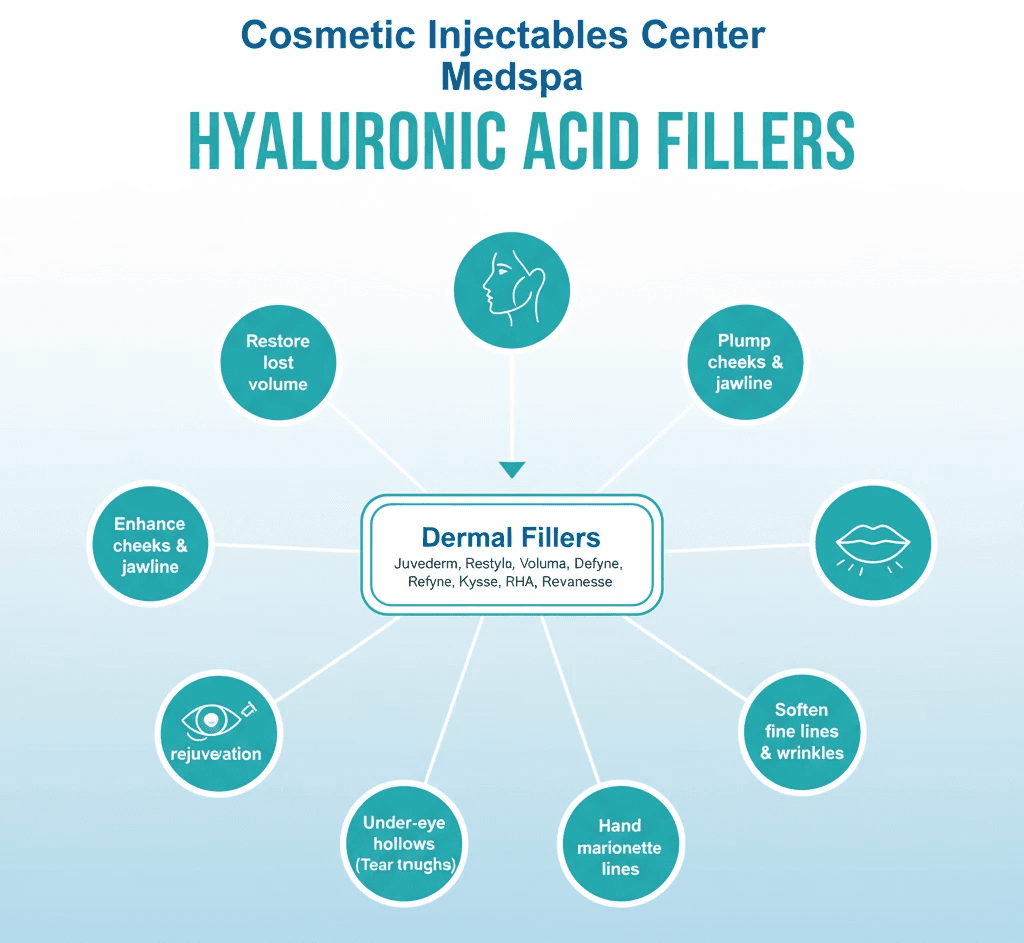
What Hyaluronic Acid Fillers Are
Hyaluronic acid fillers are injectable gels used to restore volume or smooth certain facial areas and, in some products, the backs of the hands. The FDA notes that some hyaluronic acid fillers are chemically modified, often cross-linked, to make them last longer in the body, typically around 6 to 12 months depending on the product and treatment area.
That matters for risk conversations because these are not skincare serums or over-the-counter beauty products. They are medical-device implants placed into tissue. The fact that hyaluronic acid occurs naturally in the body does not remove the risks associated with injection technique, anatomy, product choice, or aftercare.
The Main Downsides of Hyaluronic Acid Fillers
They are temporary
A major downside is maintenance. Hyaluronic acid fillers do not last forever, so patients who like their results often need repeat treatments. For some readers, the issue is not safety first but ongoing cost, upkeep, and the possibility of chasing small corrections over time. Mayo Clinic and the FDA both describe HA fillers as temporary rather than permanent.
Results are technique-dependent
Another downside is variability. Two people can receive the same brand of filler and have very different experiences depending on anatomy, placement depth, injection volume, and injector judgment. A good product does not compensate for poor technique. The AAD and Mayo Clinic both emphasize that proper medical training matters because filler complications depend heavily on who performs the injection and how.
They can look unnatural if overdone or poorly placed
Some patients worry less about safety than aesthetics, and that concern is valid. Fillers can create overfilled areas, ridges, lumps, asymmetry, or a look that does not match the patient’s goals. ASPS lists asymmetry, lumps, palpability, and under- or over-correction among recognized filler risks.

Common Side Effects to Expect
If you are asking about hyaluronic acid filler side effects, the most common short-term issues are usually local and temporary: swelling, redness, tenderness, pain at the injection site, and bruising. The AAD says these minor effects often clear within 7 to 14 days, and the FDA similarly notes that many common side effects resolve within days to weeks.
Featured-snippet-ready short answer:
Common side effects of hyaluronic acid filler include swelling, bruising, redness, tenderness, and temporary discomfort where the filler was injected. These usually improve within days to about two weeks, depending on the area treated and the individual response.
These side effects are common enough that they should be treated as part of the recovery conversation, not as evidence that something has gone wrong. What matters is whether they improve as expected, stay mild, and follow the timeline your injector discussed.
Rare but Serious Risks and Complications
The real answer to what is the downside of hyaluronic acid fillers is not just “you may bruise.” It is that uncommon but significant complications exist.
Infection, lumps, asymmetry, and delayed problems
The FDA and ASPS both note that filler complications can include infection, skin reactions, lumps, palpable product under the skin, delayed swelling, and asymmetry. The FDA also warns that some filler side effects may appear not only soon after treatment but weeks, months, or even years later.
That delayed-complication point is important. A patient who thinks “I was fine for the first week, so I’m in the clear” may not realize that some issues can show up later.
Vascular occlusion, skin injury, and vision loss
This is the complication every serious filler provider should be prepared to recognize and manage. The FDA states that the most concerning risk of dermal fillers is unintended injection into a blood vessel, which can block blood flow. That can cause tissue injury and, depending on the vessel involved, serious damage. Mayo Clinic specifically notes that if filler blocks a vessel leading to the retina, urgent treatment is needed to try to prevent blindness.
Put plainly: the rarest filler risks are also the most important ones to understand before treatment. Even though severe complications are uncommon, they are serious enough that the skill and setting of your injector matter enormously.
Who Should Not Get Hyaluronic Acid Injections, or Should Postpone Them
If your keyword target is who should not get hyaluronic acid injections, the safest editorial answer is to avoid pretending there is one universal exclusion list for every patient and every product. But there are clearly identified groups who may not be good candidates, or who should at least pause and discuss risks carefully with a qualified clinician.
Mayo Clinic says facial fillers are usually not suggested for people with bleeding disorders, a weak immune system, and certain other conditions.
In practical terms, treatment may need to be avoided or postponed if the patient has:
a bleeding disorder or a high bleeding/bruising risk,
an active infection or inflamed skin in the treatment area, [source needed]
a weakened immune system or significant medical factors that make healing or infection control more complicated,
a history of filler complications that changes the risk-benefit balance, [source needed]
unrealistic expectations about what filler can or cannot do.
The AAD also advises patients to tell their dermatologist about medical conditions, medicines and supplements, allergies, prior cosmetic treatments, and a history of cold sores before treatment. That does not mean every one of those factors is a contraindication. It means candidacy should be individualized and medically reviewed.
Why Some Dermatologists Are Cautious About Fillers
The search phrases why do dermatologists not recommend hyaluronic acid and why do some dermatologists not like hyaluronic acid can be misleading. Board-certified dermatologists do use hyaluronic acid fillers. The more accurate issue is that many reputable specialists are selective about when, where, and for whom filler makes sense.
Reasons for caution include:
the procedure is operator-dependent, so bad technique can create bad outcomes,
patients sometimes want filler when they may be better served by a different treatment plan,
overuse can create unnatural proportions,
rare vascular complications require deep anatomical knowledge and rapid response capability.
So the expert concern is usually not “hyaluronic acid is bad.” It is “filler is a medical procedure, and good judgment matters as much as the product.”
What to Expect Before, During, and After Treatment
Most filler appointments are office-based and relatively short. The AAD says many filler treatments take about 15 to 30 minutes in one office visit, though details vary by product, treatment area, and medical history.
Before treatment, a proper consultation should include discussion of your goals, medical history, allergies, prior cosmetic procedures, and current medicines and supplements. AAD and ASPS both stress this step.
During recovery, most people can return to many routine activities quickly, but ASPS notes that intense physical activity is often avoided for the first 24 to 48 hours to reduce swelling and bruising.
If you are wondering about the keyword what should I never mix with hyaluronic acid, that phrase is more commonly used for topical skincare than for fillers. For injectable filler, the more relevant question is what your injector needs to know beforehand. AAD and ASPS both advise disclosing medications, vitamins, herbal supplements, allergies, and prior procedures, because some medicines and supplements can increase bleeding or bruising risk.
FDA patient labeling for a Restylane product also warns that aspirin, NSAIDs, St. John’s Wort, blood thinners, and high-dose vitamin E may increase bruising or bleeding at the injection site. Product-specific instructions vary, so patients should follow the advice for the exact filler being used.
How to Lower Your Risk
The biggest modifiable safety factor is where and by whom you are treated.
The FDA says dermal filler injections should be performed by a licensed health care provider with appropriate training and experience. The AAD says serious side effects are more likely when filler is injected by an inexperienced provider or in a non-medical setting, and advises patients never to get filler in places such as a salon, a home, or a non-medical spa.
A practical safety checklist:
choose a licensed, properly trained medical injector,
confirm the product is FDA-approved and used in an approved area when possible,
disclose your full medical history, allergies, and supplements,
ask about the provider’s experience with the exact area being treated,
know how the office handles emergencies and complications, especially vascular occlusion.
Are Hyaluronic Acid Fillers Safe Overall?
The fairest answer to is hyaluronic acid filler safe is this: they can be safe and effective when used appropriately, but they are not low-stakes beauty products. They are medical procedures with a known side-effect profile and rare but serious complications. FDA-approved fillers have been studied for specific uses, and professional societies describe severe complications as uncommon, but the safety margin depends heavily on the injector, the anatomy, the setting, and the patient.
That is why readers should avoid both extremes: dismissing fillers as inherently dangerous, or assuming that because they are common, they are routine enough to treat casually.
Final Take
The real cons of hyaluronic acid injections are not limited to temporary swelling and bruising. The bigger downsides are that results are temporary, costs can recur, outcomes depend heavily on injector judgment, and rare but severe complications can happen, including blocked blood vessels and vision-threatening injury.
For the right patient, with the right product, in the right hands, hyaluronic acid filler can be a reasonable option. But cautious readers are asking the right question. The smartest next step is not to chase reassurance. It is to get a proper consultation with a qualified medical professional who can evaluate your anatomy, medical history, goals, and risk tolerance before you move forward.
FAQ
1. What are the most common side effects of hyaluronic acid filler?
The most common side effects are swelling, redness, tenderness, bruising, and mild pain or discomfort at the injection site. These often improve within days to about two weeks.
2. What is the biggest risk of hyaluronic acid filler?
The most serious recognized risk is accidental injection into a blood vessel, which can reduce blood flow to tissue and, in rare cases, threaten vision.
3. Who should avoid hyaluronic acid injections?
People with bleeding disorders, a weakened immune system, and certain other medical conditions may not be good candidates. A licensed clinician should review medical history and current medications before treatment.
4. Why do some dermatologists seem cautious about fillers?
The caution is usually about patient selection, injector technique, anatomy, and complication management, not a blanket rejection of hyaluronic acid itself. Fillers are medical procedures, not casual beauty treatments.
5. Are hyaluronic acid fillers reversible?
Many hyaluronic acid fillers can be dissolved with hyaluronidase in appropriate clinical settings, which is one reason HA fillers are often seen as more manageable than some non-HA fillers. Mayo Clinic notes hyaluronidase may be used urgently if retinal blood flow is affected.
6. What should I tell my provider before filler treatment?
Tell them about medical conditions, allergies, previous cosmetic procedures, and all medicines, vitamins, and supplements you take, since some can raise bruising or bleeding risk.
Other Blogs