博客
Do Dermatologists Recommend PDRN? What Current Evidence Really Says
作者
Ray
已发布
类别
设计与灵感
Do dermatologists recommend PDRN? Explore current clinical evidence, physician interest, limitations, and what clinics should verify before using PDRN products.


作者
Ray
一位享有盛誉的医学美学专家,在该领域拥有40年的深厚经验。凭借在非侵入性手术、抗衰老科学以及先进皮肤病学解决方案方面的数十年专业知识,作者致力于分享将临床创新与真实患者成果相结合的见解。热衷于为全球客户推进安全、有效且高影响力的美学治疗。
还有什么比内部优惠、专业建议和惊喜更好的呢?
注册可每周在您的电子邮件中接收最新的博客文章。
立即加入。
Our company’s main product lines include HA (Hyaluronic Acid) fillers, CaHA (Calcium Hydroxylapatite) fillers, PLLA (Poly-L-Lactic Acid) biostimulators, and other advanced aesthetic solutions, all developed and manufactured by trusted partner facilities with whom we have maintained long-term, stable collaborations.
I help them with sales and export operations, while our company also provides sourcing and procurement services in China to help international clients solve supply-related challenges. If you need assistance with procurement, please feel free to contact us.
Introduction
PDRN has moved beyond being a niche ingredient in regenerative skincare and is increasingly discussed in aesthetic medicine and dermatology. But growing popularity does not automatically mean that dermatologists universally recommend it.
The more accurate answer is yes, some dermatologists and aesthetic physicians use or consider PDRN and related polynucleotide treatments for selected applications, but the evidence is still developing. Recent literature supports clinical interest in these treatments, while also pointing to limitations in study quality, treatment protocols, and long-term evidence.
For clinics and professional buyers, this distinction matters. A product being described as “dermatologist recommended” does not establish that every formulation, treatment protocol, or indication has the same level of clinical support.
This article examines why dermatologists are interested in PDRN, what current evidence actually shows, and what clinics should evaluate before adding PDRN-based products to their treatment portfolio.
Do Dermatologists Actually Recommend PDRN?
The Answer Depends on the Clinical Context
There is no universal dermatology recommendation stating that every patient should receive PDRN.
Instead, PDRN is better understood as an emerging treatment category with specific areas of clinical interest. Dermatologists and aesthetic physicians may consider it when the treatment objective involves skin quality, tissue recovery, or regenerative-oriented approaches rather than simply adding structural volume.
Recent expert literature on polynucleotides shows that dermatologists and aesthetic physicians are actively discussing their use in areas including skin hydration and rejuvenation, structural support, barrier-related conditions, and scar remodeling. At the same time, the authors emphasize that the evidence base remains limited and that further randomized and long-term studies are needed.
This is an important distinction for both patients and professional buyers:
Clinical interest does not equal universal recommendation.
What Dermatologists Consider Before Recommending It
A dermatologist evaluating an injectable or regenerative-oriented treatment may consider several factors rather than simply asking whether PDRN is currently popular.
These can include:
The patient's treatment objective
Skin condition and treatment area
Previous aesthetic procedures
Product composition
Intended use
Available clinical evidence
Patient expectations
Potential risks and contraindications
Applicable regulatory requirements
The product itself also matters. “PDRN” describes a class of DNA-derived material, but commercial products can differ in composition, concentration, formulation, manufacturing process, intended use, and regulatory status.
A clinical discussion therefore needs to go beyond the ingredient name.
What Does the Clinical Evidence Say About PDRN?

Recent Research Supports Interest, Not a Universal Standard
The clinical literature surrounding PDRN and related polynucleotides has expanded, but it is not yet comparable to the evidence base available for many long-established dermatological treatments.
A systematic review of polynucleotides in aesthetic medicine identified nine studies involving 219 patients. The review found promising results for outcomes such as wrinkles, skin texture, and elasticity, but rated the included evidence as low to moderate quality and noted substantial variation in treatment areas and techniques. The authors concluded that further high-quality research is needed to establish effectiveness, safety, and optimal use.
That finding gives a more useful answer to the question “Do dermatologists recommend PDRN?” than a simple yes or no.
The evidence suggests potential and growing clinical acceptance, but it does not justify claiming that PDRN is an established solution for every patient or every skin concern.
Newer Reviews Are Looking More Closely at PDRN and PN
Another important development is the increasing effort to distinguish PDRN from polynucleotides (PN) rather than treating the two terms as interchangeable.
A 2025 review describes PDRN and PN as related DNA-derived biopolymers but notes differences in molecular characteristics and proposed biological functions. PDRN is discussed in relation to adenosine A2A receptor activity and nucleotide salvage pathways, while longer PN chains are associated with different structural and tissue-remodeling characteristics.
This distinction is particularly relevant when evaluating clinical claims.
A study involving PN does not automatically provide evidence for every PDRN product. Likewise, evidence for one specific formulation should not automatically be generalized to an entire category of injectable products.
For professional buyers, product-specific evidence is more useful than relying on the ingredient name alone.
Why Are Dermatologists Interested in PDRN?
The growing interest in PDRN and related polynucleotide treatments is not based on a single claimed benefit. Much of the clinical interest comes from the possibility of improving skin quality and tissue condition rather than simply adding volume or changing facial contours.
This gives PDRN-based treatments a different position from conventional volumizing fillers. However, the exact role depends on the formulation, treatment method, and clinical indication.
Interest in Skin Quality Rather Than Facial Volume
Dermatologists may consider regenerative-oriented injectables when the treatment objective is related to skin texture, hydration, elasticity, or overall skin condition.
This is different from using a conventional dermal filler primarily to restore volume or create structural projection.
Recent clinical literature on polynucleotides has reported improvements in measures such as skin elasticity, hydration, texture, and wrinkle appearance in some studies, although results have not been consistent across all research. A 2024 review specifically noted that some studies reported meaningful improvements while others found limited or no benefit, reinforcing the need for further research.
For a dermatologist, that makes PDRN or PN more of a treatment option to evaluate for a particular objective, rather than a universal replacement for established procedures.
Interest in Regenerative-Oriented Treatments
Another reason for clinical interest is the broader movement toward treatments designed to support tissue repair and remodeling.
PDRN and PN are DNA-derived materials, but they should not automatically be treated as identical. A recent review highlights differences in molecular size and proposed biological activity between PDRN and PN, which can affect how their clinical applications are discussed.
This distinction matters when evaluating research. Evidence involving a specific PN formulation should not automatically be presented as proof that every PDRN product produces the same result.
For clinics, the more useful question is therefore not simply “Does PDRN work?” but:
Which product, for which indication, in which patient, and with what level of supporting evidence?
Growing Clinical Experience
Clinical use is another reason the category continues to attract attention.
For example, a survey of 407 physicians who already used polynucleotide treatments for enlarged facial pores found that physicians reported using them across different underlying concerns, including excessive sebum production, reduced elasticity, and acne. The study measured physicians' reported practice patterns and perceived effectiveness; it was not a randomized clinical trial.
A separate survey involving 557 physicians examined the use of polynucleotides for facial erythema. Physicians reported using PN in several clinical contexts, including inflammatory facial dermatoses and recovery following energy-based procedures. Again, these findings describe real-world clinical practice and physician perception, rather than establishing efficacy through controlled trials.
That distinction is important. A treatment being used by a growing number of physicians provides evidence of clinical adoption, but it does not by itself prove that the treatment is superior to established alternatives.
Is PDRN Becoming Part of Dermatology Practice?
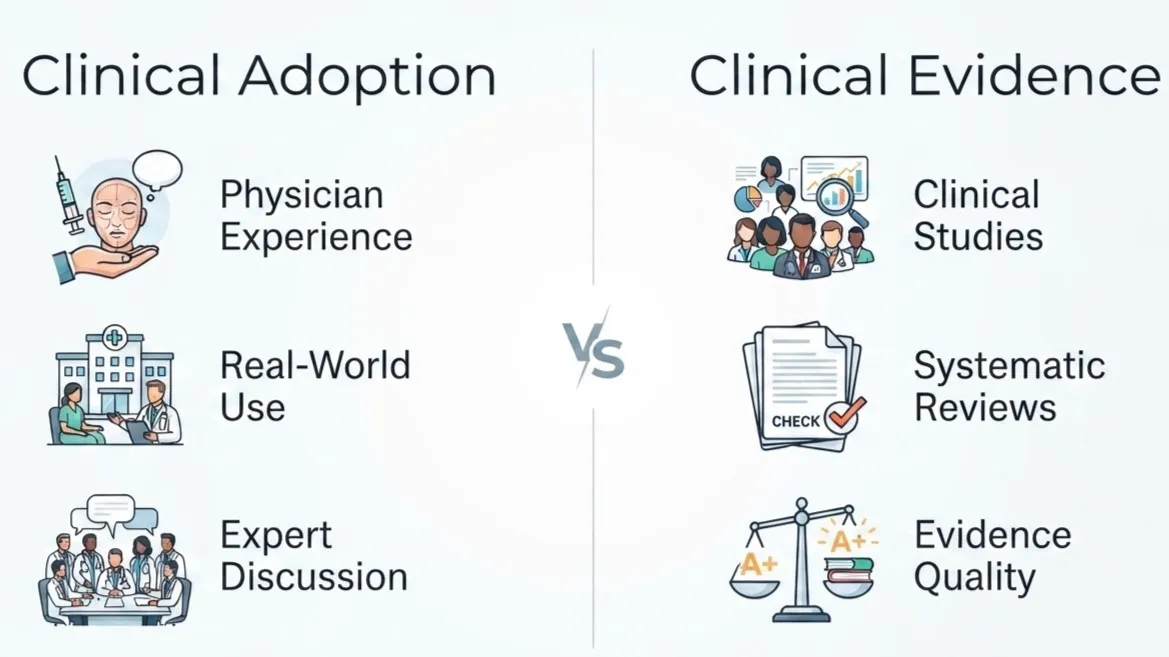
Clinical Adoption Is Not the Same as Universal Recommendation
The available evidence suggests that polynucleotide-based treatments have moved beyond purely theoretical research and are being used by dermatologists and aesthetic physicians in real clinical settings.
A 2026 expert perspective involving dermatologists and aesthetic physicians discussed PN applications in skin rejuvenation, hydration, structural support, barrier-related conditions, and scar remodeling. The authors described PNs as a promising option but also emphasized that the current evidence base remains limited and that randomized studies and further standardization are needed.
A separate 2026 systematic review examined global trends and the available evidence for PN and PDRN therapies in dermatology, further demonstrating that the field is receiving increasing clinical and research attention.
But none of this means that dermatologists have reached a universal consensus that PDRN should be recommended for everyone.
A useful way to interpret the current situation is:
Evidence or Practice Signal | What It Means |
|---|---|
Laboratory or mechanistic research | Suggests how the material may work |
Clinical studies | Provides evidence in specific patient groups and applications |
Physician surveys | Shows how clinicians are using or perceiving the treatment |
Expert consensus | Provides professional guidance based on available evidence and experience |
Systematic reviews | Evaluate the broader body of available research |
Universal clinical recommendation | Requires substantially stronger and more consistent evidence |
These categories should not be treated as interchangeable.
How Expert Consensus Fits Into the Evidence
Expert consensus can be useful when a treatment category is developing faster than high-quality clinical evidence.
An earlier consensus report on highly purified polynucleotides was developed by eight experts with experience in dermatology, plastic surgery, and aesthetic medicine. The group reached recommendations for several treatment areas, including the face, periocular region, neck, décolleté, hands, scalp, and stretch marks.
This type of publication can help clinicians develop practical approaches, but it should still be interpreted as expert guidance rather than definitive proof of efficacy.
That distinction is especially important for professional buyers. A supplier may reference a consensus paper to demonstrate clinical interest in a product category, but buyers should still review the evidence and documentation for the specific product being considered.
What Should Patients and Clinics Take From the Evidence?
The current evidence supports a balanced position.
PDRN and PN-based treatments are no longer simply cosmetic buzzwords. There is a growing body of clinical research, physician experience, expert discussion, and recent systematic review activity surrounding these materials.
At the same time, the evidence does not justify treating PDRN as a universally recommended dermatological treatment.
For patients, the relevant questions are whether the treatment matches their specific concern and whether it is being provided by an appropriately qualified professional.
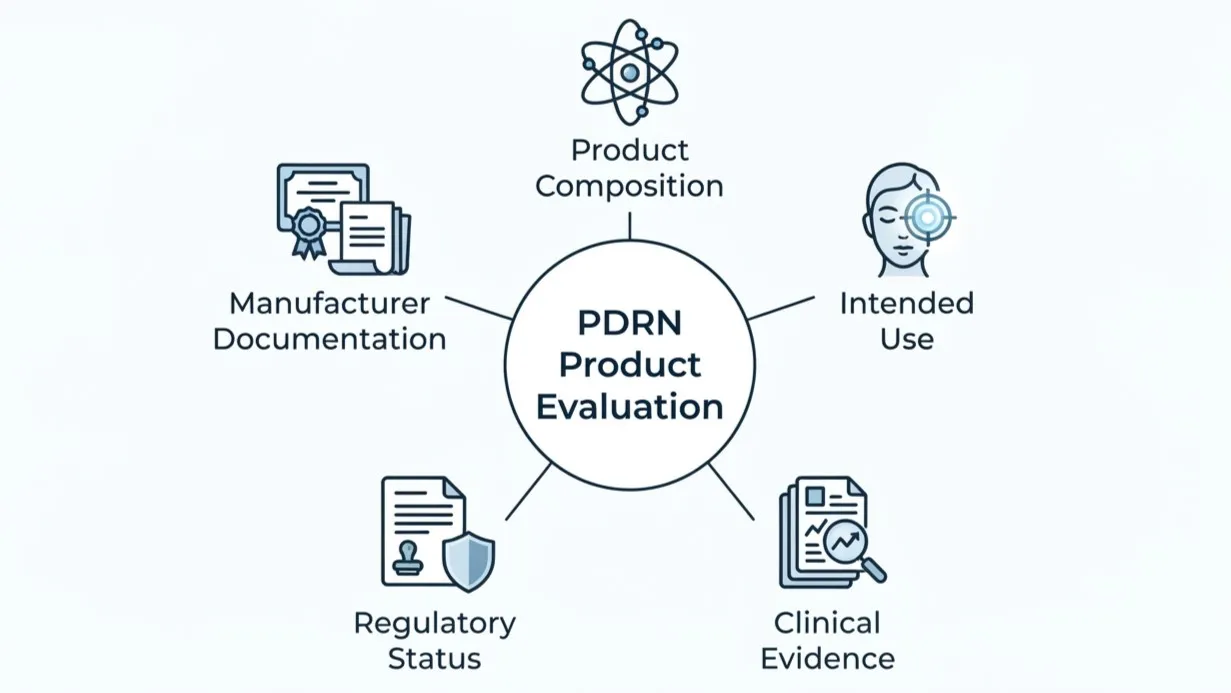
For clinics, the questions extend further:
What exactly is the product?
Is it PDRN, PN, or another DNA-derived formulation?
What is its intended use?
What clinical evidence supports the specific formulation?
What regulatory requirements apply in the target market?
What technical and quality documentation is available?
Does the product have a clear role within the clinic's existing treatment portfolio?
This evidence-first approach helps separate genuine clinical development from marketing momentum.
Frequently Asked Questions
Q1: Is PDRN considered an established dermatological treatment?
PDRN is an established pharmaceutical ingredient in some therapeutic contexts, but its use in aesthetic dermatology is a newer and still developing area. The strength of evidence depends on the specific formulation, route of administration, and indication.
Q2: Do dermatologists use PDRN in everyday clinical practice?
Some dermatologists and aesthetic physicians do use PDRN or related polynucleotide products, particularly in markets where these treatments are established. However, clinical adoption varies by country, product, and treatment indication, so usage should not be interpreted as universal professional endorsement.
Q3: Is PDRN approved for cosmetic use in the United States?
Approval and permitted use depend on the exact product and its regulatory classification. A PDRN ingredient being studied or used in another country does not automatically mean that every PDRN-containing product is FDA-approved for the same use in the United States. Clinics should verify the regulatory status of the specific product and intended application.
Q4: Does dermatologist interest in PDRN mean it is better than traditional treatments?
No. Current evidence does not establish PDRN as universally superior to established dermatological or aesthetic treatments. Its potential value is better considered in relation to a specific treatment objective, patient profile, and available alternatives.
Q5: Are PDRN and PN the same thing?
They are closely related DNA-derived materials, but they are not necessarily identical. Differences in polymer length and molecular characteristics can affect their proposed biological activity and clinical positioning. Product-specific terminology and documentation should therefore be reviewed rather than treating PDRN and PN as interchangeable terms.
Q6: Does a clinical study on one PDRN product apply to all PDRN products?
Not necessarily. Differences in molecular characteristics, concentration, formulation, manufacturing process, route of administration, and treatment protocol can affect how evidence should be interpreted. Buyers should look for evidence and technical information relating to the specific product being evaluated.
Q7: Why do some dermatologists remain cautious about PDRN?
The main issue is not necessarily a lack of promising findings, but the limited quality and consistency of the overall evidence. A 2025 systematic review found promising results from PN studies but also noted that the available studies were generally low to moderate quality and that there was limited consensus regarding optimal use.
Q8: Can PDRN be considered a replacement for dermal fillers?
Not generally. PDRN and conventional volumizing fillers address different treatment objectives. A clinic should select a product according to whether the goal is skin quality, tissue support, hydration, structural volume, or another specific indication rather than assuming that one category can replace another.
Q9: What should a clinic verify before purchasing a PDRN product?
Professional buyers should verify the exact composition, intended use, product specifications, manufacturer information, regulatory status in the target market, quality documentation, storage requirements, lot traceability, and applicable instructions for use. Claims made for one PDRN or PN product should not automatically be applied to another.
Q10: Is PDRN a medical treatment or simply a beauty trend?
It is more accurate to describe PDRN and related polynucleotide therapies as an emerging clinical category with growing research and professional interest, rather than simply calling them a beauty trend. At the same time, the current evidence does not justify treating every PDRN product or aesthetic indication as clinically established. Recent reviews continue to identify both promising findings and important evidence gaps.
Conclusion
So, do dermatologists recommend PDRN?
Some dermatologists and aesthetic physicians do consider or use PDRN and related polynucleotide treatments for selected applications, but there is not enough evidence to describe PDRN as a universally recommended dermatological treatment.
Current research is encouraging, particularly around skin quality and regenerative-oriented applications. However, systematic reviews have also identified limitations in study quality, treatment protocols, and the consistency of available evidence.
For patients, the more useful question is whether PDRN is appropriate for a specific treatment goal and individual situation.
For clinics and professional buyers, the evaluation should go further. The exact product, formulation, intended use, clinical evidence, regulatory status, and manufacturer documentation all need to be considered before adding a PDRN-based product to a treatment portfolio.
PDRN is therefore better viewed as an emerging area of clinical and aesthetic interest, rather than either a proven solution for every skin concern or a trend with no medical basis.
Frequently Asked Questions
Q1: Is PDRN considered an established dermatological treatment?
PDRN is an established pharmaceutical ingredient in some therapeutic contexts, but its use in aesthetic dermatology is a newer and still developing area. The strength of evidence depends on the specific formulation, route of administration, and indication.
Q2: Do dermatologists use PDRN in everyday clinical practice?
Some dermatologists and aesthetic physicians do use PDRN or related polynucleotide products, particularly in markets where these treatments are established. However, clinical adoption varies by country, product, and treatment indication, so usage should not be interpreted as universal professional endorsement.
Q3: Is PDRN approved for cosmetic use in the United States?
Approval and permitted use depend on the exact product and its regulatory classification. A PDRN ingredient being studied or used in another country does not automatically mean that every PDRN-containing product is FDA-approved for the same use in the United States. Clinics should verify the regulatory status of the specific product and intended application.
Q4: Does dermatologist interest in PDRN mean it is better than traditional treatments?
No. Current evidence does not establish PDRN as universally superior to established dermatological or aesthetic treatments. Its potential value is better considered in relation to a specific treatment objective, patient profile, and available alternatives.
Q5: Are PDRN and PN the same thing?
They are closely related DNA-derived materials, but they are not necessarily identical. Differences in polymer length and molecular characteristics can affect their proposed biological activity and clinical positioning. Product-specific terminology and documentation should therefore be reviewed rather than treating PDRN and PN as interchangeable terms.
Q6: Does a clinical study on one PDRN product apply to all PDRN products?
Not necessarily. Differences in molecular characteristics, concentration, formulation, manufacturing process, route of administration, and treatment protocol can affect how evidence should be interpreted. Buyers should look for evidence and technical information relating to the specific product being evaluated.
Q7: Why do some dermatologists remain cautious about PDRN?
The main issue is not necessarily a lack of promising findings, but the limited quality and consistency of the overall evidence. A 2025 systematic review found promising results from PN studies but also noted that the available studies were generally low to moderate quality and that there was limited consensus regarding optimal use.
Q8: Can PDRN be considered a replacement for dermal fillers?
Not generally. PDRN and conventional volumizing fillers address different treatment objectives. A clinic should select a product according to whether the goal is skin quality, tissue support, hydration, structural volume, or another specific indication rather than assuming that one category can replace another.
Q9: What should a clinic verify before purchasing a PDRN product?
Professional buyers should verify the exact composition, intended use, product specifications, manufacturer information, regulatory status in the target market, quality documentation, storage requirements, lot traceability, and applicable instructions for use. Claims made for one PDRN or PN product should not automatically be applied to another.
Q10: Is PDRN a medical treatment or simply a beauty trend?
It is more accurate to describe PDRN and related polynucleotide therapies as an emerging clinical category with growing research and professional interest, rather than simply calling them a beauty trend. At the same time, the current evidence does not justify treating every PDRN product or aesthetic indication as clinically established. Recent reviews continue to identify both promising findings and important evidence gaps.
其他博客