博客
Understanding PLLA-PEG Filler: How This Advanced Biostimulator Redefines Natural Anti-Aging
作者
Ray
已发布
类别
PLLA-PEG Filler
Discover how PLLA-PEG fillers redefine anti-aging. Learn the science behind this advanced biostimulator that restores natural collagen for long-lasting results.


作者
Ray
一位享有盛誉的医学美学专家,在该领域拥有40年的深厚经验。凭借在非侵入性手术、抗衰老科学以及先进皮肤病学解决方案方面的数十年专业知识,作者致力于分享将临床创新与真实患者成果相结合的见解。热衷于为全球客户推进安全、有效且高影响力的美学治疗。
还有什么比内部优惠、专业建议和惊喜更好的呢?
注册可每周在您的电子邮件中接收最新的博客文章。
立即加入。
Our company’s main product lines include HA (Hyaluronic Acid) fillers, CaHA (Calcium Hydroxylapatite) fillers, PLLA (Poly-L-Lactic Acid) biostimulators, and other advanced aesthetic solutions, all developed and manufactured by trusted partner facilities with whom we have maintained long-term, stable collaborations.
I help them with sales and export operations, while our company also provides sourcing and procurement services in China to help international clients solve supply-related challenges. If you need assistance with procurement, please feel free to contact us.
The world of aesthetic medicine is undergoing a massive paradigm shift. For the past two decades, the industry was dominated by Hyaluronic Acid (HA) fillers. While HA is excellent for immediate, localized volumization (like plumping lips or contouring a jawline), patients and practitioners are increasingly moving away from the "over-filled" or "pillow-face" look.
Today, the ultimate goal in aesthetics is not just to artificially fill wrinkles, but to regenerate the skin from within. Patients want to look like themselves—just ten years younger.
Enter the era of the Biostimulator, with PLLA-PEG (Poly-L-Lactic Acid + Polyethylene Glycol) leading the charge as the most advanced, scientifically backed formulation on the market today.
But what exactly is PLLA-PEG, how does it differ from older treatments, and why is it rapidly becoming the gold standard for natural facial rejuvenation? Let’s break down the science.
The Shift: From "Filling" to "Regenerating"
As we age, starting in our mid-20s, our bodies lose about 1% of our natural collagen every year. By the time we reach our 40s and 50s, this depletion results in structural volume loss, skin laxity (sagging), and the formation of deep folds.
Traditional HA fillers work by physically occupying space beneath the skin to smooth out these folds. They are temporary "implants."
Biostimulators like PLLA-PEG work fundamentally differently. Rather than just taking up space, they act as cellular messengers. They are injected deep into the dermis or subcutaneous layer, where they wake up the body’s own fibroblasts—the cells responsible for producing structural proteins—forcing the body to generate its own fresh, natural Type I and Type III collagen.
The result? The volume that plumps your skin is your own tissue, not a synthetic gel.
What is PLLA? (The Core Engine)
Poly-L-Lactic Acid (PLLA) is a biocompatible, biodegradable, synthetic polymer. If that sounds intimidating, it shouldn't be. The medical field has used PLLA for decades in dissolvable sutures (stitches) and orthopedic implants.
When PLLA is manufactured into microscopic, perfectly spherical particles and injected into the face, the body recognizes it. It triggers a mild, perfectly controlled sub-clinical inflammatory response. Over the course of several weeks, macrophages surround the PLLA particles, and fibroblasts are recruited to the area to lay down new collagen networks.
Eventually, the PLLA is safely broken down into water and carbon dioxide and naturally eliminated by the body, leaving behind a robust network of newly formed, natural collagen that can last for 18 to 24 months (and often longer).
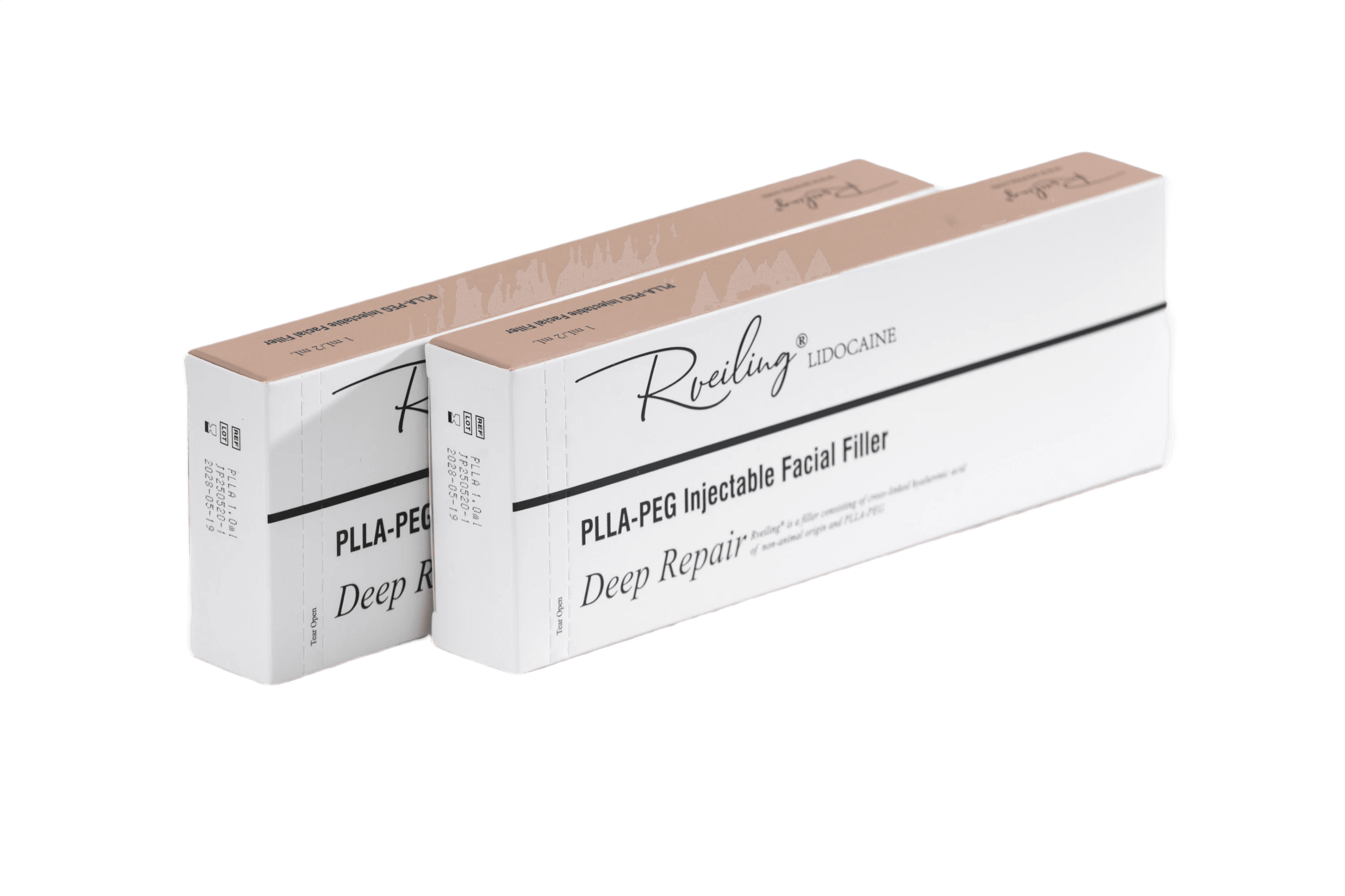
The Problem with First-Generation PLLA
If PLLA is so great, why hasn't it always been the number one treatment?
First-generation PLLA fillers (which have been on the market for years) relied on older suspension agents like Carboxymethylcellulose (CMC). While effective, they presented frustrating clinical challenges for doctors:
Long Reconstitution Times: Older PLLA came as a powder that had to be mixed with sterile water and left to sit for anywhere from 2 hours to 2 days before it could be injected.
Clogging Needles: The PLLA particles had a tendency to clump together, frequently clogging the doctor's needle mid-injection.
Risk of Nodules: Because the particles clumped easily, if the product was not injected perfectly, it could form small, palpable lumps under the skin (granulomas).
The industry needed a solution that kept the incredible collagen-stimulating power of PLLA but eliminated the clumping and safety risks.
Enter PEG: The Game-Changing Matrix
The major breakthrough in modern biostimulators is the addition of Polyethylene Glycol (PEG).
PEG is a highly hydrophilic (water-loving) and biocompatible compound. In the new generation of PLLA-PEG fillers, the PEG acts as a sophisticated hydration matrix. It coats the individual PLLA microspheres, acting like a microscopic shield.
How PEG Revolutionizes the Treatment:
Zero Clumping: Because PEG coats the particles, they physically cannot stick together. This ensures a perfectly smooth, uniform suspension.
Instant Reconstitution: PLLA-PEG fillers do not need to sit overnight. A practitioner can add sterile water, gently swirl the vial, and the product is ready to inject in under 3 to 5 minutes.
Superior Safety Profile: Because the microspheres are evenly distributed and do not aggregate, the risk of subcutaneous nodules or granulomas is dramatically reduced, making it one of the safest biostimulators on the market.
Smoother Injection: The PEG matrix allows the product to flow effortlessly through thin needles and cannulas, resulting in a much more comfortable experience for the patient and precise control for the injector.
PLLA-PEG vs. Traditional HA Fillers
To truly understand the value of PLLA-PEG, it helps to compare it to standard Hyaluronic Acid fillers.
Feature | HA Fillers (Hyaluronic Acid) | PLLA-PEG Biostimulators |
|---|---|---|
Mechanism | Physically fills space with a gel. | Stimulates your body to grow its own collagen. |
Results Timeline | Immediate. What you see is what you get. | Gradual. Results peak at 3 to 6 months. |
Longevity | 6 to 12 months (typically). | 18 to 24+ months. |
Best Used For | Lips, under-eyes, sharp jawlines, instant fixes. | Global facial volume loss, hollow temples/cheeks, skin laxity, crepey skin. |
The "Look" | Can look "puffy" if overused. | 100% natural. The skin simply looks thicker and tighter. |
The Patient Journey: What to Expect
One of the most important things to understand about PLLA-PEG is that patience is required. This is not a "quick fix" for a wedding happening next weekend; it is a long-term investment in your skin’s biological age.
The Day of Treatment: The product is mixed with Lidocaine (numbing agent) and sterile water. You will look immediately plumped—but this is mostly the water and PEG matrix.
The "Waiting Phase" (Days 3-10): The water is absorbed by your body, and your face may look like it did before the treatment. This is normal! The PLLA seeds have been planted.
The Activation Phase (Weeks 4-8): Your fibroblasts are working in overdrive. You will begin to notice your skin feeling firmer, thicker, and more elastic. Hollow areas will subtly begin to lift.
The Peak (Months 3-6): This is when the magic fully reveals itself. Your body has replaced the PLLA with a durable, structural collagen network. The results look completely natural because they are natural.
(Note: Depending on age and volume loss, most patients require a series of 2 to 3 sessions spaced 4-6 weeks apart for optimal results).
Who is the Ideal Candidate for PLLA-PEG?
PLLA-PEG is highly versatile, but it is particularly transformative for:
Patients in their 30s to 60s who are noticing global facial sagging, hollowing in the cheeks or temples, and deep nasolabial folds.
Athletes or runners who have experienced "runner's face" (severe facial fat loss due to high cardio).
Patients seeking subtle, untraceable results. If you do not want anyone to know you "had work done," but simply want to look rested and youthful, biostimulation is the answer.
Those looking for longevity. If you are tired of returning to the clinic every 6-8 months for HA filler touch-ups, PLLA-PEG offers a structural foundation that lasts years.
The Future is Regenerative
Aesthetic medicine has finally moved past the era of chasing wrinkles with artificial gels. By combining the proven, powerful collagen-stimulating capabilities of Poly-L-Lactic Acid with the safety, smoothness, and hydration of a Polyethylene Glycol matrix, science has created the ultimate anti-aging tool.
PLLA-PEG filler doesn't just change how you look; it changes how your skin behaves. It turns back the biological clock, forcing your cells to act young again, resulting in a firm, lifted, and naturally radiant complexion that stands the test of time.
Frequently Asked Questions (FAQs)
Q1: What is the main difference between PLLA-PEG and traditional first-generation PLLA fillers?
Traditional PLLA fillers used older suspension agents that required hours or days to mix and were prone to clumping, which could cause needle blockages or under-skin lumps (nodules). PLLA-PEG uses Polyethylene Glycol (PEG) as a hydration matrix. This coats the PLLA particles, preventing them from clumping, allowing for instant mixing (under 5 minutes), smoother injections, and a drastically reduced risk of nodules.
Q2: How long does it take to see results from a PLLA-PEG treatment?
Unlike Hyaluronic Acid (HA) fillers that provide instant volume, PLLA-PEG is a biostimulator. You will see an initial plumpness from the water used during injection, which subsides in a few days. The real, collagen-building results begin to appear around weeks 4 to 6, with peak results showing at months 3 to 6 as your body generates its own natural collagen networks.
Q3: How long do the results of PLLA-PEG last?
Because the treatment forces your body to create its own living tissue (Type I and Type III collagen), the results are highly durable. Most patients enjoy the lifting and firming effects for 18 to 24 months, and sometimes even longer.
Q4: Can PLLA-PEG filler be dissolved like Hyaluronic Acid (HA) filler?
No. Unlike HA fillers, which can be instantly melted away using an enzyme called hyaluronidase, PLLA-PEG cannot be dissolved. However, because it stimulates your body to grow its own natural collagen rather than leaving a synthetic gel in your face, the results look entirely natural and integrate seamlessly into your tissue.
Q5: Is PLLA-PEG safe? Will it cause lumps in my face?
PLLA has been used safely in medicine for decades. The risk of granulomas (lumps) was primarily associated with older, first-generation PLLA formulations that were mixed or injected improperly. The innovative PEG matrix in modern PLLA-PEG fillers is specifically designed to keep the microspheres perfectly separated and evenly distributed, making it one of the safest biostimulators available today when injected by a qualified professional.
Q6: Can I use PLLA-PEG and Hyaluronic Acid (HA) fillers at the same time?
Yes! Many advanced aesthetic practitioners use a "hybrid" approach. They will use PLLA-PEG deep in the cheeks, temples, or jawline to build a long-term structural foundation and stimulate collagen, while using small amounts of HA filler in areas that need immediate, precise detailing, such as the lips or under-eyes.
Q7: Is there any downtime after a PLLA-PEG injection?
Downtime is minimal. You may experience mild swelling, bruising, or tenderness at the injection sites for a few days, similar to any other injectable treatment. Practitioners usually advise patients to gently massage the treated areas for a few days post-treatment (often referred to as the "5-5-5 rule": 5 minutes, 5 times a day, for 5 days) to ensure the biostimulator is perfectly distributed.
Q8: How many treatment sessions will I need?
While some patients see great results after one session, most practitioners recommend a series of 2 to 3 treatments spaced 4 to 6 weeks apart for optimal, full-face rejuvenation. This allows the collagen-building process to layer and compound for the best structural lift.
其他博客


