博客
What Is PLLA-PEG Filler and How Does It Work?
作者
Ray
已发布
类别
PLLA-PEG Filler
What PLLA-PEG filler is, how it works, how long it may last, and how it compares with HA fillers for facial volume restoration.

作者
Ray
一位享有盛誉的医学美学专家,在该领域拥有40年的深厚经验。凭借在非侵入性手术、抗衰老科学以及先进皮肤病学解决方案方面的数十年专业知识,作者致力于分享将临床创新与真实患者成果相结合的见解。热衷于为全球客户推进安全、有效且高影响力的美学治疗。
还有什么比内部优惠、专业建议和惊喜更好的呢?
注册可每周在您的电子邮件中接收最新的博客文章。
立即加入。
Our company’s main product lines include HA (Hyaluronic Acid) fillers, CaHA (Calcium Hydroxylapatite) fillers, PLLA (Poly-L-Lactic Acid) biostimulators, and other advanced aesthetic solutions, all developed and manufactured by trusted partner facilities with whom we have maintained long-term, stable collaborations.
I help them with sales and export operations, while our company also provides sourcing and procurement services in China to help international clients solve supply-related challenges. If you need assistance with procurement, please feel free to contact us.
PLLA-PEG filler is a collagen-stimulating aesthetic filler designed to support gradual volume restoration and tissue improvement rather than functioning only as a traditional space-filling gel. In simple terms, it works by combining the biostimulatory role of PLLA with the structural advantages of PEG-based formulation, making it relevant for buyers and clinics looking beyond standard hyaluronic acid filler options. Unlike HA fillers, which are usually discussed in terms of immediate filling effect, PLLA-PEG filler is often positioned around collagen support, progressive improvement, and longer-term aesthetic planning.
Key Takeaways
PLLA-PEG filler is typically understood as a biostimulatory filler rather than a conventional filler focused only on instant volume.
Its working principle is tied to collagen stimulation and gradual tissue support.
It is often considered for facial volume loss, especially in areas where structural support and progressive improvement matter.
PLLA-PEG filler is not the same as a standard HA filler; the two categories differ in treatment logic, expected effect profile, and decision-making criteria.
For buyers and distributors, manufacturer quality, positioning, documentation, and OEM capability matter as much as the product concept itself.
The best educational angle is not “which filler is best overall,” but which filler type fits the intended clinical or market need.
What Is PLLA-PEG Filler?
PLLA-PEG filler is an injectable aesthetic product category built around poly-L-lactic acid (PLLA) and polyethylene glycol (PEG). In practical market language, it is usually discussed as a collagen-stimulating filler or biostimulatory filler, meaning the product is associated with gradual improvement rather than only immediate filling.
That distinction is important because many readers approach fillers through the lens of hyaluronic acid. HA fillers are widely known, easy to categorize, and often described in terms of instant contouring or line correction. PLLA-PEG filler belongs to a different conversation. It is better understood as part of a broader shift toward products that support collagen regeneration, volume restoration, and longer-horizon facial rejuvenation planning.
A concise definition would be:
PLLA-PEG filler is a biostimulatory aesthetic injectable designed to support collagen-related tissue improvement and gradual volume restoration.
That definition is more useful than simply calling it a “filler,” because it explains why the product is evaluated differently from conventional dermal fillers.
How PLLA-PEG Filler Works
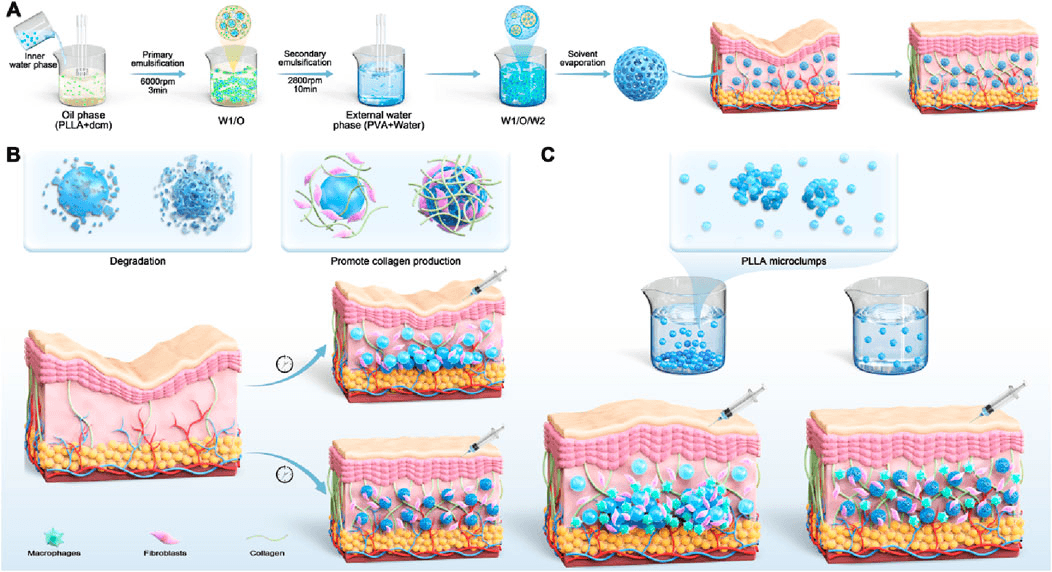
The role of PLLA
PLLA is the part most closely associated with biostimulation. In aesthetic discussions, it is linked to the body’s natural collagen response and is therefore positioned differently from fillers whose main purpose is to occupy space immediately. In commercial and educational content, this is why PLLA-based products are often described as helping support the skin and soft tissue over time rather than merely creating an instant plumping effect.
The role of PEG
PEG contributes to the formulation system and product handling logic. From a content strategy perspective, the practical point is not to overstate chemistry details without documentation, but to explain that the PLLA-PEG format is presented as a more advanced collagen-supporting filler category, not a generic injectable. That makes it especially useful in product education aimed at distributors, buyers, and clinic decision-makers.
Why collagen stimulation matters
Collagen matters because many aesthetic concerns are not only about superficial filling. Facial aging often includes broader volume loss, structural softening, and tissue support decline. A collagen-stimulating filler is relevant in these contexts because the goal is often more than quick correction. It is about building a treatment approach around progressive improvement.
That is one of the clearest ways to understand how PLLA-PEG filler works: it is positioned to support the tissue over time rather than acting only as a passive filling material.
How PLLA-PEG Filler Differs from Traditional HA Fillers
This is one of the most important sections for search intent satisfaction because many readers will be comparing PLLA-PEG filler with hyaluronic acid filler, even when they do not phrase the query that way.
Immediate volume vs gradual improvement
HA fillers are commonly understood in terms of visible filling, contouring, and correction after injection. PLLA-PEG filler is more often framed around a gradual result profile linked to collagen support. That difference affects both buyer expectations and how clinics discuss outcomes.
Biostimulation vs space-filling
A traditional HA filler is often categorized as a space-filling material. A PLLA-PEG filler is more accurately categorized as a biostimulatory filler. That does not mean one is better in every situation. It means the product logic is different.
One addresses needs where immediate shaping or correction may be the priority. The other fits scenarios where volume restoration, tissue support, and longer-view rejuvenation are central to the treatment concept.
Treatment planning differences
Because the products behave differently as categories, they are often selected differently. A buyer choosing between HA and PLLA-PEG should not ask only, “Which is better?” A better question is, “Which product category aligns with the target use case, market position, and practitioner preference?”
That framing is more useful for clinics, distributors, and OEM buyers alike.
What PLLA-PEG Filler Is Commonly Used For
Based on your wider Aowita product direction, PLLA-PEG filler is best discussed in relation to facial volume loss and collagen-related rejuvenation needs.
Facial volume loss
One of the most relevant use scenarios is facial volume depletion over time. This is where a collagen-stimulating filler becomes strategically different from a standard filler. The goal is not only to fill a line or add spot volume, but to support a broader restoration approach.
Cheeks and temples
Products in this category are often associated with areas where structure and soft-tissue support matter, especially the cheeks and temples. Those areas frequently appear in discussions around volume restoration and age-related hollowing.
Skin support and contour refinement
PLLA-PEG filler can also be framed as part of a treatment plan focused on overall support and refinement, rather than only dramatic contour changes. That is often the more credible and useful way to explain its role.
Benefits of PLLA-PEG Filler
A strong educational article should avoid overstated medical claims, but it can still explain the category’s appeal clearly.
The main perceived benefits of PLLA-PEG filler include:
a collagen-stimulating treatment concept rather than simple filling
a fit for gradual volume restoration
relevance for buyers seeking biostimulatory filler options
stronger differentiation versus standard HA-only portfolios
usefulness in clinic and distributor education because it tells a different treatment story
From a brand-content perspective, one of the biggest benefits is positioning. PLLA-PEG filler helps a company speak not only about “filling,” but also about regeneration-oriented aesthetic strategy.
How Long Does PLLA-PEG Filler Last?
Readers often ask this question early, but it should be answered carefully.
The most responsible answer is that duration depends on formulation, treatment plan, indication, practitioner technique, and individual response. Because your uploaded brief does not provide a fixed duration claim, it would be inappropriate to invent one.
What can be said credibly is this:
PLLA-PEG filler is usually discussed in the market as a longer-horizon treatment category compared with purely immediate fillers.
Its value proposition is tied more to progressive support and collagen-related improvement than to a single instant result moment.
Any exact longevity statement should come from product-specific technical documentation or approved brand positioning. [source needed]
That is a more trustworthy answer than forcing a number into the article.
Who May Consider PLLA-PEG Filler?
PLLA-PEG filler is most relevant for readers and buyers who are not simply looking for a generic filler product.
It may be considered by:
distributors building a more complete aesthetic injectable portfolio
clinic buyers comparing HA fillers vs collagen-stimulating fillers
private-label buyers who want a more differentiated injectable category
aesthetic professionals interested in volume restoration-oriented product positioning
brands looking to expand from standard filler offerings into higher-value treatment narratives
This is why the topic matters commercially: it sits at the intersection of product education and portfolio strategy.
What Buyers Should Know Before Choosing PLLA-PEG Filler
This is where a strong B2B article can outperform generic filler explainers.
1. Product format
Buyers should first clarify what format they are evaluating. Aesthetic products may come in injectable or powder-based presentations, and that affects sourcing, positioning, and education. In a product family strategy, format is not a detail. It shapes how the product is discussed and sold.
2. Use scenario
A buyer should ask what role this product is intended to play:
facial volume restoration
collagen-support positioning
premium rejuvenation category
differentiation from standard HA filler lines
The clearer the use scenario, the stronger the sourcing decision.
3. Manufacturer quality and OEM support
For B2B decision-makers, product concept alone is not enough. Manufacturer quality systems, documentation, packaging capability, formula positioning, and OEM or private-label support can all shape whether the product is commercially viable.
4. Documentation and positioning
A good supplier should help the buyer understand not only the product itself, but how to position it correctly in the market. A biostimulatory filler needs the right educational framing. If it is marketed like a basic HA filler, the product story becomes weaker.
PLLA-PEG Filler vs HA Filler: Which One Is Better?
This is the wrong question if asked in absolute terms.
A better answer is:
HA filler may be more suitable when the main need is immediate filling, contouring, or familiar market acceptance.
PLLA-PEG filler may be more suitable when the focus is collagen-support positioning, gradual improvement, and portfolio differentiation.
So the choice is not really about which product is universally superior. It is about matching the filler category to the treatment philosophy, buyer intent, and market segment.
That is the kind of nuance generic articles often miss.
Common Questions and Misunderstandings
One common misunderstanding is that every injectable filler works in the same way. It does not.
Another is that collagen-stimulating fillers should be judged only by instant visible effect. That can lead to a poor comparison framework.
A third is that “better” always means “longer-lasting.” In practice, product choice usually depends on a mix of treatment objective, handling preference, commercial positioning, and user expectation.
The most useful educational takeaway is this: PLLA-PEG filler belongs to a different decision category from basic filler comparisons.
Conclusion
PLLA-PEG filler is best understood as a biostimulatory, collagen-supporting filler category rather than just another injectable for instant filling. That is the key to understanding how it works and why it matters. Its value lies in gradual volume restoration, collagen-related tissue support, and differentiation from conventional HA-based filling strategies.
For Aowita, this topic is strategically strong because it supports both education and conversion. It helps readers understand the product itself, but it also helps buyers think more clearly about portfolio building, supplier selection, and treatment-category positioning. A strong PLLA-PEG article should therefore do more than define the product. It should explain the logic behind choosing it.
Reference Sources
2024 Systematic Review: Efficacy and Safety of Poly-L-Lactic Acid in Facial Aesthetics
FAQ about PLLA-PEG Filler
1. What is PLLA-PEG filler?
PLLA-PEG filler is a collagen-stimulating, biostimulatory aesthetic filler positioned for gradual volume restoration and tissue-support improvement rather than only immediate filling.
2. How does PLLA-PEG filler work?
It works through a treatment logic centered on collagen stimulation and progressive support, which is why it is commonly discussed differently from standard HA fillers.
3. Is PLLA-PEG filler the same as hyaluronic acid filler?
No. HA filler is generally discussed as a more immediate space-filling category, while PLLA-PEG filler is positioned as a biostimulatory filler with a different treatment rationale.
4. What is PLLA-PEG filler used for?
It is commonly associated with facial volume loss, tissue support, and collagen-related rejuvenation positioning, especially in treatment concepts focused on progressive improvement.
5. How long does PLLA-PEG filler last?
Exact duration depends on the specific product, treatment protocol, and user response. The uploaded brief does not provide a fixed longevity claim, so product-specific documentation should be used for precise statements.
6. What should buyers look for before sourcing PLLA-PEG filler?
They should review the product format, intended use scenario, supplier quality systems, OEM support, technical documentation, and how clearly the product is positioned in the market.
其他博客