博客
Cross-Linked vs Non-Cross-Linked Hyaluronic Acid: What Is the Difference?
作者
Ray
已发布
类别
设计与灵感
Compare cross-linked vs non-cross-linked hyaluronic acid, including structure, degradation, rheology, applications, manufacturing and how professional buyers evaluate HA products.

作者
Ray
一位享有盛誉的医学美学专家,在该领域拥有40年的深厚经验。凭借在非侵入性手术、抗衰老科学以及先进皮肤病学解决方案方面的数十年专业知识,作者致力于分享将临床创新与真实患者成果相结合的见解。热衷于为全球客户推进安全、有效且高影响力的美学治疗。
还有什么比内部优惠、专业建议和惊喜更好的呢?
注册可每周在您的电子邮件中接收最新的博客文章。
立即加入。
Our company’s main product lines include HA (Hyaluronic Acid) fillers, CaHA (Calcium Hydroxylapatite) fillers, PLLA (Poly-L-Lactic Acid) biostimulators, and other advanced aesthetic solutions, all developed and manufactured by trusted partner facilities with whom we have maintained long-term, stable collaborations.
I help them with sales and export operations, while our company also provides sourcing and procurement services in China to help international clients solve supply-related challenges. If you need assistance with procurement, please feel free to contact us.
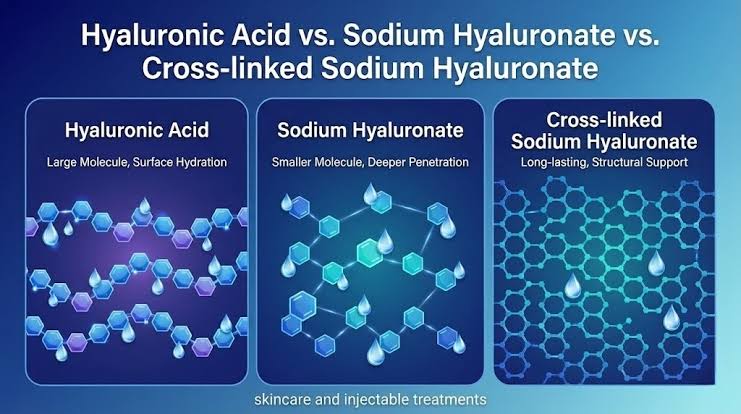
Hyaluronic acid is used across skincare, injectable skin-quality products and dermal fillers, but the term “hyaluronic acid” alone tells us relatively little about how a finished product will behave.
One of the most important distinctions is whether the HA is cross-linked or non-cross-linked.
Non-cross-linked hyaluronic acid largely retains its linear polymer structure and is comparatively susceptible to enzymatic and oxidative degradation. Cross-linked HA contains connections between HA chains that create a three-dimensional network, making it possible to produce more stable viscoelastic gels with greater resistance to deformation and degradation.
This difference is one of the foundations of modern HA dermal filler technology.
However, cross-linked HA should not simply be considered “better” HA. Cross-linked and non-cross-linked formulations have different material characteristics, and the appropriate technology depends on the intended product design, formulation and professional application.
For aesthetic brands, distributors and OEM buyers, understanding these differences is important when evaluating HA raw materials, skin-quality products and injectable dermal filler systems.
What Is Hyaluronic Acid?
Hyaluronic acid (HA) is a naturally occurring glycosaminoglycan found throughout the extracellular matrix of human tissues.
Its molecular structure consists of repeating units of glucuronic acid and N-acetylglucosamine arranged in long polymer chains.
HA is strongly hydrophilic, meaning it interacts extensively with water. This contributes to its important biological roles in tissue hydration, lubrication and extracellular-matrix organization.
Because of these characteristics, HA is widely used in:
Topical skincare
Ophthalmic products
Orthopedic applications
Wound-care products
Injectable skin-quality formulations
Dermal fillers
However, HA used in these different product categories is not necessarily the same material.
Molecular weight, concentration, cross-linking, formulation and manufacturing conditions can all change how HA behaves.
What Is Non-Cross-Linked Hyaluronic Acid?
Non-cross-linked hyaluronic acid consists predominantly of HA polymer chains that have not been chemically connected into a permanent three-dimensional network.
It may also be described as:
Uncross-linked HA
Linear HA
Free HA
Soluble HA
depending on the formulation and technical context.
Because the chains remain comparatively mobile, non-cross-linked HA generally behaves more like a viscous polymer solution than a highly structured elastic gel.
Key Characteristics of Non-Cross-Linked HA
Non-cross-linked HA typically demonstrates:
High hydrophilicity
Good water interaction
Greater molecular mobility
Lower structural support
Lower resistance to deformation
Faster biological degradation
Research on injectable HA materials has shown that native or uncross-linked HA is rapidly degraded by endogenous hyaluronidase and oxidative processes, limiting its ability to maintain long-term structural volume. [1]
This is one reason conventional volumizing HA dermal fillers are generally based on cross-linked HA rather than purely linear HA.
What Is Cross-Linked Hyaluronic Acid?
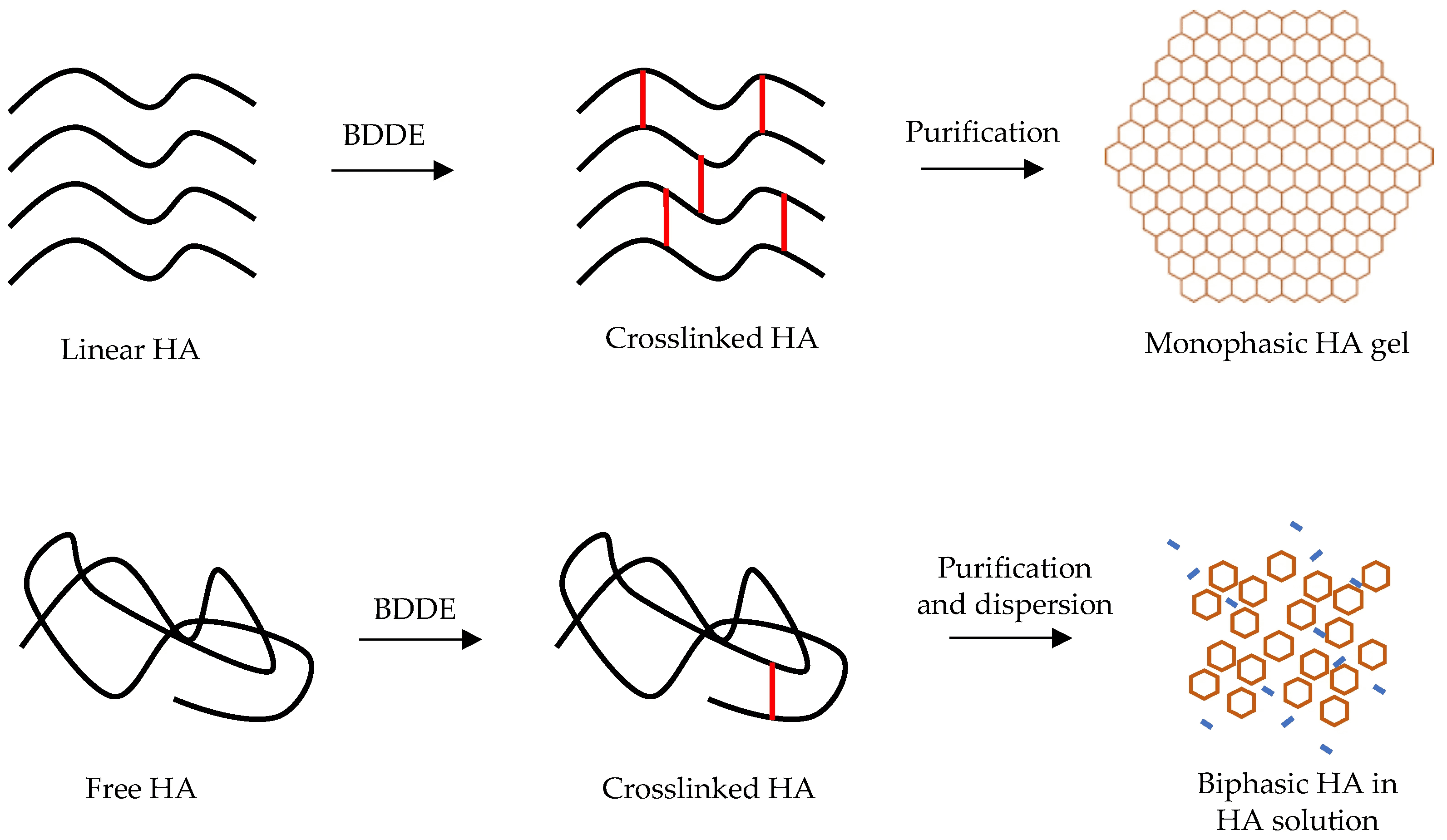
Cross-linked hyaluronic acid is created by forming connections between HA polymer chains.
Instead of existing primarily as independent linear molecules, the chains become connected into a three-dimensional network.
This network transforms HA from a relatively mobile polymer solution into a more structured hydrogel.
Cross-linking can increase:
Resistance to enzymatic degradation
Gel stability
Elastic properties
Viscoelastic behavior
Shape retention
Residence time
Cross-linked HA therefore forms the technological foundation of many injectable dermal fillers. [2]
However, the characteristics of a cross-linked filler depend on much more than whether cross-linking occurred.
Manufacturing parameters such as cross-linking efficiency, HA molecular weight, HA concentration, homogenization and post-cross-linking processing strongly influence the final gel.
Cross-Linked vs Non-Cross-Linked HA: Key Differences
Property | Cross-Linked HA | Non-Cross-Linked HA |
|---|---|---|
Molecular Structure | HA chains connected into a network | Predominantly linear/free HA chains |
Physical Form | Structured hydrogel | More solution-like or fluid |
Degradation Resistance | Generally higher | Generally lower |
Residence Time | Typically longer | Typically shorter |
Elasticity | Can provide measurable elastic gel behavior | Usually much lower structural elasticity |
Structural Support | Can be engineered for support and projection | Limited structural support |
Flow Behavior | Depends on cross-linking and rheology | Generally more mobile |
Typical Role | Dermal fillers and structured HA gels | Hydration-oriented or soluble HA applications |
Manufacturing Complexity | Higher | Lower |
Cross-Linker Required | Usually yes for chemical cross-linking | No |
These are broad differences rather than universal rules.
A lightly cross-linked HA gel may behave very differently from a highly cross-linked volumizing filler, and modern skin-quality products may contain both cross-linked and non-cross-linked HA components.
Why Is Non-Cross-Linked HA Degraded More Quickly?
The body naturally contains enzymes capable of breaking down hyaluronic acid.
One of the most important groups is hyaluronidases, which cleave the glycosidic bonds of the HA backbone.
Reactive oxygen species can also contribute to HA degradation.
Non-cross-linked HA provides relatively accessible polymer chains and is therefore cleared relatively quickly in vivo.
A recent review of HA filler degradation concluded that uncross-linked HA undergoes rapid degradation, while cross-linked HA generally demonstrates greater resistance to enzymatic breakdown. [1]
This difference is critical when HA is intended to provide persistent structural support.
How Does Cross-Linking Slow HA Degradation?
Cross-linking does not make HA permanently non-degradable.
Instead, it alters the physical architecture of the polymer network.
The cross-linked structure can restrict access and movement of degrading enzymes through the gel and increase the resistance of the material to breakdown.
Cross-linked HA can still undergo:
Enzymatic degradation
Oxidative degradation
Hydrolytic processes
but the degradation process is generally slower than for non-cross-linked HA.
Importantly, the HA backbone itself remains susceptible to hyaluronidase even after common forms of cross-linking. [3]
This is one of the properties that distinguishes HA-based fillers from many non-HA permanent or semipermanent filler materials.
How Is Hyaluronic Acid Cross-Linked?
Several cross-linking strategies have been studied, but one of the most established cross-linkers used in commercial dermal filler manufacturing is BDDE — 1,4-butanediol diglycidyl ether.
BDDE contains reactive groups capable of forming covalent connections between HA chains.
The manufacturing process can be simplified as:
HA hydration
→
controlled cross-linking reaction
→
three-dimensional HA network formation
→
purification
→
gel processing
→
filling and final product manufacturing
Parameters such as:
pH
Temperature
Reaction time
HA molecular weight
HA concentration
Cross-linker concentration
can influence cross-linking efficiency and final gel characteristics.
BDDE remains one of the most widely studied cross-linkers for commercial HA filler technology. [4]
What Is the Difference Between Cross-Linking Degree and Modification Degree?
These terms are sometimes used incorrectly as if they were identical.
They are not.
Degree of Modification
Degree of modification describes the proportion of HA disaccharide units that have been chemically modified by bound cross-linker.
This can include cross-linker molecules connected to HA at only one end as well as molecules forming complete bridges.
Degree of Cross-Linking
Degree of cross-linking more specifically describes cross-linker molecules that successfully form bridges between HA chains.
This distinction matters because simply increasing the amount of cross-linker used in manufacturing does not necessarily create an equally large increase in effective cross-linking.
Manufacturing efficiency matters.
For professional product evaluation, the effectiveness of the network can therefore be more meaningful than the quantity of cross-linker initially introduced.
Does More Cross-Linking Mean Better HA?
No.
This is one of the most important misconceptions surrounding HA filler technology.
Increasing cross-linking can increase resistance to degradation and influence gel strength, but excessive cross-linking can also change:
Stiffness
Flexibility
Swelling behavior
Tissue integration
Injectability
Rheological properties
Research evaluating HA filler properties shows that increasing cross-linking can increase gel rigidity and persistence, while simultaneously affecting hydrophilicity and other physicochemical characteristics. [2]
The objective of filler development is therefore not maximum cross-linking.
It is optimized cross-linking.
The ideal network depends on the intended characteristics of the final product.
How Does Cross-Linking Affect Rheology?
Rheology describes how a material flows and deforms under mechanical force.
This is one of the major technical differences between non-cross-linked HA solutions and structured cross-linked HA fillers.
Important rheological properties include:
G′ — Storage Modulus
G′ describes the elastic component of the gel and its resistance to deformation.
Cross-linking can contribute to higher G′ by strengthening the HA network.
G″ — Loss Modulus
G″ describes the viscous component of the gel's response during deformation.
Complex Modulus — G*
G* combines elastic and viscous components and provides information about overall resistance to deformation.
Complex Viscosity
Complex viscosity provides another measure of a gel's resistance to deformation or flow under specified rheological conditions.
Cohesivity
Cohesivity describes the internal forces helping a gel remain integrated.
Cross-linking can strongly influence these characteristics, but rheology also depends on HA concentration, molecular weight and manufacturing technology. [5]
Therefore:
Cross-linked does not automatically mean high G′.
A manufacturer can engineer different cross-linked gels with significantly different rheological properties.
Cross-Linked vs Non-Cross-Linked HA for Structural Support
One of the clearest differences between these technologies is their ability to provide persistent mechanical support.
Pure non-cross-linked HA does not normally provide the structural resistance required for conventional volumizing dermal fillers.
Cross-linked HA can be engineered into gels capable of:
Maintaining volume
Resisting deformation
Providing projection
Supporting contour
Maintaining gel structure over a longer period
For this reason, conventional HA dermal fillers commonly use cross-linked HA.
The exact properties required depend on the intended product design.
A filler developed for stronger structural support should not necessarily have the same rheological profile as a softer product designed for a more flexible tissue environment.
Cross-Linked vs Non-Cross-Linked HA for Skin-Quality Products
The distinction becomes more nuanced in skin-quality applications.
Non-cross-linked HA has been used in injectable formulations intended primarily to improve hydration and skin characteristics rather than provide significant structural volume.
Because it is less structurally persistent, its effect profile differs from conventional cross-linked fillers.
However, it would be inaccurate to state that all skin boosters are non-cross-linked.
Modern skin-quality products may contain:
Non-cross-linked HA
Lightly cross-linked HA
Small-particle cross-linked HA
Hybrid HA technologies
A contemporary review of injectable skin boosters notes that both cross-linked and non-cross-linked HA technologies have been used for skin-quality applications. [6]
Therefore, product classification should be based on the actual formulation rather than marketing terminology alone.
Is Non-Cross-Linked HA the Same as a Skin Booster?
No.
“Non-cross-linked HA” describes the physical or chemical state of the HA.
“Skin booster” describes a product category or treatment concept.
They are not equivalent terms.
Some skin-quality products use non-cross-linked HA, while others use lightly cross-linked or specially engineered cross-linked HA gels.
Professional buyers should examine the actual composition and product specification instead of assuming that every skin booster contains the same type of HA.
Is Cross-Linked HA the Same as Dermal Filler?
Not always, although cross-linked HA is widely used in dermal fillers.
“Cross-linked HA” describes the material.
“Dermal filler” describes an intended product category.
Different cross-linked HA gels can be engineered for different purposes.
Product behavior depends on:
HA concentration
HA molecular weight
Cross-linking technology
Rheology
Particle characteristics
Syringe system
Intended use
Therefore, cross-linking is one important part of filler design rather than the complete product definition.
Cross-Linked HA vs Free HA in Dermal Fillers
An important detail is that some commercial HA fillers contain both cross-linked and soluble or non-cross-linked HA.
The soluble HA fraction may be incorporated to modify gel processing or extrusion characteristics.
Therefore, describing a filler simply as “cross-linked HA” does not necessarily mean every HA molecule inside the formulation is cross-linked.
The balance between cross-linked gel and soluble HA can influence:
Rheology
Extrusion
Water uptake
Gel behavior
This is another reason technical evaluation should go beyond headline HA concentration.
Does Higher HA Concentration Mean More Cross-Linking?
No.
HA concentration and cross-linking are separate parameters.
For example, two products may both contain:
20 mg/mL HA
yet have very different:
Cross-linking degrees
Elasticity
Cohesivity
Viscosity
Particle structure
Degradation profiles
HA concentration tells a buyer how much HA is present.
It does not explain how the polymer network has been engineered.
This is why professional HA filler comparison requires more than simply comparing mg/mL.
What Does Cross-Linking Mean for Filler Manufacturing?
Cross-linking introduces additional manufacturing complexity.
A professional HA filler production process may need to control:
HA Raw Material
Including:
Source
Molecular weight
Purity
Microbial quality
Cross-Linking Reaction
Including:
Cross-linker ratio
Temperature
pH
Reaction time
Purification
Residual process-related substances must be appropriately controlled.
Gel Processing
The gel may undergo:
Homogenization
Particle processing
Sieving
Addition of soluble HA
Buffer adjustment
depending on the product platform.
Rheological Characterization
Testing may evaluate:
G′
G″
G*
Complex viscosity
Cohesivity
Finished Product Testing
Quality systems may also include appropriate:
Sterility controls
Physicochemical testing
Stability evaluation
Extrusion testing
Batch consistency verification
Manufacturing quality is therefore just as important as the basic cross-linking concept.
Cross-Linked vs Non-Cross-Linked HA for B2B Buyers
For distributors, aesthetic brands and OEM customers, the most useful question is usually not:
“Which one is better?”
Instead, ask:
“Which HA technology matches the intended product?”
For a Structural HA Filler
Evaluate:
Cross-linking technology
HA concentration
G′
Cohesivity
Viscosity
Degradation resistance
Extrusion characteristics
For a Skin-Quality Product
Evaluate:
HA molecular weight
HA concentration
Cross-linking status
Rheological profile
Intended delivery method
Product positioning
For Private Label Development
Also consider:
Syringe volume
Lidocaine requirements
Packaging
Product range architecture
Regulatory documentation
Manufacturing quality systems
A professional HA supplier should be able to explain why a particular formulation was engineered for a particular product category.
Aowita Cross-Linked Hyaluronic Acid Manufacturing
Aowita develops cross-linked sodium hyaluronate gel and HA dermal filler products for professional aesthetic markets.
Its Rveiling® HA portfolio includes multiple HA gel configurations designed around different structural requirements.
Aowita's current cross-linked HA products emphasize controlled gel structure, cohesivity, shape retention and different product specifications for professional aesthetic applications.
For brands and distributors seeking OEM or private-label HA products, product development can involve consideration of:
HA formulation
Cross-linking technology
Rheological characteristics
Syringe specification
Lidocaine options
Packaging
Brand customization
Manufacturing documentation
The objective should not be to create the “most cross-linked” HA filler.
It should be to create the appropriate HA gel architecture for the intended product positioning.
Conclusion
The difference between cross-linked and non-cross-linked hyaluronic acid begins at the molecular level but ultimately influences almost every aspect of product behavior.
Non-cross-linked HA consists predominantly of relatively mobile polymer chains and is generally degraded more rapidly.
Cross-linking connects HA chains into a three-dimensional network, creating a more stable viscoelastic gel that can provide greater resistance to degradation and mechanical deformation.
This makes cross-linked HA particularly important in dermal filler manufacturing.
However, cross-linking is not a simple quality score.
More cross-linking does not automatically mean a better product, and non-cross-linked HA should not be considered an inferior material.
The appropriate technology depends on the intended formulation.
For professional brands, distributors and OEM buyers, the most meaningful evaluation combines:
Cross-linking technology
HA concentration
Molecular weight
Rheological properties
Degradation characteristics
Manufacturing quality
Intended product application
Understanding these factors provides a much stronger foundation for evaluating HA products than comparing concentration or cross-linking status alone.
References
1. Hong GW, et al. Decomposition and Changes in In Vivo Post-HA Filler Injection: A Review. The review reports rapid degradation of uncross-linked HA and greater persistence of cross-linked HA.
2. Fundarò SP, et al. The Rheology and Physicochemical Characteristics of Hyaluronic Acid Fillers: Their Clinical Implications. Reviews cross-linking, degree of modification, rheology, hydrophilicity and degradation resistance.
3. De Boulle K, et al. A Review of the Metabolism of 1,4-Butanediol Diglycidyl Ether-Crosslinked Hyaluronic Acid Dermal Fillers. Describes enzymatic and oxidative degradation of both cross-linked and uncross-linked HA.
4. Tezel A, Fredrickson GH. Review literature on cross-linking chemistry and BDDE-cross-linked HA filler metabolism and manufacturing. BDDE remains an extensively studied cross-linker in commercial HA fillers.
5. Pierre S, et al. Rheologic and Physicochemical Characteristics of Hyaluronic Acid Fillers: Overview and Relationship to Product Performance. Reviews the relationship among cross-linking, HA concentration, G′, G″ and other filler properties.
6. Injectable “Skin Boosters” in Aging Skin Rejuvenation: A Current Overview. Reviews both cross-linked and non-cross-linked HA technologies used in skin-quality treatments.
Frequently Asked Questions
What is the main difference between cross-linked and non-cross-linked hyaluronic acid?
Cross-linked HA contains connections between polymer chains that form a three-dimensional gel network. Non-cross-linked HA remains predominantly linear and more mobile. Cross-linking generally increases structural stability and resistance to degradation.
Does cross-linked HA last longer than non-cross-linked HA?
Generally, yes. Cross-linking makes the HA network more resistant to degradation, which usually increases its persistence compared with uncross-linked HA. Actual duration depends on the complete formulation, product design and biological environment.
Is cross-linked HA better than non-cross-linked HA?
Not universally. They serve different formulation goals. Cross-linked HA is particularly useful when persistent viscoelastic structure is required, while non-cross-linked HA can be appropriate in products where hydration and greater molecular mobility are more important.
Is all dermal filler HA cross-linked?
Most conventional volumizing HA dermal fillers use cross-linked HA because native HA degrades too rapidly and provides insufficient structural persistence. Individual formulations may also contain soluble or non-cross-linked HA.
Is non-cross-linked HA used in skin boosters?
Yes, some skin-quality injectable products use non-cross-linked HA. However, skin boosters may also contain lightly cross-linked or otherwise engineered HA, so the terms should not be treated as synonyms.
Does higher cross-linking mean a filler will last longer?
Greater effective cross-linking can increase resistance to degradation, but duration also depends on HA concentration, molecular weight, network efficiency, rheological properties, injection environment and other formulation variables.
Does higher cross-linking mean higher G′?
Cross-linking can influence G′, but there is no simple universal relationship across different manufacturers and technologies. HA concentration, molecular weight, processing and network architecture also influence G′.
What is BDDE?
BDDE, or 1,4-butanediol diglycidyl ether, is an established chemical cross-linker used in many commercial HA dermal filler technologies.
Can cross-linked HA still be degraded by hyaluronidase?
Yes. Cross-linking slows degradation but does not completely prevent it. Hyaluronidase can still cleave the HA backbone.
Can two cross-linked HA fillers behave differently?
Yes. Two products may both be cross-linked but demonstrate substantially different G′, cohesivity, viscosity, swelling and extrusion characteristics because of differences in formulation and manufacturing technology.
其他博客