博客
Cross-Linked vs Non-Cross-Linked Hyaluronic Acid: What Most People Get Wrong
作者
Ray
已发布
类别
设计与灵感
When choosing hyaluronic acid products or cosmetic procedures, many people only look at the "concentration" and "brand," but overlook a more crucial concept— cross-linked and non-cross-linked hyaluronic acid . Different types of hyaluronic acid determine whether it is more suitable for filling and shaping, or for hydration, moisturizing and overall skin management.

作者
Ray
一位享有盛誉的医学美学专家,在该领域拥有40年的深厚经验。凭借在非侵入性手术、抗衰老科学以及先进皮肤病学解决方案方面的数十年专业知识,作者致力于分享将临床创新与真实患者成果相结合的见解。热衷于为全球客户推进安全、有效且高影响力的美学治疗。
还有什么比内部优惠、专业建议和惊喜更好的呢?
注册可每周在您的电子邮件中接收最新的博客文章。
立即加入。
Our company’s main product lines include HA (Hyaluronic Acid) fillers, CaHA (Calcium Hydroxylapatite) fillers, PLLA (Poly-L-Lactic Acid) biostimulators, and other advanced aesthetic solutions, all developed and manufactured by trusted partner facilities with whom we have maintained long-term, stable collaborations.
I help them with sales and export operations, while our company also provides sourcing and procurement services in China to help international clients solve supply-related challenges. If you need assistance with procurement, please feel free to contact us.
1.What is hyaluronic acid?
Hyaluronic acid (HA) is a natural polysaccharide widely found in human skin, joints, and eyes, and has a strong water-absorbing capacity.
One gram of hyaluronic acid can theoretically absorb about 1,000 times its own weight in water, so it is widely used in skin care products, injectable fillers, and various medical aesthetic procedures.
Main functions: moisturizing, increasing skin elasticity, and filling in depressions.
Common forms: topical hyaluronic acid in skincare products, and cross-linked/non-cross-linked hyaluronic acid products for injection.

2.What is cross-linked hyaluronic acid?
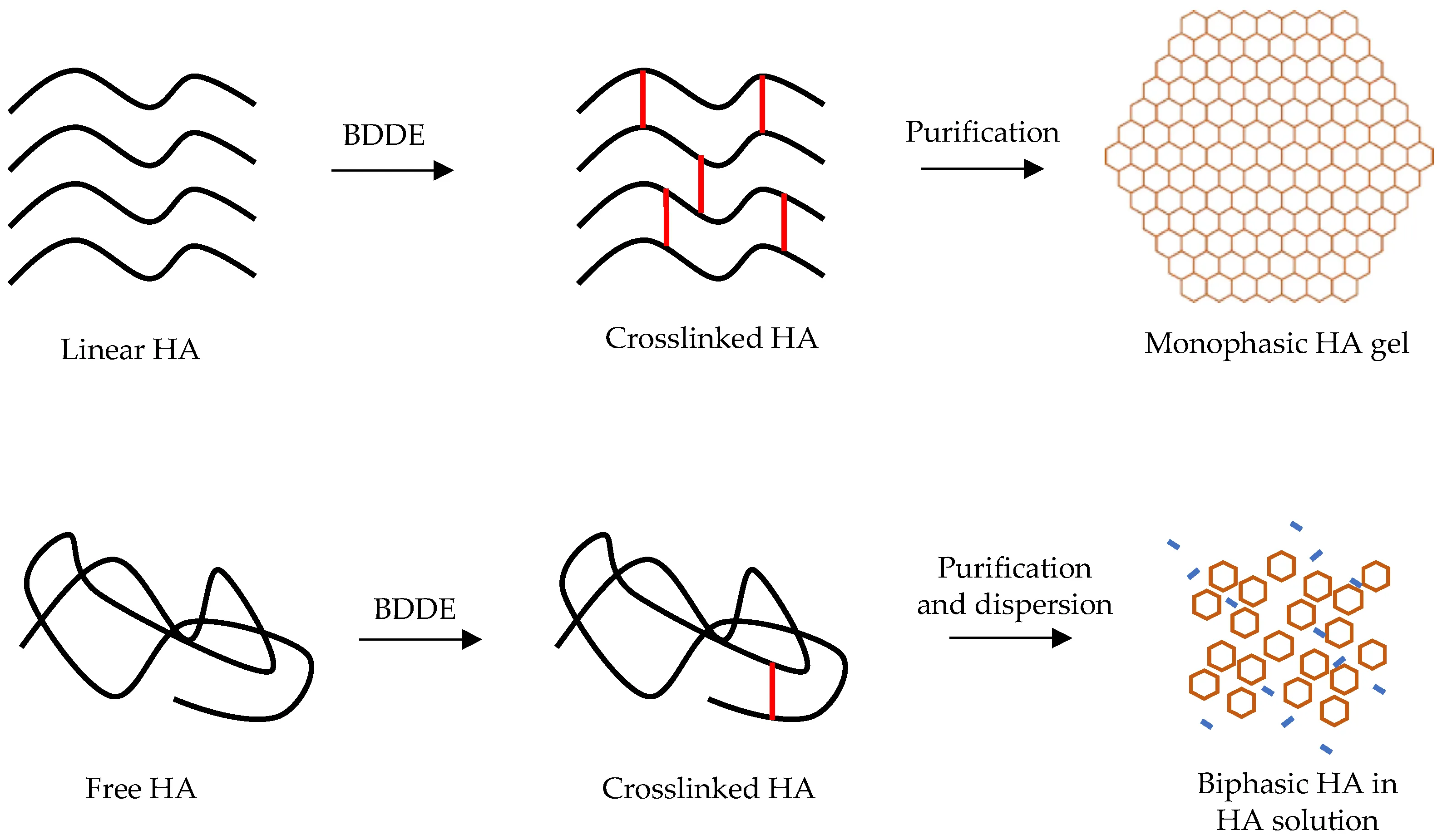
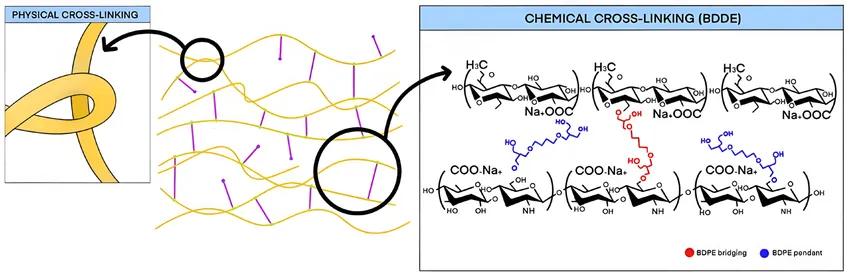
Cross-linked hyaluronic acid is a form of hyaluronic acid that uses chemical cross-linking agents to connect the originally loose hyaluronic acid molecular chains into a three-dimensional network structure, making it more robust and resistant to decomposition.
Structural features
The molecules form a stable network, providing greater "support".
Durability
Generally more resistant to degradation than non-crosslinked hyaluronic acid, and the effect can last for several months or even more than a year (depending on the product and the individual).
Application scenarios:
Facial contouring (such as chin, bridge of the nose, cheekbones, etc.)
Parts that require a certain amount of "support" and "shaping"
For office workers who want to have a "lunchtime micro-plastic surgery" in big cities like Tokyo, cross-linked hyaluronic acid is often used to quickly improve facial contours and make the face more three-dimensional.
3.What is non-crosslinked hyaluronic acid?
Non-crosslinked hyaluronic acid is closer to its "natural state," with fewer crosslinking agents connecting the molecular chains, resulting in a more "fluid" and softer texture.
Structural features
low viscosity and good fluidity, more like an upgraded version of "high moisturizing serum".
Duration
It is metabolized faster in the body, and its duration is generally shorter than that of cross-linked hyaluronic acid.
Application scenarios:
Hyaluronic acid injections, moisturizing injections
Overall skin texture improvement (fine lines, dryness, dullness)
Helps improve skin's radiance and smoothness.
If you spend long hours in air-conditioned environments or commute frequently in cities with pronounced dry seasons, non-crosslinked hyaluronic acid treatments are more suitable for "skin maintenance" than for sculpting.
4.Cross-linked vs. Non-cross-linked: Key Differences at a Glance
The table below summarizes the key differences between cross-linked and non-cross-linked hyaluronic acid, making it easy to quickly compare products or treatments.
Dimension | Cross-linked hyaluronic acid | Non-Cross-Linked Hyaluronic Acid |
|---|---|---|
Molecular structure | Molecular chains are linked into a network by cross-linking agents, which provides greater support. | Its structure is close to that of nature, its molecular chains are relatively loose, and it has strong fluidity. |
texture | Thick and well-formed, suitable for "supporting" tissues. | Lightweight and water-like, making it more suitable for diffused distribution. |
Endurance | The effects generally last longer, up to several months or more, depending on the product. | It metabolizes quickly and has a relatively short duration of effect. |
Applicable parts | Areas requiring shaping: bridge of the nose, chin, jawline, cheekbones, etc. | Areas needing overall hydration: cheeks, forehead, and superficial skin around the eyes, etc. |
Main purpose | Fill, shape, and improve deep depressions or creases | Hydrates, reduces fine lines, improves skin texture and radiance |
Common Projects | Filler injections and contouring procedures | Hydration injections, moisturizing injections, and skin condition management treatments |
Price range (example) | Typically, the price is high per session, involving high-support products and doctor's skills. | The price is highly flexible per service, making it suitable for periodic maintenance. |
5.Why is it that more "crosslinking" is not necessarily better?
Many people believe that the higher the cross-linking, the better, but this is not entirely true.
The higher the cross-linking, the "harder" the product is usually, making it more suitable for support, but not for delicate areas or superficial injections.
In areas such as around the eyes, lips, and neck wrinkles, if you pursue a high degree of cross-linking, problems such as an unnatural feel or small bumps may occur.
The correct approach is:
Shaping and contouring → Selecting the appropriate cross-linked hyaluronic acid for the area, performed by an experienced doctor.
Hydration and skin texture → Choose non-crosslinked or low-crosslinked products, combined with layered injections or water-light treatments
6.Common misconceptions: You may have fallen for them too.
In major cities like Tokyo, Shanghai, and Hong Kong, similar misunderstandings are frequently heard:
"Cross-linked hyaluronic acid is definitely safer."
Safety depends on product qualifications, doctor's skills, and injection level, not on the single indicator of "cross-linking".
"Non-crosslinked hyaluronic acid has too short a duration, making it not cost-effective."
The value of non-crosslinked hyaluronic acid lies in improving the overall condition of the skin , making it suitable as a long-term maintenance treatment rather than a one-time "makeover".
"Just use the same type of hyaluronic acid on all areas."
Different areas of the skin have different thicknesses and mobility; products with different properties should be used for the forehead, nasolabial folds, under-eye hollows, and chin.
If, during a consultation at a local clinic (such as a cosmetic clinic in Shibuya or Shinjuku, Tokyo), the doctor only recommends the same type of hyaluronic acid without explaining the underlying principles, you should be wary.
How to choose based on city and lifestyle?
Your city environment and lifestyle will influence the type of hyaluronic acid you should use and the frequency of treatments.
Cities like Tokyo with dry air and distinct seasonal changes:
Prolonged exposure to heating and air conditioning can easily lead to dehydration of the skin.
Consider having a non-crosslinked hyaluronic acid hydration/moisturizing treatment every 1–3 months to maintain skin condition.
People who frequently travel for work or appear on camera:
Need a three-dimensional facial contour and good photogenic appearance
Under the evaluation of a professional doctor, cross-linked hyaluronic acid can be used to improve the supporting structures of the chin, jawline, and midface.
Whether you are in Tokyo, Osaka, or another city, choosing a reputable medical institution nearby and understanding the doctor's experience and the source of the products is the most important step before any project.
7.How can I determine whether a product is cross-linked or non-cross-linked?
When choosing products or reading clinic introductions, you can make a judgment based on the following information.
Please refer to the product manual or the official website:
It will usually be labeled Cross-Linked or Non-Cross-Linked, or labeled "for filling" or "for skin moisturizing/aqua".
Ask the doctor:
Ask directly, "Is this product cross-linked or non-cross-linked? Is it suitable for this area and my skin type?"
See the indication description:
Those emphasizing "contour shaping and deep filling" are mostly cross-linked hyaluronic acid.
Products that emphasize "hydration, fine lines, and overall skin texture improvement" are mostly non-crosslinked hyaluronic acid or low-crosslinked products.
8.Several questions you must ask your doctor before making a choice
Whether you're working at a local clinic in Tokyo or planning to do projects in other countries or regions, it's advisable to ask at least the following questions.
Did you use cross-linked or non-cross-linked hyaluronic acid on me?
Is this product primarily for shaping, or for moisturizing and improving skin texture?
Given my current skin condition, which option would you recommend? Why?
How long will the effects last? How often do I need a follow-up appointment?
Is there any authoritative certification (such as certification from regulatory agencies in Japan, the European Union, the United States, etc.)?
9.Who is better suited for cross-linking? Who is better suited for non-cross-linking?
From the perspective of needs, a simple classification can be made (for reference only, the final assessment shall be based on professional medical evaluation).
People who prefer cross-linked hyaluronic acid:
To improve obvious hollows or unclear contours, such as nasolabial folds, a short chin, or a lack of definition in the bridge of the nose.
I hope the effects will be relatively long-lasting, and I can accept a certain recovery period.
People who prefer non-crosslinked hyaluronic acid:
My skin is dull, dry, and has many fine lines; I want it to look better and become more hydrated.
I prefer to do small, regular maintenance projects rather than making one-off major changes.
Many people in Tokyo actually do the following: first improve skin texture with non-crosslinked hyaluronic acid treatments, and then use crosslinked hyaluronic acid for targeted shaping in key areas. The combination of the two methods results in a more natural effect.
10.In conclusion, the key is not "which is better," but "which is more suitable for you."
There is no absolute "better or worse" between cross-linked and non-cross-linked hyaluronic acid; it's all about whether it matches your facial structure, skin condition, living environment, and budget.
Before making a final decision, it is recommended to consult with a qualified doctor face-to-face, keeping in mind the key questions raised in this article, and choose a treatment plan that suits you, rather than simply following advertisements or social media trends.
FAQS
FAQ1: What is the main difference between cross-linked and non-cross-linked hyaluronic acid?
Answer:The key difference lies in molecular structure and longevity. Cross-linked hyaluronic acid has chemically bonded HA chains, making it more stable and longer-lasting in the skin, while non-cross-linked hyaluronic acid consists of free HA molecules that are rapidly absorbed and metabolized.
FAQ2: Which lasts longer—cross-linked or non-cross-linked hyaluronic acid?
Answer:Cross-linked hyaluronic acid lasts significantly longer, typically several months, due to its resistance to enzymatic degradation. Non-cross-linked hyaluronic acid usually provides short-term hydration and is absorbed within days to weeks.
FAQ3: Is cross-linked hyaluronic acid better for dermal fillers?
Answer:Yes. Cross-linked hyaluronic acid is generally preferred for dermal fillers because it provides structural support, volume retention, and controlled lifting capacity. Non-cross-linked HA is more commonly used for skin hydration, mesotherapy, or skin boosters rather than volumization.
FAQ4: Does non-cross-linked hyaluronic acid penetrate the skin better?
Answer:Non-cross-linked hyaluronic acid penetrates and diffuses more easily due to its lower molecular complexity. This makes it ideal for improving skin hydration, elasticity, and glow, but not suitable for long-term volume correction.
FAQ5: Is cross-linked hyaluronic acid less safe than non-cross-linked HA?
Answer:No. When properly manufactured and purified, cross-linked hyaluronic acid is safe and biocompatible. Safety depends more on factors such as cross-linking technology, residual cross-linker levels, and production quality rather than whether the HA is cross-linked or not.
其他博客