博客
How to Evaluate Injectable Aesthetic Product Documentation Before Importing
作者
Ray
已发布
类别
设计与灵感
Learn how to evaluate injectable aesthetic product documentation before importing, including CoA, IFU, ISO 13485, CE documents, and market requirements.


作者
Ray
一位享有盛誉的医学美学专家,在该领域拥有40年的深厚经验。凭借在非侵入性手术、抗衰老科学以及先进皮肤病学解决方案方面的数十年专业知识,作者致力于分享将临床创新与真实患者成果相结合的见解。热衷于为全球客户推进安全、有效且高影响力的美学治疗。
还有什么比内部优惠、专业建议和惊喜更好的呢?
注册可每周在您的电子邮件中接收最新的博客文章。
立即加入。
Our company’s main product lines include HA (Hyaluronic Acid) fillers, CaHA (Calcium Hydroxylapatite) fillers, PLLA (Poly-L-Lactic Acid) biostimulators, and other advanced aesthetic solutions, all developed and manufactured by trusted partner facilities with whom we have maintained long-term, stable collaborations.
I help them with sales and export operations, while our company also provides sourcing and procurement services in China to help international clients solve supply-related challenges. If you need assistance with procurement, please feel free to contact us.
Introduction
Importing injectable aesthetic products involves more than comparing product prices, minimum order quantities, and packaging options. Before placing an order, professional buyers should also determine whether the manufacturer can provide complete and reliable product documentation.
For clinics, distributors, and aesthetic brands, these documents help verify what a product is, how it should be handled, who manufactured it, and whether the available information supports its intended use and target market requirements.
However, not every certificate or document has the same purpose. An ISO 13485 certificate, a Certificate of Analysis (CoA), product specifications, and regulatory authorization provide different types of information. Treating them as interchangeable can lead to incorrect purchasing decisions.
A practical documentation review should therefore look at the product, manufacturer, quality system, traceability, and target-market requirements together.
What Product Documentation Should Buyers Review?
The exact documentation available will depend on the product, manufacturer, and target market. However, professional buyers commonly encounter several categories of documents during supplier evaluation.
Product Specifications
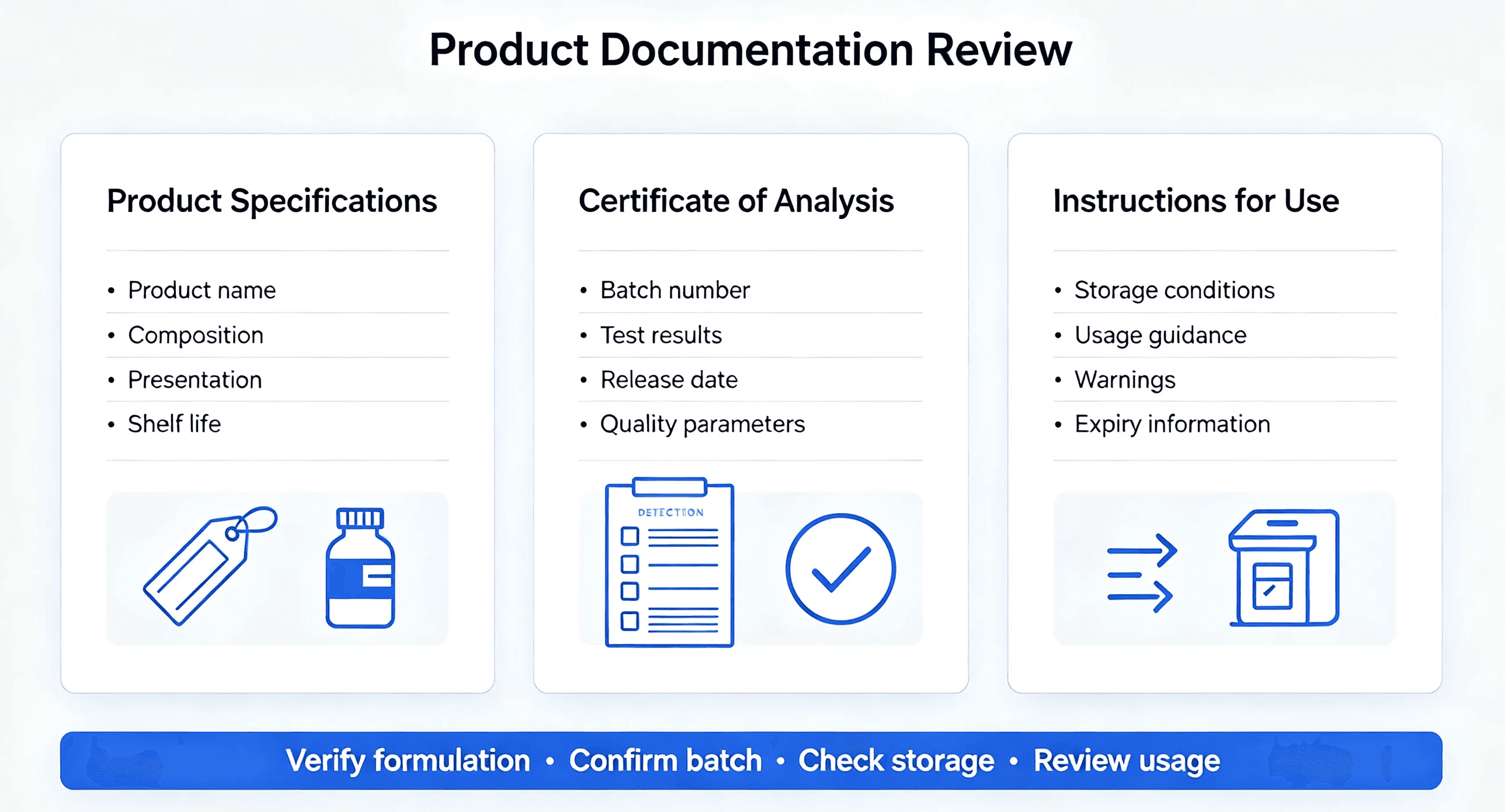
Product specifications describe the basic technical characteristics of the injectable product.
Depending on the product, specifications may include:
Product name and model
Composition or key ingredients
Concentration
Product volume
Physical characteristics
Intended storage conditions
Shelf life
Packaging information
These details allow buyers to confirm whether the product they are evaluating matches the product they intend to purchase.
Specifications should also be consistent across related documents. Differences in product name, composition, volume, or other key information should be clarified with the manufacturer before an order is finalized.
Certificate of Analysis (CoA)
A Certificate of Analysis is generally associated with a specific batch or lot and provides information about testing performed on that batch.
Depending on the product and manufacturer, a CoA may contain information such as:
Batch or lot number
Manufacturing date
Test items
Test results
Applicable specifications
Release or approval information
For buyers, one of the most useful functions of a CoA is connecting a particular batch with its quality-control information.
A CoA should therefore not be treated simply as a general certificate for an entire product line. Buyers should check whether the document corresponds to the actual batch being supplied.
Instructions for Use (IFU)
The Instructions for Use provide important information about how a professional product is intended to be handled or used.
Depending on the product, an IFU may address:
Product description
Intended use
Directions for use
Contraindications
Warnings and precautions
Storage requirements
Potential adverse reactions
Packaging information
For professional buyers, reviewing the IFU before purchasing can reveal important details that may not appear on a product quotation or marketing page.
Quality Management Documentation
Product-level documents are only one part of supplier evaluation. Buyers should also examine information about the manufacturer's quality management system.

ISO 13485 Certification
ISO 13485 is an international quality management system standard specifically associated with medical devices and related regulatory requirements.
For an injectable aesthetic manufacturer, an ISO 13485 certificate can provide information about the organization's quality management framework.
However, buyers should understand what the certificate actually demonstrates.
ISO 13485 certification does not by itself mean that every product manufactured by the company is approved for sale in the United States.
The certificate relates to the manufacturer's quality management system and its certified scope. Buyers should therefore check:
The legal name of the certified organization
Certificate validity
Certification scope
Certification body
Relevant manufacturing activities
This distinction is particularly important when importing products into a market with its own regulatory requirements.
Manufacturing and Quality-Control Information
Depending on the supplier and product, buyers may also request information related to manufacturing and quality control.
The purpose is not necessarily to obtain every internal manufacturing record, but to establish whether the supplier has a structured system for controlling product quality.
Relevant information may include:
Quality-control procedures
Batch testing
Sterility-related information where applicable
Production controls
Packaging controls
Traceability procedures
A manufacturer that can clearly explain its quality system is generally easier for professional buyers to evaluate than a supplier that provides only promotional materials.
Regulatory Documents: What Buyers Should Not Confuse
One of the most common mistakes in international sourcing is treating every certificate as proof of regulatory approval.
They are not the same thing.
Quality Certification vs Product Authorization
A quality management certificate describes an organization's quality system.
A product authorization or market authorization concerns whether a particular product can legally be marketed or used for a specific purpose in a particular jurisdiction.
These are separate questions.
For example, a manufacturer may operate under an ISO 13485-certified quality management system while a specific product still requires additional regulatory review before it can legally be marketed in the United States.
For USA-focused buyers, the relevant regulatory pathway should therefore be checked separately rather than inferred from the presence of an ISO certificate or CE-related documentation.
CE Documentation
CE marking is associated with the European regulatory framework and should not be interpreted as FDA approval.
If a supplier provides CE-related documentation, buyers should determine:
Which product the documentation applies to
The applicable European regulatory framework
Whether the documentation is current
Which conformity assessment or certification body is involved, where applicable
Whether the documented product matches the product being purchased
The key point is simple: a document should always be evaluated according to its actual scope and market purpose.
Why Document Consistency Matters
A supplier may provide several documents, but having more documents does not automatically mean having better documentation.
The information should be consistent across the documentation package.
For example, buyers should compare:
Product name
Manufacturer name
Product specifications
Batch or lot information
Packaging information
Storage conditions
Expiration information
If the product name on the quotation differs from the name on the specification sheet, or the manufacturer information differs between documents, the discrepancy should be clarified before purchasing.
Consistent documentation makes product verification and subsequent inventory management much easier.
How to Check Injectable Product Documentation Before Importing

Reviewing documents is more effective when buyers follow a consistent process rather than simply collecting certificates from a supplier.
Start With the Exact Product
Before reviewing certificates, identify the exact product being purchased.
Confirm:
Product name
Product type
Intended application
Product specifications
Packaging format
Manufacturer
This prevents a common sourcing problem where documentation is provided for a similar product rather than the exact product being considered.
Verify the Manufacturer Information
The manufacturer named on the product documents should correspond with the company you are purchasing from.
Check whether the available information is consistent across:
Product packaging
Technical documents
Certificates
Company information
Commercial documents
If a trading company is involved, buyers should also clarify the relationship between the trading company and the actual manufacturer.
Check Certificate Validity and Scope
A certificate should never be evaluated only by its title.
Buyers should check:
Issuing organization
Certificate number
Issue date
Expiration date, where applicable
Certified company
Certification scope
Relevant product or manufacturing activities
A valid certificate with the wrong scope may not provide the evidence a buyer expects.
Documentation Questions to Ask an Injectable Manufacturer
Professional buyers can make supplier evaluation more efficient by asking specific questions before placing an order.
Questions About the Product
Ask:
What is the exact product name and composition?
What are the available specifications?
What is the shelf life?
What are the required storage conditions?
What is the intended use of the product?
Questions About Quality Control
Ask:
What quality management system is used?
What testing is performed for each batch?
Can a batch-specific CoA be provided?
How is product traceability maintained?
What documentation accompanies each shipment?
Questions About the Target Market
For international buyers, the supplier should also be asked which documentation is available for the intended market.
For a USA-focused business, buyers should independently verify the applicable U.S. regulatory requirements rather than assuming that documentation issued for another market provides authorization in the United States.
This distinction becomes particularly important when a supplier serves multiple international markets.
Red Flags in Injectable Product Documentation
Incomplete documentation does not necessarily mean that a supplier is unreliable, but certain warning signs deserve closer attention.
Generic or Unrelated Certificates
A certificate should clearly identify the relevant organization, scope, and applicable product or manufacturing activity.
A generic certificate with no clear connection to the supplier or product provides limited value.
Inconsistent Product Information
Different product names, specifications, manufacturers, or batch information across documents should be clarified before purchase.
Expired or Unverifiable Certificates
Buyers should check whether certificates are current and whether their authenticity can be verified through the relevant certification organization when appropriate.
Pressure to Purchase Before Documentation Review
A supplier that avoids reasonable documentation questions or pressures buyers to place an order before reviewing important product information should be approached carefully.
Claims That One Certificate Proves Everything
Statements such as “ISO certified, therefore FDA approved” or “CE certified, therefore legal everywhere” oversimplify regulatory requirements.
Professional suppliers should be able to distinguish between quality management certification, product documentation, and market-specific regulatory status.
Building a Documentation Checklist for Importing
A simple checklist can make supplier comparison much easier.
Before placing an order, buyers can organize documentation into five categories:
Category | What to Check |
|---|---|
Product | Specifications, composition, packaging, intended use |
Quality | ISO 13485 and relevant quality-control information |
Batch | Lot number, testing information, CoA |
Handling | Storage conditions, shelf life, IFU |
Regulatory | Market-specific requirements and applicable authorization |
The exact documents required will vary according to the product and destination market. Buyers should therefore use this checklist as a starting point rather than assuming that every product requires the same documentation package.
Why Documentation Should Be Part of Supplier Selection
Documentation should not be treated as paperwork completed after the supplier has already been selected.
It can provide useful information about how a manufacturer manages its products and communicates with professional customers.
A manufacturer that maintains organized product specifications, batch records, quality documentation, and clear instructions can make purchasing and inventory management more straightforward.
For clinics, distributors, and aesthetic brands, this can also make it easier to maintain internal records and respond to customer or regulatory inquiries.
Conclusion
Evaluating injectable aesthetic product documentation is an important part of international sourcing.
Buyers should look beyond the number of certificates a supplier provides and focus on whether the documentation is relevant, current, consistent, traceable, and appropriate for the intended market.
Product specifications, CoAs, IFUs, quality management certificates, and regulatory documents each serve different purposes. Understanding those differences helps buyers avoid misleading assumptions and make more informed supplier decisions.
For USA buyers in particular, product documentation from other markets should not automatically be treated as U.S. market authorization. The applicable regulatory requirements should always be verified for the specific product and intended use.
A structured documentation review, combined with careful supplier evaluation, can reduce sourcing risks and provide a stronger foundation for long-term cooperation with an injectable aesthetic manufacturer.
Frequently Asked Questions
Q1: What documents should I request before importing injectable aesthetic products?
The exact requirements vary by product and destination market, but buyers may request product specifications, IFU, batch-related documentation, CoA, quality management certificates, packaging information, and applicable regulatory documents.
Q2: How can I verify whether a certificate is genuine?
Check the certificate number, issuing organization, company name, validity period, and certification scope. Where verification services are available, buyers can also confirm the certificate through the relevant certification body.
Q3: Does ISO 13485 mean an injectable product is FDA approved?
No. ISO 13485 relates to a manufacturer's quality management system. It does not by itself establish that a specific injectable product is authorized for marketing in the United States.
Q4: Is a Certificate of Analysis the same as a product certificate?
No. A CoA generally provides testing or quality information associated with a particular batch or lot, while other certificates may address a manufacturer's quality system or a product's regulatory status.
Q5: What should I do if the information differs between two supplier documents?
Ask the manufacturer to explain and correct the discrepancy before placing the order. Differences in product name, specifications, manufacturer information, or batch details should not simply be ignored.
Q6: Do all injectable aesthetic products require the same documentation?
No. Documentation requirements can vary according to the product type, intended use, manufacturing process, and destination market. Buyers should determine the applicable requirements for the specific product.
Q7: Why is the product's IFU important for professional buyers?
The IFU provides important information about intended use, handling, warnings, contraindications, storage, and other product-specific considerations that may not appear in marketing materials.
Q8: Should buyers request documentation for every batch?
Batch-specific documentation depends on the product and supplier's quality system. For products where batch traceability is relevant, buyers should understand how batch information and associated testing records are provided and maintained.
Q9: Can CE documentation be used as proof that a product is approved in the USA?
No. CE-related documentation concerns the applicable European regulatory framework and should not be treated as U.S. market authorization. USA requirements need to be evaluated separately.
Q10: What is the biggest documentation mistake when sourcing injectable products?
One of the biggest mistakes is assuming that having multiple certificates automatically means the product is authorized or suitable for a particular market. Buyers should evaluate each document according to its purpose, scope, validity, and relevance to the specific product.
其他博客