博客
Is There a Difference Between Cheap and Expensive Hyaluronic Acid? What Buyers Should Really Compare
作者
Ray
已发布
类别
设计与灵感
Learn what affects price, quality, formulation, testing, and what clinics should verify before buying.


作者
Ray
一位享有盛誉的医学美学专家,在该领域拥有40年的深厚经验。凭借在非侵入性手术、抗衰老科学以及先进皮肤病学解决方案方面的数十年专业知识,作者致力于分享将临床创新与真实患者成果相结合的见解。热衷于为全球客户推进安全、有效且高影响力的美学治疗。
还有什么比内部优惠、专业建议和惊喜更好的呢?
注册可每周在您的电子邮件中接收最新的博客文章。
立即加入。
Our company’s main product lines include HA (Hyaluronic Acid) fillers, CaHA (Calcium Hydroxylapatite) fillers, PLLA (Poly-L-Lactic Acid) biostimulators, and other advanced aesthetic solutions, all developed and manufactured by trusted partner facilities with whom we have maintained long-term, stable collaborations.
I help them with sales and export operations, while our company also provides sourcing and procurement services in China to help international clients solve supply-related challenges. If you need assistance with procurement, please feel free to contact us.
Introduction
Hyaluronic acid products can vary significantly in price, but a higher price does not automatically mean a better product. The same is true in the opposite direction: a lower price does not necessarily mean poor quality.
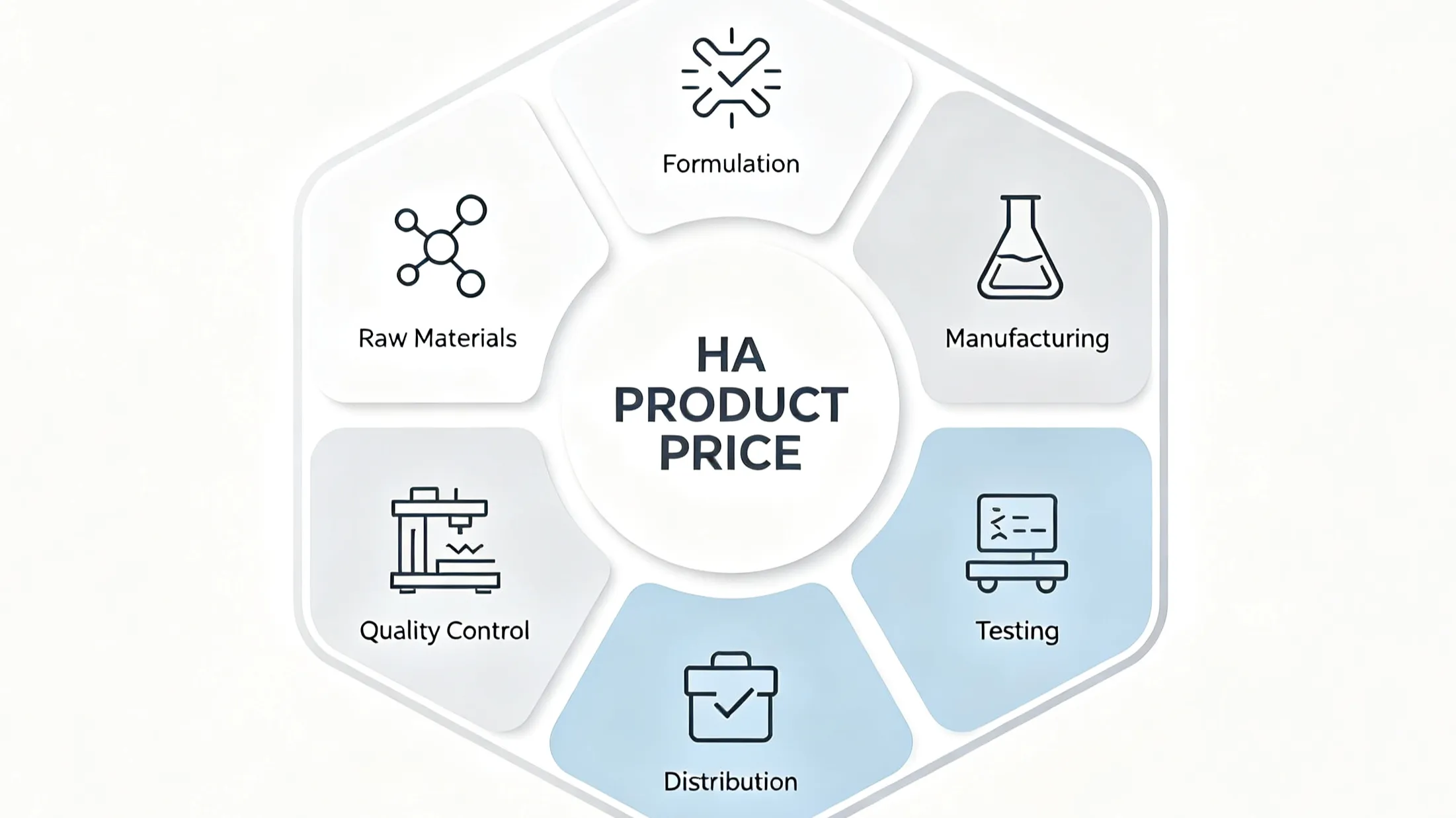
For clinics, distributors, and aesthetic brands, the more useful question is what is actually behind the price difference. Raw materials, formulation, manufacturing processes, quality controls, documentation, distribution, and product positioning can all influence the final cost.
This is particularly important for injectable aesthetic products. Two products may both contain hyaluronic acid while differing considerably in their formulation, intended use, manufacturing controls, and supporting documentation.
Is Expensive Hyaluronic Acid Always Better?
Price and Product Quality Are Not the Same Thing
The price of a hyaluronic acid product is only one part of the purchasing decision.
A higher-priced product may reflect additional manufacturing controls, specialized formulation technology, clinical development, regulatory work, or distribution costs. However, price alone cannot establish that a product has better clinical performance or quality.
Likewise, a lower-priced product may result from differences in manufacturing scale, distribution channels, packaging, market positioning, or other commercial factors rather than an inherent quality problem.
For professional buyers, comparing price without understanding these variables can lead to the wrong conclusion.
The better approach is to compare the product itself and the evidence supporting it.
Why Similar HA Products Can Have Different Prices
Hyaluronic acid is not a single standardized finished product.
Different HA-based aesthetic products can have different molecular characteristics, concentrations, crosslinking approaches, formulations, manufacturing processes, and intended applications. These differences can affect both production requirements and the way a product is positioned in the market.
The commercial price can also be influenced by factors outside the formulation itself.
For example, two products with similar basic ingredient descriptions may have different costs because one manufacturer invests more in quality-control systems, product development, testing, packaging, regulatory documentation, or distribution support.
This is why comparing the ingredient name alone is not enough.
What Factors Can Affect the Price of Hyaluronic Acid Products?
Raw Materials and Material Specifications
The cost of the starting material can vary depending on its source, specifications, purification requirements, and manufacturing controls.
For finished injectable products, however, buyers should avoid evaluating quality solely by asking whether the product contains “high-quality HA.” The relevant question is what specifications apply to the finished product and how those specifications are controlled.
Formulation and Crosslinking
HA-based injectable products may use different formulation and crosslinking approaches depending on their intended application.
Crosslinking can influence the physical properties of an HA gel, while other formulation parameters can affect characteristics such as viscosity, cohesivity, and behavior after administration.
These properties are product-specific. A more expensive crosslinking approach is not automatically better for every application.
For a clinic, the important question is whether the formulation is appropriate for the intended use and supported by reliable product documentation.
Manufacturing and Quality Control
Manufacturing requirements can also contribute to the final cost.
Professional buyers may need to consider factors such as:
Manufacturing environment
Quality management system
Process controls
Batch testing
Sterility-related controls where applicable
Lot traceability
Packaging controls
Product release procedures
These factors may not be obvious from the product's retail price, but they can be important when evaluating an injectable aesthetic product.
Testing and Documentation
Testing and technical documentation can also add to the cost of developing and maintaining a product.
Depending on the product and target market, buyers may encounter technical specifications, test reports, quality documents, certificates, declarations, or other regulatory documentation.
These documents should not be treated as interchangeable. A certificate, for example, does not automatically provide the same information as a product-specific test report.
For B2B buyers, the quality and relevance of the documentation can be more informative than the price tag itself.
Cheap vs. Expensive Hyaluronic Acid: What Should Buyers Compare?
Price can be a useful starting point, but it should not be the final criterion. For professional buyers, the more meaningful comparison is between the specifications, quality controls, intended use, and supporting documentation of the products.
Two HA products can have similar ingredient descriptions while differing in formulation and manufacturing details. Conversely, a higher-priced product may include additional commercial or distribution costs that do not necessarily translate into better clinical performance.
Product Specifications
Start with the technical specifications of the finished product rather than the marketing description.
Depending on the product, relevant information may include HA concentration, formulation characteristics, crosslinking approach, intended treatment area, and other product-specific parameters.
A buyer should ask whether these specifications are clearly documented and whether they match the intended application.
Intended Use
The right product depends on what the clinic intends to achieve.
An HA product designed for skin-quality applications may have different characteristics from one designed for structural volume enhancement. Comparing them only by price or HA concentration would not provide a meaningful assessment.
The question should therefore be:
Is the product appropriately formulated for the intended use?
rather than simply:
Is this the cheapest or most expensive option?
Manufacturer and Quality System
The manufacturer behind the product is another important factor.
For B2B buyers, it can be useful to evaluate the manufacturer's quality management system, production controls, testing procedures, traceability, and ability to maintain consistency between batches.
A well-documented manufacturing process can provide more useful information about product reliability than a premium price alone.
Regulatory and Technical Documentation
Professional buyers should also examine the documentation supporting the product in the target market.
Depending on the product and jurisdiction, this may include applicable certificates, test reports, declarations, technical documentation, labeling, and instructions for use.
These documents should be evaluated according to what they actually demonstrate. A regulatory certificate does not automatically prove superior clinical performance, while a test report does not necessarily establish regulatory authorization.
Why Two HA Products With Similar Ingredients May Perform Differently
Ingredient Name Does Not Define the Entire Product
Seeing “hyaluronic acid” on two product labels does not mean the products are technically identical.
The finished formulation can depend on characteristics such as molecular properties, concentration, crosslinking, gel structure, manufacturing conditions, and other formulation parameters.
For injectable products, these differences can influence the physical behavior and intended clinical positioning of the product.
That is why buyers should evaluate the finished product rather than treating HA as a single interchangeable commodity.
Concentration Alone Does Not Determine Quality
It can be tempting to assume that a product containing more HA must be better.
That conclusion is too simplistic.
A higher concentration may be relevant for some formulations and applications, but product performance depends on the complete formulation and its intended use. A product with a lower HA concentration is not automatically inferior if it has been designed for a different treatment objective.
For this reason, concentration should be considered alongside other technical specifications rather than used as a standalone quality indicator.
Crosslinking Is Also Application-Dependent
Crosslinking is another area where simple “more is better” comparisons can be misleading.
The degree and method of crosslinking can influence the physical properties of an HA gel. However, the appropriate characteristics depend on what the product is designed to do.
An HA product intended for superficial skin-quality applications does not necessarily need the same formulation characteristics as a product intended for deeper tissue volume correction.
The relevant question is therefore whether the formulation is fit for purpose, not whether it uses the most complex technology available.
What Should Clinics Compare Before Buying?
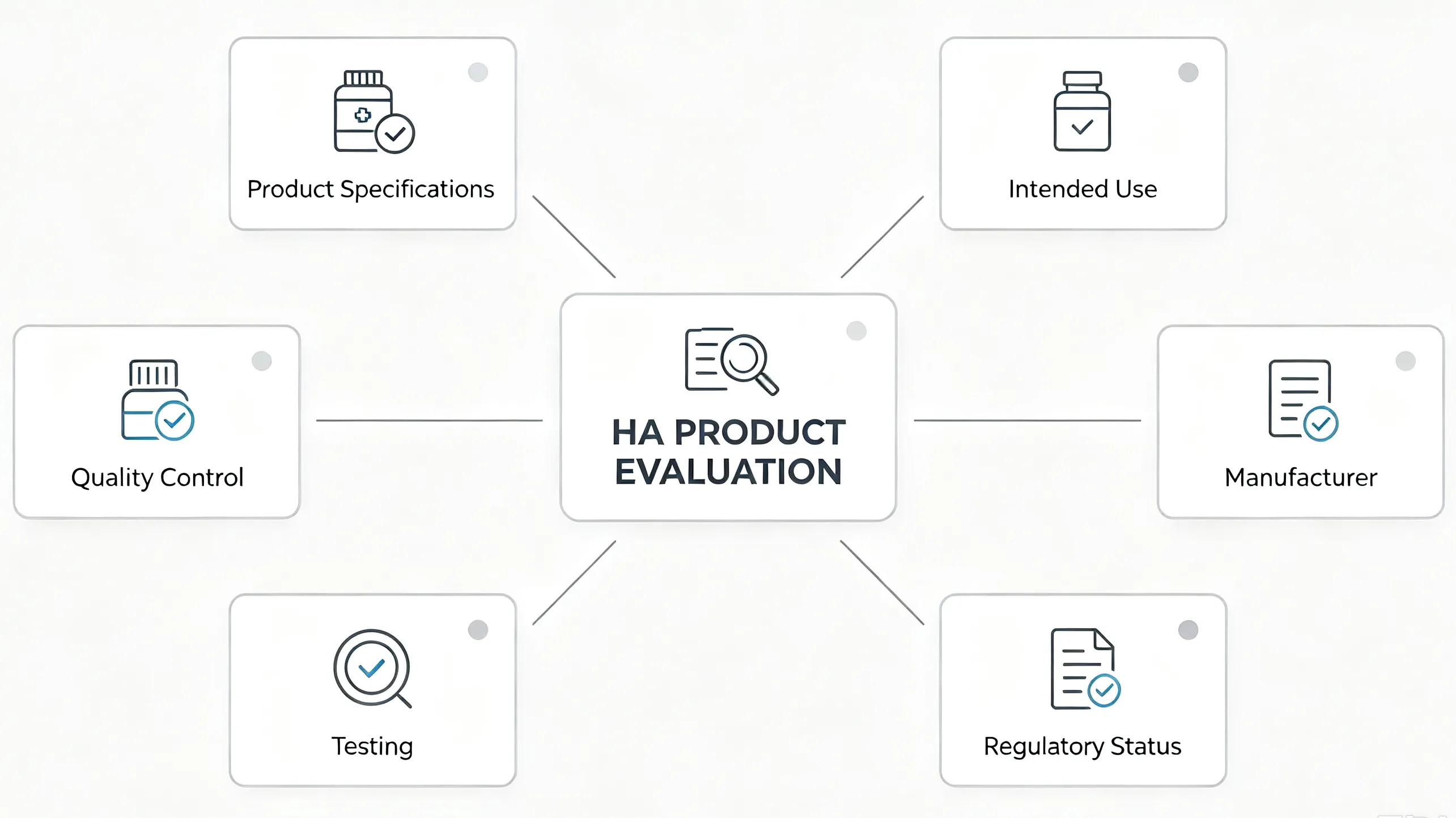
A practical comparison should look beyond the quoted unit price.
Factor | What to Check |
|---|---|
Product composition | Exact formulation and material specifications |
HA characteristics | Relevant concentration and molecular/formulation information |
Intended use | Treatment area and product positioning |
Manufacturing | Production controls and quality management |
Testing | Applicable product-specific test reports |
Documentation | Certificates, declarations, and technical documents |
Regulatory status | Requirements applicable to the target market |
Batch consistency | Lot control and traceability |
Supplier capability | Manufacturing and documentation support |
This approach gives buyers a more useful basis for comparison than simply ranking products from cheap to expensive.
A lower-priced product may be the right choice when its specifications, documentation, quality controls, and intended use meet the buyer's requirements. A higher-priced product may also be justified when its additional development, manufacturing, documentation, or support costs provide value relevant to the buyer.
The objective is not to find the most expensive HA product. It is to find a product whose quality, specifications, documentation, and cost make sense for the intended application.
How Should Clinics Evaluate Hyaluronic Acid Products Before Buying?
For clinics, distributors, and aesthetic brands, the best way to compare HA products is to move from price comparison to product verification. A supplier quotation is only the starting point. Before placing an order, buyers should understand exactly what they are purchasing and what documentation supports it.
Ask for the Exact Product Specifications
Request the technical specifications for the specific product rather than relying on a general description such as “medical-grade hyaluronic acid.”
Depending on the product, this may include:
HA concentration
Formulation characteristics
Crosslinking information where applicable
Intended use
Packaging configuration
Storage requirements
Shelf life
The specifications should be clear enough for the buyer to distinguish the product from other HA formulations offered by the same supplier.
Verify Quality and Testing Documentation
Ask the supplier which quality-control and testing documents are available for the specific product.
Where applicable, buyers may want to review:
Product specifications
Test reports
Batch-related documentation
Quality certificates
Manufacturing information
Traceability records
The exact documentation required will depend on the product and target market. Buyers should also confirm that documents correspond to the actual product and are current.
Consider the Manufacturer, Not Just the Product
A product's long-term value also depends on the manufacturer's ability to maintain consistent production.
For repeat B2B orders, consider whether the supplier has appropriate quality-management processes, documented manufacturing procedures, batch controls, and a system for handling product specifications consistently over time.
This becomes particularly important when a clinic or distributor plans to reorder the same product rather than make a one-time purchase.
Compare Total Value Instead of Unit Price
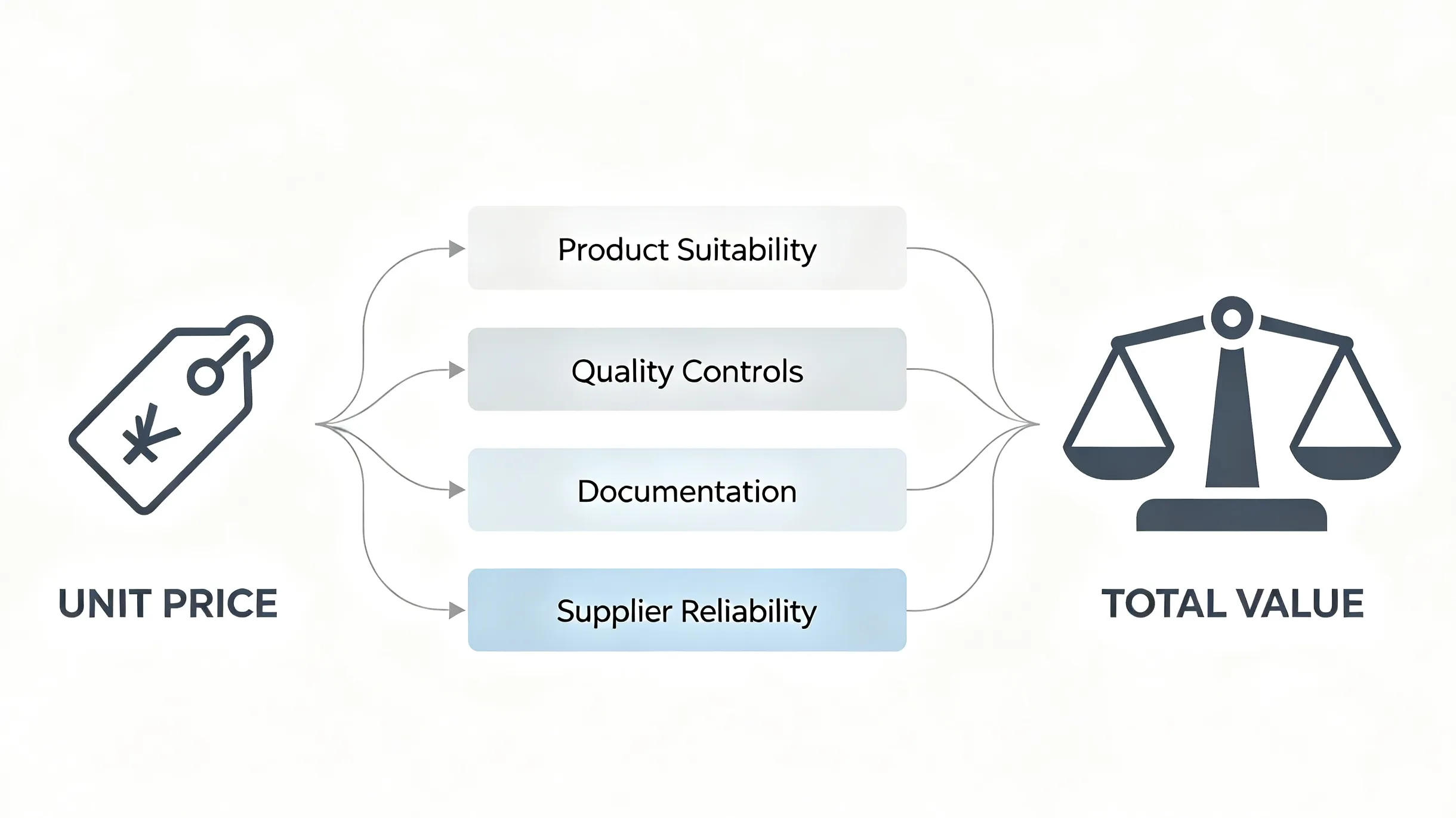
A lower unit price can be attractive, but it does not necessarily represent the lowest overall purchasing cost.
For example, differences in packaging, documentation, quality-control requirements, logistics, technical support, or order consistency may affect the total value of a supplier relationship.
The comparison should therefore look at:
Product suitability + quality controls + documentation + supplier reliability + price
rather than price alone.
What Should Buyers Ask an HA Supplier?
Before placing a bulk order, professional buyers can use the following checklist:
What is the exact composition of the product?
What is the intended use of the product?
What technical specifications are available?
What testing has been performed on the product?
Which quality and regulatory documents are available?
Do the documents correspond to the exact product being purchased?
How is batch consistency controlled?
What are the storage and shelf-life requirements?
What information is provided for repeat orders?
What market-specific requirements apply to the intended destination?
These questions help shift the purchasing process from “Which product is cheaper?” to “Which product can we verify and confidently use for its intended purpose?”
Frequently Asked Questions
Q1: Is expensive hyaluronic acid always better?
No. A higher price does not automatically indicate better quality or clinical performance. Buyers should compare formulation, intended use, manufacturing controls, documentation, and other relevant specifications.
Q2: Why is some hyaluronic acid much cheaper than other products?
Price can be influenced by raw materials, formulation, manufacturing scale, quality controls, testing, packaging, distribution, regulatory work, and brand positioning. The exact reason depends on the product and supplier.
Q3: Are all hyaluronic acid products made the same way?
No. HA products can differ in molecular characteristics, concentration, formulation, crosslinking approach, manufacturing process, and intended use.
Q4: Does a higher HA concentration mean a better product?
Not necessarily. Concentration is only one product characteristic. Its relevance depends on the formulation and intended application.
Q5: What is more important than price when buying HA products?
Product suitability, specifications, quality controls, supporting documentation, regulatory requirements, and supplier reliability should all be considered alongside price.
Q6: Can two HA products with similar ingredients have different performance?
Yes. Similar ingredient descriptions do not necessarily mean identical formulations or physical properties. Other formulation and manufacturing factors can create meaningful differences.
Q7: Should clinics ask for test reports before buying HA products?
Where applicable, yes. Buyers should request relevant product-specific testing and quality documentation and confirm what each document actually demonstrates.
Q8: Does ISO 13485 mean that an HA product is automatically better?
No. ISO 13485 relates to a medical-device quality management system. It should not be interpreted by itself as proof that a particular HA product has superior clinical performance.
Q9: Is a cheaper HA product necessarily lower quality?
No. A lower price can result from manufacturing scale, distribution structure, packaging, market positioning, or other commercial factors. Quality should be evaluated using product-specific evidence rather than price alone.
Q10: What should clinics verify before placing a bulk HA order?
Clinics should verify the exact product specifications, intended use, applicable regulatory requirements, quality and testing documentation, storage conditions, traceability, and the manufacturer's ability to maintain consistent production.
Conclusion
There is a difference between cheap and expensive hyaluronic acid products, but price alone does not explain the difference in quality.
For professional buyers, the more useful comparison is based on the complete product: formulation, specifications, intended use, manufacturing controls, testing, documentation, regulatory requirements, and supplier reliability.
If two products meet the same requirements, the lower-priced option may offer better purchasing value. If a higher-priced product provides additional features or documentation that matter to the intended application, the additional cost may also be justified.
The key is to compare what you can verify, not simply what the price suggests.
Frequently Asked Questions
Q1: Is expensive hyaluronic acid always better?
No. A higher price does not automatically indicate better quality or clinical performance. Buyers should compare formulation, intended use, manufacturing controls, documentation, and other relevant specifications.
Q2: Why is some hyaluronic acid much cheaper than other products?
Price can be influenced by raw materials, formulation, manufacturing scale, quality controls, testing, packaging, distribution, regulatory work, and brand positioning. The exact reason depends on the product and supplier.
Q3: Are all hyaluronic acid products made the same way?
No. HA products can differ in molecular characteristics, concentration, formulation, crosslinking approach, manufacturing process, and intended use.
Q4: Does a higher HA concentration mean a better product?
Not necessarily. Concentration is only one product characteristic. Its relevance depends on the formulation and intended application.
Q5: What is more important than price when buying HA products?
Product suitability, specifications, quality controls, supporting documentation, regulatory requirements, and supplier reliability should all be considered alongside price.
Q6: Can two HA products with similar ingredients have different performance?
Yes. Similar ingredient descriptions do not necessarily mean identical formulations or physical properties. Other formulation and manufacturing factors can create meaningful differences.
Q7: Should clinics ask for test reports before buying HA products?
Where applicable, yes. Buyers should request relevant product-specific testing and quality documentation and confirm what each document actually demonstrates.
Q8: Does ISO 13485 mean that an HA product is automatically better?
No. ISO 13485 relates to a medical-device quality management system. It should not be interpreted by itself as proof that a particular HA product has superior clinical performance.
Q9: Is a cheaper HA product necessarily lower quality?
No. A lower price can result from manufacturing scale, distribution structure, packaging, market positioning, or other commercial factors. Quality should be evaluated using product-specific evidence rather than price alone.
Q10: What should clinics verify before placing a bulk HA order?
Clinics should verify the exact product specifications, intended use, applicable regulatory requirements, quality and testing documentation, storage conditions, traceability, and the manufacturer's ability to maintain consistent production.
其他博客