Blog
How Aesthetic Clinics Can Create a Treatment-Based Injectable Product Strategy
Author
Ray
Published
Category
Design & Inspiration
Learn how aesthetic clinics can build a treatment-based injectable product strategy by combining fillers, skin boosters, and biostimulators for personalized patient care.


Author
Ray
An esteemed medical aesthetics expert with 40 years of profound experience in the field. With decades of expertise in non-invasive procedures, anti-aging science, and advanced dermatological solutions, the author is dedicated to sharing insights that connect clinical innovation with real-world patient results. Passionate about advancing safe, effective, and high-impact aesthetic treatments for a global clientele.
What’s better than insider perks, pro tips, and surprises?
Sign up to get the most recent blog articles in your email every week.
Join now.
Our company’s main product lines include HA (Hyaluronic Acid) fillers, CaHA (Calcium Hydroxylapatite) fillers, PLLA (Poly-L-Lactic Acid) biostimulators, and other advanced aesthetic solutions, all developed and manufactured by trusted partner facilities with whom we have maintained long-term, stable collaborations.
I help them with sales and export operations, while our company also provides sourcing and procurement services in China to help international clients solve supply-related challenges. If you need assistance with procurement, please feel free to contact us.
Introduction
The aesthetic industry is moving beyond single-product treatments. Today, many clinics are developing broader treatment strategies that combine different injectable solutions based on individual patient needs rather than relying on one product for every concern.
For aesthetic clinics, building an effective injectable product strategy is not simply about adding more products to the treatment menu. The goal is to create a structured approach where each injectable category has a clear purpose and supports specific aesthetic outcomes.
A well-designed treatment-based strategy can help clinics provide more personalized treatment plans, improve patient satisfaction, and create long-term relationships with patients.
Instead of asking, “Which injectable product is the best?” professional practitioners increasingly need to consider:
What aesthetic concern does the patient want to address?
Is the goal volume restoration, skin improvement, or collagen support?
Which product category best matches the treatment objective?
Understanding these differences allows clinics to create more effective and flexible injectable treatment systems.
Why Clinics Need a Treatment-Based Injectable Strategy
Traditional aesthetic practices often organize their services around individual products. However, patients usually do not think about treatments based on product names. They focus on their concerns, such as facial aging, volume loss, skin quality, or maintaining a youthful appearance.
A treatment-based strategy changes the focus from products to patient needs.
For example:
A patient experiencing facial volume loss may benefit from a volume-restoring approach.
A patient concerned about early skin aging may be more interested in skin quality improvement.
A patient seeking gradual rejuvenation may prefer treatments that support collagen production over time.
By organizing injectable products around treatment goals, clinics can provide more personalized recommendations instead of offering the same solution to every patient.
Understanding Patient Needs Before Selecting Injectable Products
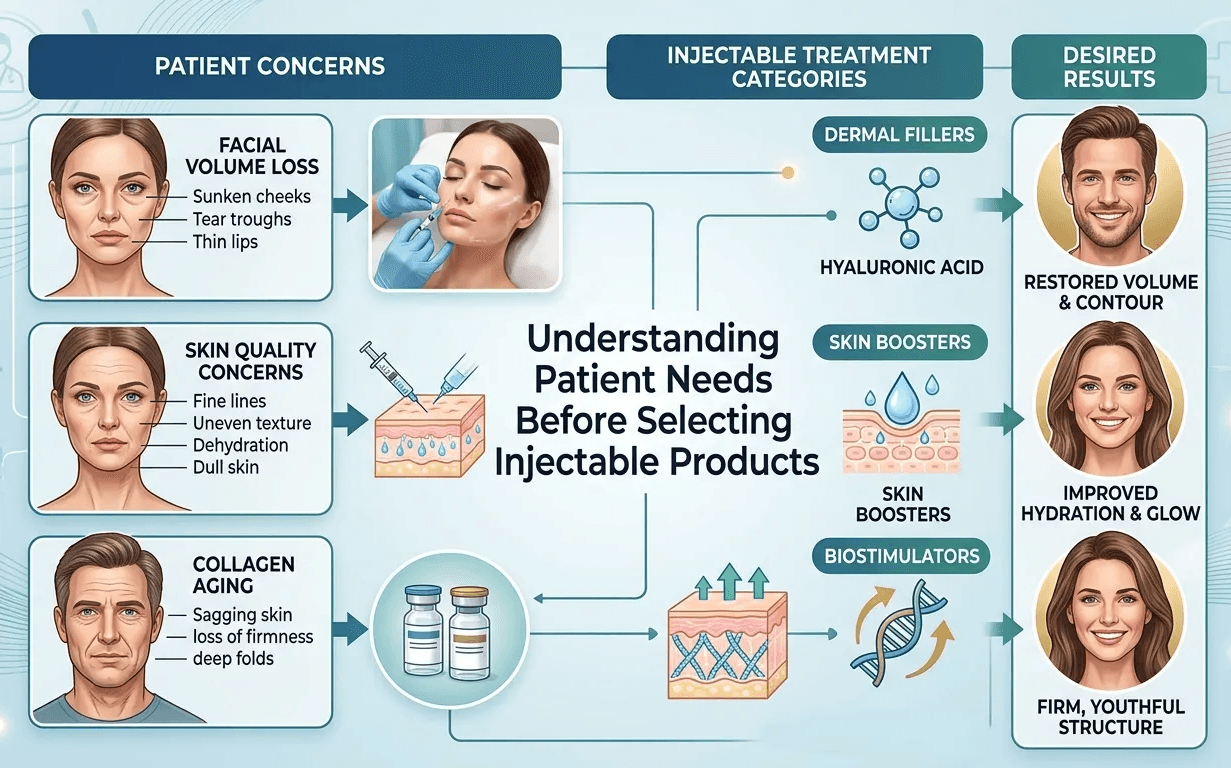
Before choosing injectable products, clinics should first understand the main aesthetic concerns they want to address.
Different patient goals require different treatment approaches, and product selection should support the desired outcome.
Addressing Facial Volume Loss and Structural Changes
Loss of facial volume is one of the most common concerns among aesthetic patients.
As people age, changes in collagen levels, fat distribution, and facial structure can contribute to:
Reduced cheek fullness
Less defined facial contours
Deeper folds and lines
For these concerns, volume-restoring injectable solutions such as hyaluronic acid fillers are often considered because they can help restore support and enhance facial contours.
However, treatment planning should focus on achieving balanced results rather than simply adding volume. The appropriate product characteristics depend on the treatment area, patient anatomy, and desired aesthetic outcome.
Improving Skin Quality and Early Signs of Aging
Not every patient is looking for facial reshaping. Many younger and preventive-aesthetic patients are more focused on maintaining skin quality.
Common concerns include:
Dull skin appearance
Reduced hydration
Uneven skin texture
Early signs of aging
For these patients, skin-focused injectable solutions may provide an alternative approach. Products such as HA-based skin boosters, PDRN formulations, PN-related solutions, and peptide-based treatments are often positioned around improving overall skin condition rather than changing facial structure.
This category allows clinics to expand beyond traditional filler treatments and address a wider range of patient expectations.
Supporting Long-Term Collagen Improvement
Some patients prefer gradual aesthetic changes rather than immediate volume enhancement.
Collagen biostimulators, including PLLA and CaHA-based solutions, are designed around stimulating the body's natural collagen response.
These treatments may appeal to patients who are interested in:
Gradual improvement
Natural-looking results
Long-term skin support
For clinics, including collagen-focused solutions within their injectable strategy provides another option for patients whose goals differ from traditional filler treatments.
Building a Balanced Injectable Product Framework
A complete injectable strategy does not require every available product category. Instead, clinics should focus on creating a balanced framework where each product serves a specific treatment purpose.
A practical structure may include:
Foundation Category: Volume Restoration
Products designed for restoring facial structure and improving contour.
Enhancement Category: Skin Quality Improvement
Products focused on hydration, texture, and overall skin condition.
Long-Term Category: Collagen Stimulation
Products designed for gradual rejuvenation and structural support.
This approach helps clinics avoid unnecessary product overlap while ensuring practitioners have suitable options for different patient needs.
Matching Injectable Categories With Treatment Goals

A treatment-based injectable strategy works best when clinics clearly understand how different product categories support different aesthetic objectives.
Rather than recommending products based on popularity, practitioners can evaluate the patient’s concerns, desired outcome, and treatment timeline before selecting an appropriate approach.
Volume Restoration With Hyaluronic Acid Fillers
Hyaluronic acid fillers are often considered a core component of many aesthetic clinics’ injectable offerings because they can address a wide range of volume-related concerns.
They are commonly used when the treatment goal involves:
Restoring lost facial volume
Improving facial proportions
Enhancing specific contours
Softening the appearance of certain lines
However, HA fillers are not a universal solution for every aesthetic concern. Their role within a clinic’s strategy is primarily focused on structural enhancement and volume management.
A well-designed portfolio may include different HA filler options to support various treatment requirements, allowing practitioners to select products based on factors such as treatment area, desired correction, and patient expectations.
Skin Quality Improvement With Skin Boosters and Regenerative Solutions
The growing demand for natural-looking aesthetic improvement has increased interest in treatments focused on skin condition rather than facial reshaping.
Skin boosters and regenerative injectable solutions can complement traditional filler treatments by addressing concerns such as hydration, skin texture, and overall appearance.
This category may include formulations based on ingredients such as:
Hyaluronic acid
PDRN
PN
Peptides
For clinics, these products can help create treatment options for patients who want aesthetic improvement without significant changes to facial volume or structure.
Collagen Support With Biostimulators
Collagen decline is a major factor in visible facial aging, which has increased interest in injectable treatments designed to support collagen production.
Biostimulatory products such as PLLA and CaHA-based solutions provide another treatment pathway for patients seeking gradual rejuvenation.
Compared with traditional volume-focused approaches, collagen biostimulation emphasizes progressive improvement over time.
For clinics, this allows practitioners to offer different treatment philosophies:
Immediate structural enhancement
Gradual collagen-focused improvement
Long-term aesthetic maintenance
A balanced strategy can include both approaches depending on individual patient needs.
Why Clinics Should Avoid a One-Product Approach
Using one injectable product category for every patient may limit treatment flexibility.
Patients have different:
Facial anatomy
Aging patterns
Skin conditions
Aesthetic expectations
Treatment preferences
A patient seeking facial contour improvement may have different needs from someone focused on skin quality or preventive aging care.
A broader treatment-based strategy allows clinics to create more customized recommendations while avoiding unnecessary treatments that do not match the patient’s goals.
However, portfolio expansion should remain strategic. Adding too many similar products may increase inventory complexity without creating meaningful value.
The objective is not to have the largest number of products, but to have the right products for clearly defined treatment purposes.
Creating Long-Term Patient Treatment Plans
Modern aesthetic care is increasingly moving toward ongoing treatment relationships rather than isolated procedures.
A patient’s aesthetic goals may change over time. Early concerns about skin quality may later develop into concerns about volume loss or facial structure.
A treatment-based injectable strategy allows clinics to support patients through different stages of their aesthetic journey.
For example:
A younger patient may initially focus on skin quality improvement and preventive treatments.
A patient experiencing early volume changes may consider a combination of skin-focused and structural approaches.
A mature patient with more significant facial changes may require a comprehensive rejuvenation strategy.
This approach helps clinics move from individual procedures toward personalized aesthetic planning.
How to Develop an Effective Injectable Product Strategy

Building a successful injectable strategy requires balancing clinical needs with business considerations.
Evaluate Patient Demographics and Market Demand
Before expanding an injectable portfolio, clinics should understand their target patient group.
Factors to consider include:
Common aesthetic concerns among patients
Age distribution
Treatment preferences
Local market trends
Existing service offerings
A clinic serving primarily preventive-aesthetic patients may require a different product mix compared with a practice specializing in advanced facial rejuvenation.
Select Products With Clear Roles
Each injectable product in a clinic’s portfolio should have a defined purpose.
A strong product strategy should answer:
What patient concern does this product address?
How does it complement existing treatments?
When would practitioners choose this option over another?
Clear positioning makes it easier for practitioners to recommend treatments and helps patients better understand their options.
Work With Reliable Injectable Manufacturers
The quality of a treatment strategy depends not only on product selection but also on supplier reliability.
Clinics and professional buyers should consider manufacturers that can provide:
Consistent product quality
Technical documentation
Quality management systems
Product training support
Stable supply capability
A reliable manufacturing partner helps clinics maintain consistency while expanding their injectable offerings.
Aowita Biotech provides injectable aesthetic solutions including dermal fillers, skin boosters, and collagen-focused products for professional markets worldwide. With ISO 13485 quality management practices and international market experience, manufacturers with structured quality systems can support clinics and brands developing long-term aesthetic solutions.
Conclusion
Creating an effective injectable product strategy requires clinics to think beyond individual products and focus on patient treatment goals.
A balanced approach combines different injectable categories, including HA fillers for volume restoration, skin boosters for quality improvement, and biostimulators for collagen-focused rejuvenation.
The most successful aesthetic practices are not those offering the largest number of products, but those that understand how each solution fits into a complete treatment framework.
By aligning product selection with patient needs, market demand, and reliable supplier support, clinics can build more flexible treatment offerings and create stronger long-term growth.
Frequently Asked Questions
1. What is a treatment-based injectable product strategy?
A treatment-based injectable product strategy organizes aesthetic products around patient needs and treatment goals rather than individual product names. It helps clinics select suitable solutions based on concerns such as volume loss, skin quality, or collagen support.
2. How many injectable products should an aesthetic clinic offer?
There is no fixed number of injectable products a clinic should offer. The ideal portfolio depends on patient demand, treatment focus, practitioner expertise, and business goals. A focused selection with clear purposes is often more effective than a large collection of overlapping products.
3. Can different injectable products be used as part of the same aesthetic treatment plan?
Yes. Different injectable categories may address different aspects of facial aging and aesthetic concerns. Professional practitioners may consider combining approaches based on individual patient needs, treatment goals, and clinical evaluation.
4. Should clinics choose injectable products based on market trends?
Market trends can provide useful insights, but product selection should also consider patient needs, treatment applications, product quality, and supplier reliability. Following trends alone may result in unnecessary product expansion.
5. What is the difference between a product-based and treatment-based approach?
A product-based approach focuses mainly on individual products, while a treatment-based approach focuses on solving specific patient concerns. The treatment-based model allows clinics to create more personalized recommendations.
6. Why are clinics expanding beyond traditional dermal fillers?
Many patients are increasingly interested in improving overall skin quality, preventing visible aging, and achieving natural-looking results. This has increased demand for solutions such as skin boosters and collagen-supporting injectables.
7. How can clinics decide which injectable categories to add first?
Clinics should evaluate their current patient base, common treatment requests, practitioner capabilities, and business objectives. Starting with products that address the most frequent patient concerns can create a stronger foundation.
8. What role do injectable manufacturers play in a clinic’s product strategy?
Manufacturers can support clinics beyond product supply by providing technical information, documentation, training resources, and consistent product availability. A reliable supplier can help clinics develop their treatment offerings more effectively.
9. Are more injectable products always better for an aesthetic clinic?
Not necessarily. Too many similar products may increase inventory complexity and make treatment positioning more difficult. A well-structured portfolio with clearly defined product roles is usually more valuable.
10. How often should clinics review their injectable product strategy?
Clinics should periodically review their injectable strategy based on changes in patient demand, treatment trends, product performance, and business development goals. Regular evaluation helps ensure the portfolio remains relevant and effective.
Other Blogs