Blog
How Long Do Hyaluronic Acid Facial Fillers Last? What Affects Results, Touch-Ups, and Cost
Author
Ray
Published
Category
Facial Fillers
Learn how long hyaluronic acid fillers last, what affects results, when touch-ups help, what aftercare matters, and what fillers may cost.

Author
Ray
An esteemed medical aesthetics expert with 40 years of profound experience in the field. With decades of expertise in non-invasive procedures, anti-aging science, and advanced dermatological solutions, the author is dedicated to sharing insights that connect clinical innovation with real-world patient results. Passionate about advancing safe, effective, and high-impact aesthetic treatments for a global clientele.
What’s better than insider perks, pro tips, and surprises?
Sign up to get the most recent blog articles in your email every week.
Join now.
Our company’s main product lines include HA (Hyaluronic Acid) fillers, CaHA (Calcium Hydroxylapatite) fillers, PLLA (Poly-L-Lactic Acid) biostimulators, and other advanced aesthetic solutions, all developed and manufactured by trusted partner facilities with whom we have maintained long-term, stable collaborations.
I help them with sales and export operations, while our company also provides sourcing and procurement services in China to help international clients solve supply-related challenges. If you need assistance with procurement, please feel free to contact us.
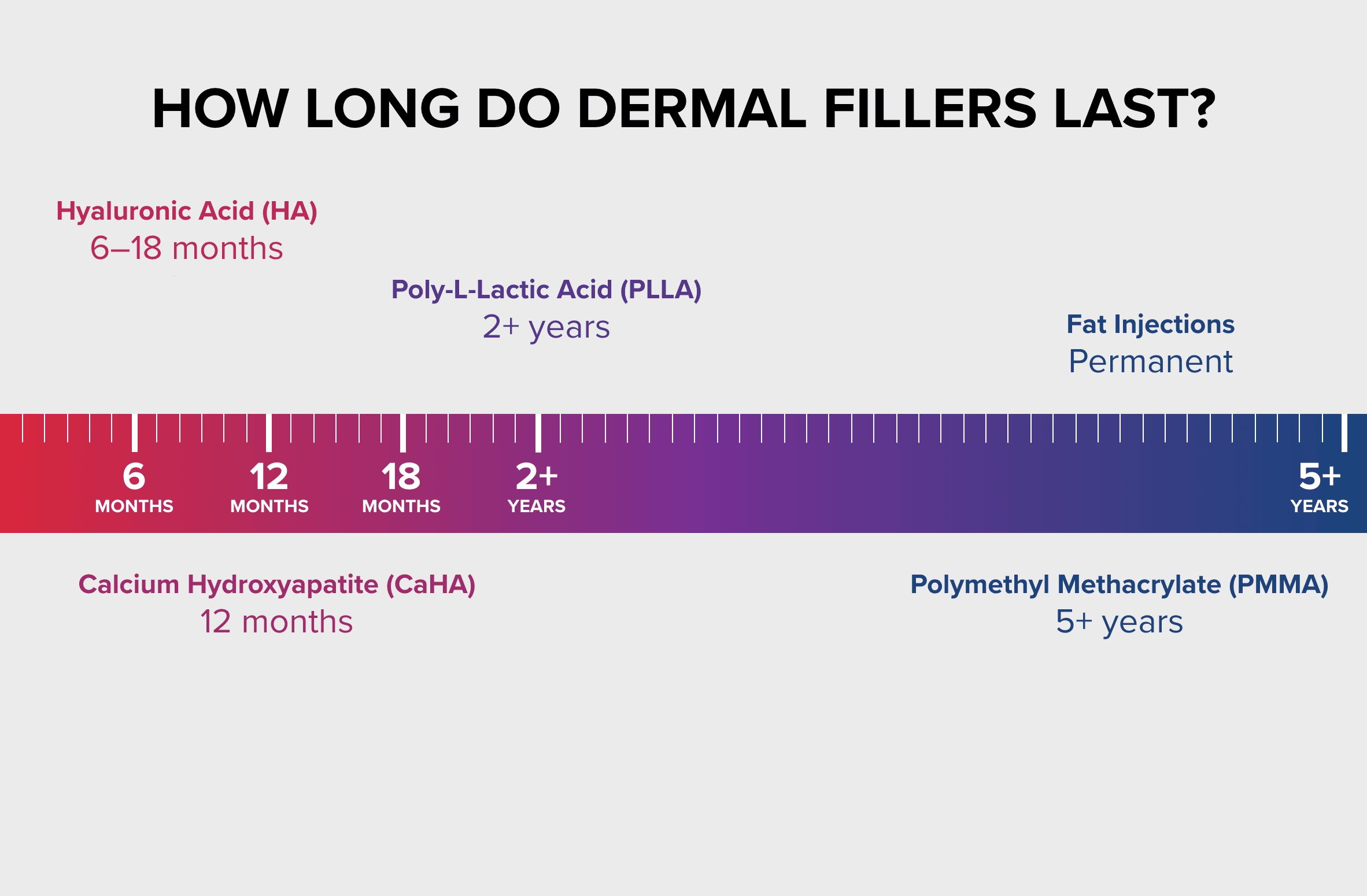
If you’re researching facial fillers, the first question is usually the right one: how long will the results actually last? In most cases, hyaluronic acid facial fillers last about 6 to 12 months, though some patients see results fade earlier in high-movement areas like the lips, while others keep noticeable improvement for closer to 12 to 18 months depending on the product, placement, and their own metabolism. The FDA notes that hyaluronic acid filler effects are commonly around 6 to 12 months, while major plastic surgery sources note that many HA fillers in practice fall into roughly the 6- to 18-month range.
Key Takeaways
Most hyaluronic acid fillers last 6 to 12 months, but some can last longer depending on the product and treatment area.
Lips often wear off faster than cheeks, chin, or jawline because the area moves more.
Touch-ups are common, and some product labeling describes touch-up treatment around 2 to 4 weeks after an initial visit when refinement is needed.
Aftercare matters, especially in the first day or two: avoid strenuous exercise right away, minimize sun and heat exposure, and do not touch or massage the area unless your injector tells you to.
In the U.S., the average cost of hyaluronic acid dermal fillers is about $715, but total treatment cost varies widely by product, provider, geography, and how many syringes you need.
Featured snippet-ready answer
How long do hyaluronic acid facial fillers last?
Most hyaluronic acid facial fillers last 6 to 12 months. Some wear off sooner in mobile areas like the lips, while certain cheek, chin, or jawline fillers may last 12 to 18 months. Longevity depends on the formula used, where it is injected, how much is injected, your metabolism, and the skill of the injector.
What hyaluronic acid filler is
Hyaluronic acid, or HA, is a substance naturally found in the body that helps the skin hold water and maintain volume. In facial aesthetics, HA fillers are gel-like injectables used to restore lost volume, soften lines, and shape areas such as the lips, cheeks, chin, jawline, and under-eyes. Many HA fillers are chemically modified, or crosslinked, so they last longer after injection.
One reason HA fillers remain so popular is flexibility. They can create subtle or more noticeable changes, and unlike some longer-lasting filler categories, HA fillers can also be dissolved with hyaluronidase if correction is needed.
How long fillers last by treatment area
The best way to set expectations is not to ask, “How long do fillers last?” in the abstract. Ask, “How long does this filler usually last in this part of the face?”
Lips
Lip filler often fades faster than filler in lower-movement areas. A reasonable expectation is about 4 to 12 months, with many patients noticing softening on the earlier side compared with cheeks or jawline. That shorter lifespan is not necessarily a problem. It is partly a reflection of how often the lips move and how dynamic the area is.
Nasolabial folds and marionette lines
Smile lines often respond well to HA fillers, and many patients can expect results in the 6- to 12-month range, though this varies by product and severity of volume loss. These areas can last well when the right filler is matched to the depth of correction needed.
Cheeks and midface
Cheek filler often lasts longer than lip filler because the product is usually placed deeper and the area is less mobile. It is common for midface filler to hold well for around 12 months or longer, depending on the formulation and the amount of structural support needed.
Chin and jawline
Chin and jawline enhancement often uses firmer HA fillers designed for shape and support. These areas can be among the longer-lasting HA applications, commonly around 12 to 18 months in appropriate candidates.
Under-eyes
Tear trough filler can be long-lasting in some patients because the area moves less, but it is also one of the most technique-sensitive facial filler treatments. Longevity varies, and the bigger issue is often not duration, but appropriate patient selection and precise placement.

What affects how long your results last
This is where generic articles usually stop too early. Longevity is not just about the brand name on the syringe.
1. Product formulation and crosslinking
Not all HA fillers are built the same. Some are softer and spread more easily for superficial correction or lips. Others are firmer and more structural for cheeks, chin, or jawline. The degree of crosslinking and the rheology of the filler influence how long it resists breakdown and how it behaves in tissue.
2. Injection depth and facial movement
Fillers placed in highly mobile areas tend to break down faster. That is one reason lips usually need maintenance sooner than cheeks. Deep structural placement can also support better longevity than superficial placement when the product choice is appropriate.
3. Your metabolism and activity level
Some people simply metabolize HA fillers faster. Higher activity levels, body chemistry, and individual tissue response can all influence how quickly results soften. This is one reason two patients can get the same product and still have different wear times.
4. Amount injected and treatment goals
A very subtle correction may look beautiful, but it can also become less noticeable sooner because there is less margin before the effect appears diminished. On the other hand, overfilling is not the answer. The goal should be a treatment plan that fits your anatomy and your preferred look, not the longest possible duration at any cost. Ongoing treatments are generally required for long-term maintenance.
5. Injector technique and product selection
A skilled injector does more than place filler. They choose the right product for the right layer, understand facial anatomy, and build a plan that prioritizes proportion and safety. The FDA and AAD both emphasize that dermal fillers are medical procedures and should be performed by qualified, appropriately trained professionals.
Does hyaluronic acid filler ever fully go away?
In general, HA filler is temporary and is gradually broken down by the body over time. The FDA describes HA filler effects as temporary, and major specialty sources also frame HA fillers as treatments that require repeat sessions to maintain results.
That said, the real-world answer is more nuanced than a simple yes or no. In everyday patient language, most people mean, “Will my visible result fade?” Usually, yes. But the timeline is not identical for everyone, and some subtle effects may linger beyond the headline duration depending on product, area, and tissue response. A clean editorial way to say this is: the cosmetic effect is not permanent, but the fade is gradual, not on-off.
How often can you get hyaluronic acid injections?
There is no universal lifetime cap for how many times someone can get HA filler. What matters is whether each treatment is medically appropriate, spaced sensibly, and part of a conservative long-term plan. Some patients return once or twice a year for maintenance; others only treat selectively when volume loss becomes noticeable again. AAD guidance also emphasizes discussing whether the filler is temporary, whether it is FDA-approved for that use, and what risks apply to you specifically.
In practice, the better question is not “How many times can I get filler?” but “How often should I treat this area without chasing volume for its own sake?” That mindset usually leads to more natural results.
When a touch-up makes sense
A touch-up is not always a redo. Often, it is a refinement.
Some HA filler product materials describe a touch-up treatment 2 to 4 weeks after the initial injection if more correction is needed or if the first visit was intentionally conservative. That makes clinical sense. Early swelling can distort first impressions, and subtle shaping is often better done in stages.
A touch-up may make sense when:
the original plan was intentionally conservative
swelling has settled and a small asymmetry is now easier to assess
you want slightly more volume, but not a full repeat treatment
one area metabolized faster than expected
A full maintenance visit, by contrast, is usually about restoring volume months later rather than fine-tuning the initial result.
What you should not do after hyaluronic acid injections
The first 24 to 72 hours matter more than most people think. If you want smoother recovery and less swelling, keep aftercare simple and disciplined.
What not to do right after filler
Do not do strenuous exercise until the next day; some recovery guidance recommends avoiding intense physical activity for 24 to 48 hours to minimize swelling and bruising.
Do not touch, rub, or massage the area unless your injector specifically tells you to. AAD guidance advises avoiding touching the treated area for three days unless instructed to massage it.
Avoid significant sun and heat exposure right after treatment.
Minimize alcohol for the first 24 hours, since it may worsen bruising and swelling.
What should you do instead? Follow your injector’s specific instructions, use cool compresses if advised, and give the filler time to settle before judging the final result. Temporary swelling, redness, tenderness, and bruising are common early reactions.
How much hyaluronic acid filler costs in the U.S.
The average cost of hyaluronic acid dermal fillers is $715, according to the American Society of Plastic Surgeons. Lip augmentation with dermal fillers is listed at an average of $743. Those are useful benchmarks, but they do not represent a guaranteed total out-the-door price.
Your actual cost can change based on:
the product selected
the number of syringes needed
provider expertise
city and regional pricing
whether you need a staged plan or maintenance visits
ASPS also notes that pricing varies widely, and surgeon fees are only one part of the overall financial picture.
A smarter way to budget is to think in annual maintenance cost, not just cost per syringe. A lower-cost filler that fades quickly can end up costing more over 12 months than a more durable option used strategically.
Which facial filler lasts the longest?
Across all filler categories, not every facial filler is hyaluronic acid, and some non-HA fillers are considered longer lasting than HA products. But within the HA category, firmer, more structural fillers used in areas like the chin, jawline, and sometimes cheeks often last longer than lip fillers. FDA and specialty-society sources consistently describe HA fillers as temporary, while noting that longevity varies by formulation and treatment area.
For patients comparing options, the real decision is not just “which lasts the longest?” It is which filler is safest and most appropriate for the area I’m treating and the look I want? Longevity should support the aesthetic plan, not override it.
Is hyaluronic acid injection good for the face?
For the right candidate, treated by a qualified professional, yes—HA filler can be a useful facial treatment for restoring volume, softening folds, improving contour, and enhancing balance. The FDA has approved dermal fillers for multiple facial uses, including areas such as nasolabial folds, cheeks, chin, lips, and hands, depending on the product.
But “good” depends on three things:
the right diagnosis
the right injector
the right amount of product
A filler is not automatically the answer to every cosmetic concern. In some cases, skin quality, laxity, facial structure, or movement patterns mean another treatment approach may be more appropriate. That is one reason a careful consultation matters so much.
How to make filler results look better, not just last longer
The most successful filler patients usually focus on quality of outcome, not maximum duration.
A practical framework:
Choose a qualified injector first. Credentials and anatomy knowledge matter more than promotions.
Treat the right area. Sometimes the place that bothers you is not the place that needs volume.
Start conservatively. You can usually add more later; reversing overfilling is harder emotionally and aesthetically.
Respect aftercare. The first 24 to 72 hours are not the time to test your recovery.
Plan maintenance before you need rescue. A small scheduled review often produces more natural-looking continuity than waiting until everything has faded.
Final thoughts
So, how long do hyaluronic acid facial fillers last? For most patients, the best general answer is 6 to 12 months, with some treatments fading sooner and others holding closer to 12 to 18 months depending on the area, product, and person.
The more useful takeaway is this: filler longevity is not one number. It is the result of product design, anatomy, injector skill, treatment area, and how thoughtfully you maintain your results over time.
If you are comparing providers or deciding whether filler is right for you, the smartest next step is a consultation focused on fit, not just price: what product is being used, why it suits your anatomy, how long results are realistically expected to last in your treatment area, what aftercare is required, and what your maintenance plan may look like over a full year. That is where better decisions—and better outcomes—usually begin.
FAQ
1) How long do hyaluronic acid injections last in the face?
Most hyaluronic acid (HA) facial filler injections last about 6 to 12 months, although some areas and products may last closer to 12 to 18 months. Results usually fade faster in high-movement areas like the lips and may last longer in areas such as the cheeks, chin, or jawline. Longevity depends on the product used, the treatment area, the amount injected, your metabolism, and injector technique.
2) Why do some dermatologists not recommend hyaluronic acid?
Some dermatologists do not discourage hyaluronic acid fillers entirely, but they may recommend against them in certain patients or situations. The reason is not usually that HA is inherently “bad,” but that it is not the best treatment for every concern. For example, some patients are not good candidates because of facial anatomy, significant skin laxity, unrealistic expectations, previous filler issues, or higher complication risk in certain areas. In other cases, a dermatologist may believe that skin tightening, biostimulatory treatments, surgery, or Botox would address the concern more effectively than filler.
3) Does hyaluronic acid help with saggy skin?
Sometimes—but only to a point. Hyaluronic acid filler can improve the appearance of mild sagging when volume loss is part of the problem. For example, replacing lost volume in the cheeks can create a subtle lifting effect and improve facial balance. But HA filler does not truly tighten loose skin. If the main issue is significant skin laxity rather than volume loss, fillers may offer limited improvement and, in some cases, can even make the face look heavy if overused. Sagging skin often needs a different treatment approach.
4) How many times can you get hyaluronic acid injections?
There is no fixed universal limit on how many times you can get hyaluronic acid injections. Many patients have repeat treatments once or twice a year, depending on the area treated and how quickly their results fade. The more important issue is whether repeat treatment is appropriate, conservative, and medically well planned. Good injectors usually focus on maintaining balance and avoiding overfilling rather than simply repeating injections indefinitely.
5) Does hyaluronic acid filler ever fully go away?
Hyaluronic acid filler is considered temporary and gradually breaks down over time. In most patients, the visible cosmetic result softens progressively rather than disappearing all at once. While the treatment is not permanent, the exact fade pattern can vary based on the filler type, treatment area, and individual metabolism.
6) Which facial areas make hyaluronic acid filler wear off faster?
Areas with a lot of movement—especially the lips—often metabolize filler more quickly. By contrast, less mobile or deeper structural areas such as the cheeks, chin, and jawline may hold results longer.
7) Who is a good candidate for hyaluronic acid facial filler?
A good candidate is usually someone who wants to treat volume loss, facial contour, or specific lines and folds, has realistic expectations, and is being evaluated by a qualified medical professional. The best candidates are not simply looking for “more filler,” but for the right treatment for the right problem.
Other Blogs