Blog
OEM vs ODM vs Private Label Injectable Aesthetic Products: What Is the Difference?
Author
Ray
Published
Category
Design & Inspiration
Understand the differences between OEM, ODM, and private label injectable aesthetic products and learn how to choose the right manufacturing model for your brand.

Author
Ray
An esteemed medical aesthetics expert with 40 years of profound experience in the field. With decades of expertise in non-invasive procedures, anti-aging science, and advanced dermatological solutions, the author is dedicated to sharing insights that connect clinical innovation with real-world patient results. Passionate about advancing safe, effective, and high-impact aesthetic treatments for a global clientele.
What’s better than insider perks, pro tips, and surprises?
Sign up to get the most recent blog articles in your email every week.
Join now.
Our company’s main product lines include HA (Hyaluronic Acid) fillers, CaHA (Calcium Hydroxylapatite) fillers, PLLA (Poly-L-Lactic Acid) biostimulators, and other advanced aesthetic solutions, all developed and manufactured by trusted partner facilities with whom we have maintained long-term, stable collaborations.
I help them with sales and export operations, while our company also provides sourcing and procurement services in China to help international clients solve supply-related challenges. If you need assistance with procurement, please feel free to contact us.
Introduction
The injectable aesthetic market has grown rapidly as more clinics, distributors, and beauty brands look for reliable ways to develop and expand their product offerings.
For companies entering this market, choosing the right manufacturing partnership model is one of the first important decisions. Many businesses encounter terms such as OEM, ODM, and private label, but these models represent different levels of product development, customization, and brand control.
Selecting the wrong model can affect development timelines, investment requirements, product positioning, and long-term business growth.
For example, a new aesthetic brand may prefer a ready-to-market private label solution, while an established company with specific formulation requirements may need a customized OEM or ODM partnership.
Understanding the differences between these manufacturing models helps buyers make more informed decisions when sourcing injectable aesthetic products.
What Is OEM Injectable Aesthetic Manufacturing?
OEM (Original Equipment Manufacturing) refers to a manufacturing model where a company produces injectable aesthetic products according to the buyer’s requirements.
In an OEM partnership, the buyer usually has more control over product specifications, branding, packaging, and market positioning. The manufacturer provides production capabilities and technical support while producing products based on the agreed requirements.
For injectable aesthetic products, OEM manufacturing may involve:
Customized product specifications
Brand-specific packaging
Manufacturing according to agreed quality standards
Support with production processes and documentation
OEM is commonly selected by companies that already have a clear product concept or market strategy and want greater control over their product identity.
Advantages of OEM Injectable Manufacturing
One of the main advantages of OEM manufacturing is customization.
Companies can develop products that better match their target market, including:
Specific product positioning
Customized packaging design
Long-term product development plans
For established aesthetic companies, OEM can provide more flexibility compared with purchasing standard products from the market.
However, OEM usually requires more involvement from the buyer. Companies may need to provide clearer requirements, participate in product development discussions, and invest more time in planning before commercial launch.
What Is ODM Injectable Aesthetic Manufacturing?
ODM (Original Design Manufacturing) is a model where the manufacturer provides existing product development capabilities and helps create products based on the buyer’s needs.
Compared with OEM, ODM allows buyers to benefit from the manufacturer’s existing technical experience, research capabilities, and product development knowledge.
In the injectable aesthetic industry, ODM partnerships may include:
Formula adjustment
Packaging customization
Technical consultation
Manufacturing support
This model is suitable for companies that want customized products but may not have their own formulation or development resources.
Advantages of ODM Injectable Manufacturing
The biggest advantage of ODM is that it can reduce the time and complexity involved in developing a new injectable aesthetic product.
By working with an experienced manufacturer, buyers can access:
Existing development expertise
Faster product customization
Professional technical guidance
More efficient product introduction
For companies entering the aesthetic market for the first time, ODM can provide a balance between customization and development efficiency.
However, buyers should carefully evaluate the manufacturer’s technical capabilities, quality systems, and product development experience before selecting an ODM partner.
What Are Private Label Injectable Aesthetic Products?
Private label refers to products manufactured by a supplier and sold under another company’s brand name.
In this model, the manufacturer typically provides an existing product solution, while the buyer focuses on branding, marketing, distribution, and sales.
Private label injectable aesthetic products are often chosen by:
New aesthetic brands
Distributors expanding product portfolios
Clinics creating branded treatment solutions
Companies entering the market with limited development resources
Advantages of Private Label Injectable Products
Private label solutions can help businesses enter the market more efficiently because they usually require less product development compared with OEM or ODM models.
Key benefits may include:
Shorter launch timelines
Lower development requirements
Easier product portfolio expansion
Reduced technical complexity
For companies that want to quickly introduce aesthetic products while focusing on branding and market development, private label can be an effective approach.
However, buyers should still evaluate product quality, manufacturer qualifications, documentation, and regulatory requirements before selecting a supplier.
OEM vs ODM vs Private Label: Key Differences
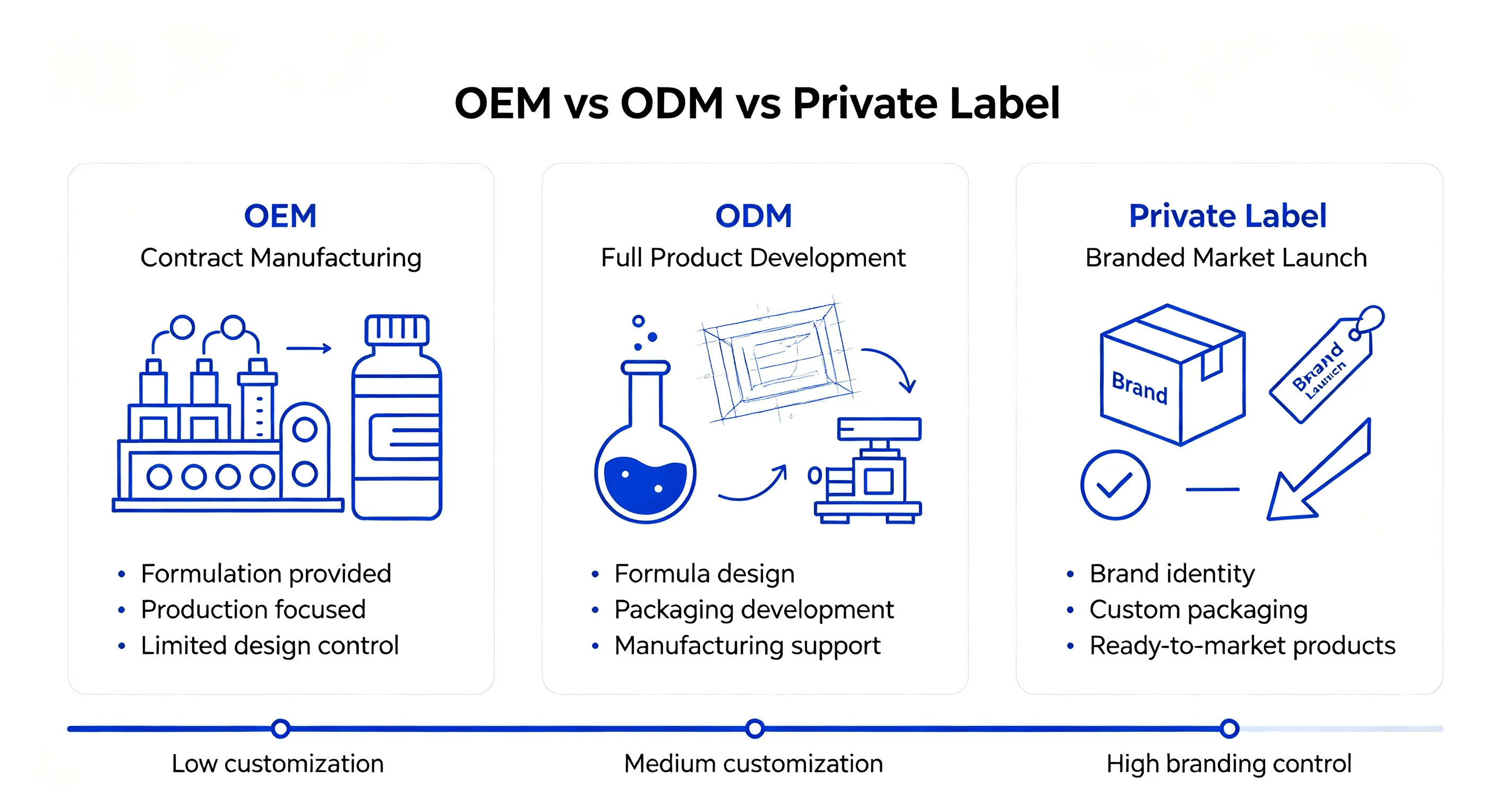
Although OEM, ODM, and private label models are often mentioned together, they represent different levels of customization and involvement from the buyer.
Understanding these differences can help aesthetic companies choose a manufacturing approach that matches their business stage, resources, and growth objectives.
Factor | OEM | ODM | Private Label |
|---|---|---|---|
Product development | Buyer provides requirements and works with manufacturer | Manufacturer provides development support and existing expertise | Usually based on existing products |
Customization level | High | Medium to high | Limited to branding and packaging options |
Development involvement | Higher buyer involvement | Shared responsibility | Lower buyer involvement |
Launch speed | Usually longer | Moderate | Usually faster |
Best suited for | Established brands with clear product concepts | Companies seeking customization with technical support | Businesses wanting faster market entry |
The best choice depends on whether a company prioritizes customization, speed, investment level, or control over the final product.
How to Choose the Right Manufacturing Model
There is no single manufacturing model that works for every aesthetic business. The right choice depends on the company’s goals, experience, and available resources.
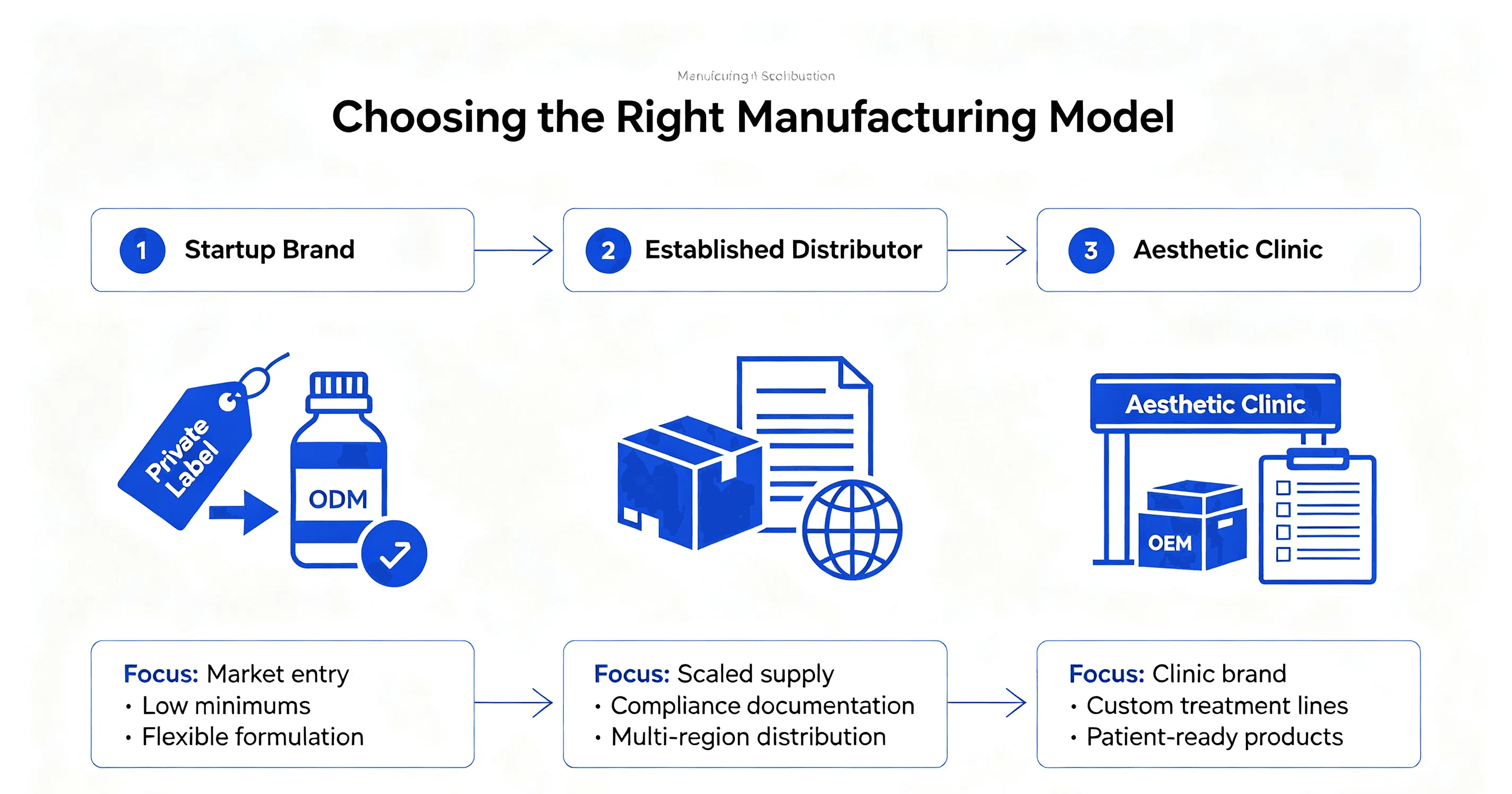
For New Aesthetic Brands
New brands entering the injectable market often need to balance product quality with development efficiency.
Private label or ODM models may be suitable because they allow companies to introduce products without building a complete product development system from the beginning.
Important considerations include:
Supplier experience
Product documentation
Brand positioning
Market requirements
Future expansion plans
A reliable manufacturing partner can help new brands understand product options and avoid unnecessary complexity during the early stages.
For Established Distributors
Distributors with existing market channels may require more flexibility and product differentiation.
OEM or ODM partnerships can provide more opportunities to create products that match specific customer needs and regional market expectations.
For these buyers, important factors may include:
Product customization capability
Production capacity
Supply consistency
Technical support
Long-term cooperation potential
For Clinics Developing Their Own Product Lines
Some aesthetic clinics are expanding beyond treatment services and developing their own branded products.
For these companies, private label or ODM solutions may provide a practical way to build a product portfolio while focusing on patient relationships and clinical expertise.
However, clinics should ensure that their chosen products align with professional requirements and applicable market regulations.
What to Evaluate Before Partnering With an Injectable Manufacturer
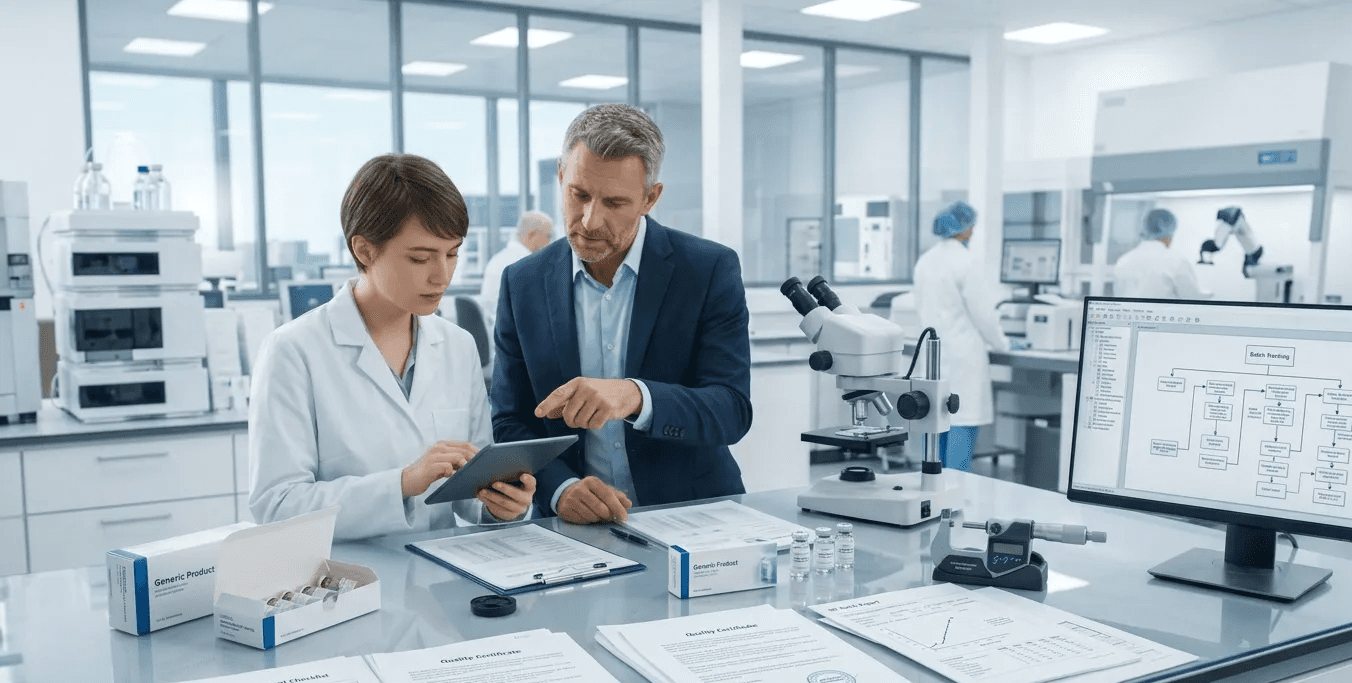
Choosing a manufacturing model is only the first step. Selecting the right manufacturing partner is equally important.
Aesthetic companies should evaluate several key factors before cooperation.
Manufacturing Quality and Compliance
Injectable aesthetic products require strict quality control throughout production.
Professional buyers should review:
Quality management systems
Manufacturing processes
Product testing information
Production standards
Documentation availability
A manufacturer with structured quality systems can provide greater confidence in product consistency and reliability.
Product Documentation and Traceability
Proper documentation is essential for professional injectable products.
Buyers should consider whether the manufacturer can provide:
Product specifications
Technical documents
Batch information
Storage requirements
Manufacturing records
Traceability helps companies manage products throughout distribution and supports quality management after launch.
Customization and Technical Support
A strong manufacturing partner should provide more than production capacity.
Depending on the cooperation model, buyers may need support with:
Product selection
Packaging development
Technical communication
Market preparation
Product updates
Clear communication between the buyer and manufacturer is important for achieving the expected product outcome.
Why Choosing the Right Partner Matters
The injectable aesthetic market requires a balance between product innovation, quality control, and market demand.
A manufacturing partnership is not only a supplier relationship. It can influence:
Product consistency
Brand reputation
Customer trust
Long-term business development
Companies should avoid selecting manufacturers based only on price. A lower initial cost may create additional challenges if product quality, documentation, communication, or supply reliability do not meet expectations.
Working with an experienced injectable aesthetic manufacturer allows brands and distributors to develop products with greater confidence and build sustainable market strategies.
Conclusion
OEM, ODM, and private label injectable aesthetic products each offer different advantages depending on a company’s goals.
OEM provides greater customization and control for businesses with clear product requirements.
ODM combines customization with manufacturer expertise, making it suitable for companies seeking technical support during development.
Private label provides a more efficient option for businesses looking to launch products quickly with lower development involvement.
The right choice depends on factors such as business stage, market strategy, customization needs, and available resources.
Before selecting a manufacturing partner, professional buyers should evaluate not only product options but also manufacturing quality, documentation, technical capability, and long-term cooperation potential.
Frequently Asked Questions
Q1: What is the main difference between OEM and private label injectable aesthetic products?
A: The main difference is the level of customization. OEM usually involves producing products based on specific buyer requirements, while private label typically uses an existing product that is marketed under the buyer’s brand name.
Q2: Is ODM better than OEM for injectable aesthetic products?
A: ODM is not necessarily better than OEM. ODM can be more suitable for companies that need manufacturer support during product development, while OEM may be better for businesses that require greater control over product specifications and customization.
Q3: Which manufacturing model is best for a new aesthetic brand?
A: For new aesthetic brands, private label or ODM models are often considered because they can reduce development complexity and allow faster market entry. The best choice depends on the brand’s goals, budget, and desired level of customization.
Q4: Can clinics create their own injectable aesthetic brand?
A: Yes, some clinics develop branded aesthetic product lines through private label or ODM partnerships. However, they should evaluate product quality, supplier capabilities, documentation, and applicable market requirements before launching.
Q5: How long does it take to develop an OEM injectable aesthetic product?
A: The timeline depends on factors such as product requirements, customization level, documentation preparation, manufacturing process, and market requirements. Customized projects generally require more planning than ready-made private label solutions.
Q6: What should buyers ask an injectable aesthetic manufacturer before cooperation?
A: Buyers should ask about manufacturing capabilities, quality systems, product documentation, customization options, production capacity, technical support, and experience serving international markets.
Q7: Can private label products be customized?
A: Private label customization depends on the manufacturer and product type. Common customization options may include branding, packaging, and market-specific presentation, while the level of formula modification varies.
Q8: Why do some companies choose ODM instead of developing products independently?
A: ODM allows companies to benefit from a manufacturer’s existing technical knowledge and development experience. This can reduce the resources required for product creation while still allowing some level of customization.
Q9: What factors affect the cost of OEM and ODM injectable products?
A: Costs can be influenced by product complexity, customization requirements, packaging design, order volume, documentation needs, and manufacturing processes.
Q10: How can companies find a reliable injectable aesthetic manufacturing partner?
A: Companies should evaluate manufacturers based on product quality systems, industry experience, documentation support, production capabilities, communication efficiency, and ability to meet target market requirements.
Other Blogs